
Thai Baht (THB): Currency of Thailand - Value, Symbol & More
Thai Baht is the official legal currency of the Kingdom of Thailand (formerly Siam). For coinage, the baht is divided into 100 satangs (comparable to cents in Canadian or US dollarsUnited States Dollar (USD)The United States Dollar refers to the national currency of the U.S and is represented by the ISO code USD and is often abbreviated as US$.). The baht is denoted with the symbol ฿.
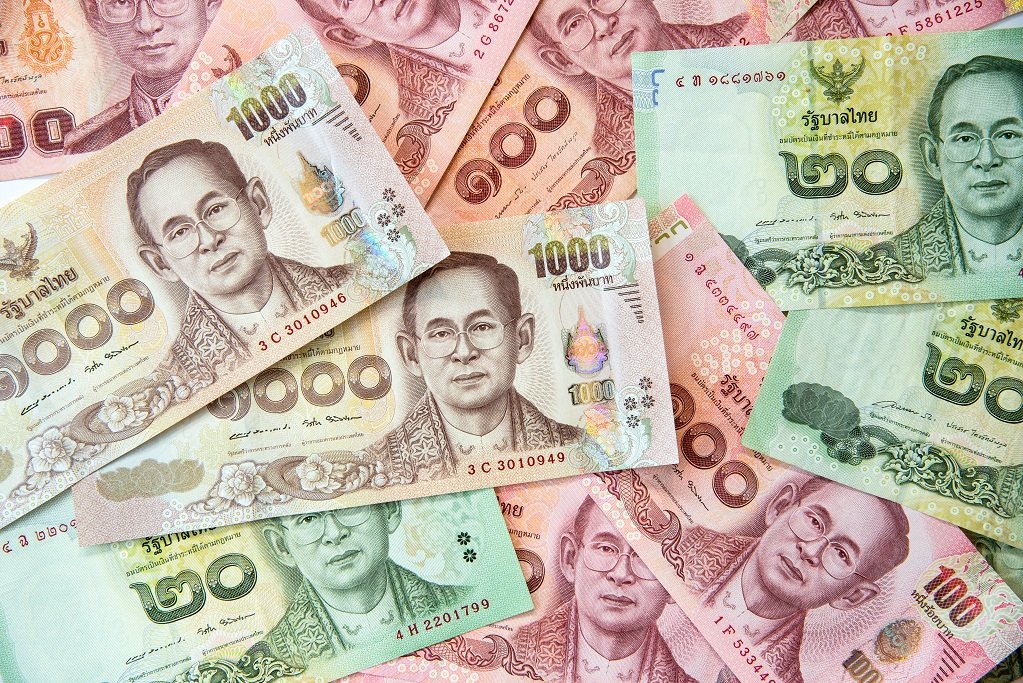
Thailand’s central bank, the Bank of Thailand, authorizes all minting of Thai coins and printing of Thai banknotes. However, some of the minting and banknote printing is contracted to the China Banknote Printing and Minting Corporation, the same state-owned Chinese corporation that produces all the coins and banknotes of the People’s Republic of China.
The baht is considered one of the strongest Southeast Asian currencies and is one of the most widely used currencies for payments worldwide. Despite ongoing political unrest in the country, the Thai baht was one of the best-performing currencies in the foreign exchangeForeign ExchangeForeign exchange (Forex or FX) is the conversion of one currency into another at a specific rate known as the foreign exchange rate. The conversion rates for almost all currencies are constantly floating as they are driven by the market forces of supply and demand. (forex) market as of 2018.
Summary
- Thai baht is the official legal currency of the Kingdom of Thailand.
- Thailand’s central bank, the Bank of Thailand, authorizes all minting of Thai coins and printing of Thai banknotes.
- Thailand is one of Southeast Asia’s strongest and most rapidly growing economies.
Thai Baht in Operation
Thai baht is one of the oldest currencies in circulation, dating back approximately 800 years, to the 13th century. Its trading symbol in the forex market is THB. For example, the exchange rate of the baht and the British pound is stated as GBP/THB.
Like the British pound sterling, the baht was originally based on a unit of mass – specifically, 15 grams. The value of 1 baht was equal to 15 grams of silver, and all baht coins were composed of solid silver of a designated amount.
The baht remained linked to silver until the end of the 19th century. At that time, Thailand switched its currency to the current decimal-based system, dividing the baht into 100 satangs.
Over the years, the Thai baht has been pegged to several currencies, as well as to gold. In the early 20th century, the currency was pegged to the British pound sterling, with the exchange rate being periodically adjusted.
The exchange rate range over a period of approximately 20 years fluctuated between 11 baht per one British pound and 22 baht per one pound. The baht was also pegged briefly to the Japanese yen, and following World War II, to the price of gold, with a fixed exchange rate of one baht per 0.25974 gram of gold.
The Thai central bank pegged the baht to the US dollar from the mid-1950s until 1997. The initial dollar peg translated to 20 baht = 1 USD. During the Reagan presidency, when the US economy enjoyed a period of rapid growth and a strong US dollar, the peg was adjusted upward to 25 baht = 1 USD.
Following the Asian Financial CrisisAsian Financial CrisisThe Asian Financial Crisis is a crisis caused by the collapse of the currency exchange rate and hot money bubble. It started in Thailand in July 1997 and that started in 1997, the Bank of Thailand chose to allow the baht to freely float in the foreign exchange market, as opposed to setting a fixed exchange rate value. The USD/THB exchange rate subsequently rose as high as 56 baht to 1 USD. As of 2020, the exchange rate is roughly 30 baht per US dollar.
Coins and Banknotes in Thailand
As of 2020, coins in the Thai baht are minted in denominations of 1, 5, 10, 25, and 50 satangs. There are also ฿1, ฿2, ฿5, and ฿10 coins. Banknote denominations are ฿20, ฿50, ฿100, ฿500, and ฿1,000.
The current series of Thai banknotes, the 2018 series, all feature a portrait of the country’s King, King Maha Vajiralongkorn, on the obverse side. The reverse sides of each denomination differ, each carrying an image of a preceding ruler of the country.
Thailand is one of the founding members of the trade organization called the Association of Southeast Asian Nations (ASEAN). The country’s economy depends heavily on exports, accounting for approximately 66% of the country’s Gross Domestic Product (GDP). Its key exports include computers, electrical appliances, textiles, and jewelry. In addition, fishing, agriculture, and tourism are major industries in Thailand.
Learn More
CFI offers the Commercial Banking & Credit Analyst (CBCA)™Program Page - CBCAGet CFI's CBCA™ certification and become a Commercial Banking & Credit Analyst. Enroll and advance your career with our certification programs and courses. certification program for those looking to take their careers to the next level. To keep learning and advancing your career, the following resources will be helpful:
- Top Banks in ThailandTop Banks in ThailandBanks in Thailand are governed by the country's central bank, the Bank of Thailand, which was established in 1942. It supervises local financial institutions
- Hard CurrencyHard CurrencyA hard currency refers to a currency that is generally issued by developed countries, globally traded, and seen as politically and
- Exchange RateExchange RateAn exchange rate is the rate at which one currency can be exchanged for another between nations or economic zones. It is used to determine the
- DenominationDenominationA denomination is a classification for the face value of a financial instrument. This includes financial instruments such as bonds, currency
-

Bank Drafts: Definition, How They Work & Usage
A bank draft is a convenient and secure instrument for making large payments without having to withdraw cash from one’s account. Bank drafts are guaranteed by financial institutions and can be u
-
Understanding Bank Ratings: A Guide to Financial Stability
Bank rating is a measure of financial soundness for banks. Just like credit agencies such as Standard & Poor’s (S&P)S&P – Standard and PoorsStandard & Poor’s is an Am
finance
- Understanding Account Balances: A Comprehensive Guide
- Understanding Account Numbers: Your Key to Financial Records
- Understanding Account Statements: A Comprehensive Guide
- Acquirer Definition: Understanding Corporate Acquisitions
- Understanding Add-On Interest: How It Works & Loan Payments
- Understanding Alpha: A Guide to Investment Performance
- Jumbo CDs: Higher Rates & Deposits Explained
- Understanding Regulation Z: Your Rights as a Borrower
- Annuities Explained: A Simple Guide to Retirement Income
-
 Understanding Balanced Budgets: Definition & Importance
A balanced budget is a budgetOperating BudgetAn operating budget consists of revenues and expenses over a period of time, typically a quarter or a year, which a company uses to plan its operations. Do...
-
 Bancassurance Explained: How Banks and Insurance Partner
Bancassurance refers to an agreement between a bank and an insurance company. In bancassurance, the insurance company can use the bank’s distribution channels to sell products. Banks, in return,...