
Understanding Unicorn Startups: Valuation & Definition
In finance, “unicorn” is a term that describes a privately-owned startupStartup Valuation Metrics (for internet companies)Startup Valuation Metrics for internet companies. This guide outlines the 17 most important e-commerce valuation metrics for internet starts to be valued with a valuation of over $1 billion. The term was introduced by venture capital investor, Aileen Lee, in 2013 to describe rare tech startups that were valued at more than $1 billion.

The phenomenon of unicorns is quite controversial. Although some professionals believe that such companies are just a result of technological progress and innovation, others believe that the increasing number of unicorns is a sign of a bubblePrice BubbleThe sustained rise in the price of an asset above its "normal market value" results in the formation of a price bubble. Price bubbles are sustained by expectations of future increases in the price of an asset. in the industry.
Valuation of Unicorns
The valuation of unicorns is derived from valuations developed by venture capitalists and investors who participated in the financing roundsSeries A FinancingSeries A financing (also known as series A round or series A funding) is one of the stages in the capital-raising process by a startup. Essentially, the series A round is the second stage of startup financing and the first stage of venture capital financing. of the companies. Since all unicorns are startups, their value is primarily based on their growth potential and expected development. The unicorns’ valuation is not strongly related to their actual financial performanceThree Financial StatementsThe three financial statements are the income statement, the balance sheet, and the statement of cash flows. These three core statements are or other fundamental data. Note that despite their abnormally high valuations, many of the companies have yet to generate any profits.
Valuing unicorns is a sophisticated process that involves the consideration of various factors and the development of long-term forecasts. Additional complications often arise due to the business models of such companies. Some companies become the first business of their kind in an industry, which makes the valuation process even more complicated.
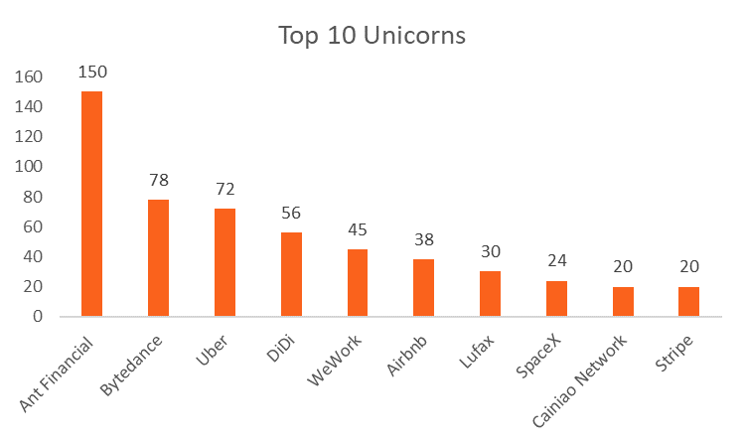
Listed below are the top ten unicorns in the world, according to total valuation, as of November 2018 (source):
Reasons for the Abnormally High Valuation of Unicorns
The abnormal valuations are typically justified by the following reasons:
1. Fast-growth strategy
Nowadays, venture capitalists primarily rely on fast-growth strategies for a startup’s development. Such strategies encourage investing large amounts of money in every round of financing, in order to capture the biggest possible market share as soon as possible, as well as to prevent the emergence of major rivals in the marketplace. Therefore, a unicorn company’s valuation skyrockets every round of financing.
2. Buyouts
Currently, many promising startups do not meet the requirements for an IPOInitial Public Offering (IPO)An Initial Public Offering (IPO) is the first sale of stocks issued by a company to the public. Prior to an IPO, a company is considered a private company, usually with a small number of investors (founders, friends, family, and business investors such as venture capitalists or angel investors). Learn what an IPO is. Instead, tech giants such as Facebook or Google acquire many startups to diversify their business and to prevent potential major competitors from arising in the marketplace. Large companies benefit from the deals because they are able to acquire developed technologies instead of building something similar from scratch. The intense competition among the tech giants causes them to offer a significant premium that boosts the valuation of target companies, creating unicorns.
3. Innovations
Innovations in technologies allow the faster growth of startups. By leveraging the new technologies, unicorn startups manage to reach their customers faster and shorten the time required to achieve mass production.
Additional Resources
CFI offers the Financial Modeling & Valuation Analyst (FMVA)™Become a Certified Financial Modeling & Valuation Analyst (FMVA)®CFI's Financial Modeling and Valuation Analyst (FMVA)® certification will help you gain the confidence you need in your finance career. Enroll today! certification program for those looking to take their careers to the next level. To keep learning and advancing your career, the following CFI resources will be helpful:
- Angel InvestorAngel InvestorAn angel investor is a person or company that provides capital for start-up businesses in exchange for ownership equity or convertible debt. They may provide a one-time investment or an ongoing capital injection to help the business move through the difficult early stages.
- Corporate VenturingStartup Valuation Metrics (for internet companies)Startup Valuation Metrics for internet companies. This guide outlines the 17 most important e-commerce valuation metrics for internet starts to be valued
- Equity CrowdfundingEquity CrowdfundingEquity crowdfunding (also known as crowd-investing or investment crowdfunding) is a method of raising capital used by startups and early-stage companies. Essentially, equity crowdfunding offers the company’s securities to a number of potential investors in exchange for financing.
- Seed FinancingSeed FinancingSeed financing (also known as seed capital, seed money, or seed funding) is the earliest stage of the capital-raising process of a startup. Seed financing is a type of equity-based financing. In other words, investors commit their capital in exchange for an equity interest in a company.
-

Understanding Alpha: A Guide to Investment Performance
Alpha is a measure of the performance of an investment as compared to a suitable benchmark index, such as the S&P 500S&P – Standard and PoorsStandard & Poor’s is an American fi
-

Annuity Due Explained: Payments at the Beginning of Each Period
Annuity due refers to a series of equal payments made at the same interval at the beginning of each period. Periods can be monthly, quarterly, semi-annually, annually, or any other defined period. Exa
finance
- Equity Valuation: A Comprehensive Guide for Investors
- Asset Valuation: Understanding Property Value for Business & Finance
- Jumbo CDs: Higher Rates & Deposits Explained
- Commodity Valuation: Understanding Intrinsic Value & Market Pricing
- Credit Valuation Adjustment (CVA): Understanding Counterparty Risk
- Understanding Historic Pricing and Net Asset Value (NAV)
- Stock Valuation: A Comprehensive Guide for Investors
- Inventory Valuation: A Comprehensive Guide for Businesses
- What is a Unicorn Startup? Definition & Significance
-
 Acquirer Definition: Understanding Corporate Acquisitions
An acquirer is a registered company that purchases a portion of, or all the rights to, another company. The acquiring company takes over the management of another company by obtaining a majority stake...
-
 Understanding Add-On Interest: How It Works & Loan Payments
Add-on interest refers to the calculation method of determining the total interest to be paid on a loan. Once the interest’s been added to the principal, the amount is divided by the number of m...