
Understanding Use of Proceeds: A Guide for Investors
The use of proceeds statement is a short document that summarizes how a company that aims to secure additional capital is going to spend the funds. In other words, the document provides the reader with a snapshot of what aspects of the business the company will spend money on.
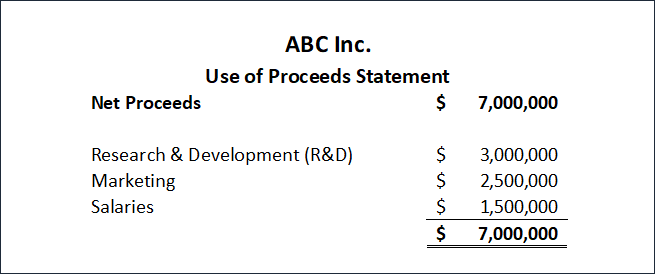
The use of proceeds statement is commonly included with other documents, such as a business plan or prospectusProspectusA prospectus is a legal disclosure document that companies are required to file with the Securities and Exchange Commission (SEC). The document provides information about the company, its management team, recent financial performance, and other related information that investors would like to know. (a document that provides details about initial public offerings). Note that the use of proceeds statement generally comprises only a small part of these comprehensive documents (no longer than 1-2 pages).
The statement is frequently prepared by startupsStartup Valuation Metrics (for internet companies)Startup Valuation Metrics for internet companies. This guide outlines the 17 most important e-commerce valuation metrics for internet starts to be valued and early-stage entrepreneurs in order to provide potential investors with an overview of how their invested funds will be spent. However, more mature companies also prepare a use of proceeds statements. A common scenario is when a company is preparing for an IPOInitial Public Offering (IPO)An Initial Public Offering (IPO) is the first sale of stocks issued by a company to the public. Prior to an IPO, a company is considered a private company, usually with a small number of investors (founders, friends, family, and business investors such as venture capitalists or angel investors). Learn what an IPO is or debt issuance.
Summary
- The use of proceeds statement is a short summary that discloses how a company is planning to spend the capital obtained from investors.
- The statement is commonly included in the business plan or prospectus.
- Two forms of the use of proceeds statement are a written summary and a graph (chart).
How to Create the Use of Proceeds Statement?
The use of proceeds can be generally presented in two main formats: as a written summary or as a chart. In either format, the key rule is to keep it simple! Unlike a financial modelTypes of Financial ModelsThe most common types of financial models include: 3 statement model, DCF model, M&A model, LBO model, budget model. Discover the top 10 types that includes many assumptions and variables, this is just a snapshot of the proposed allocation of capital being sought from investors.
1. Written summary
In the written summary, the company’s management lists the areas of the business that require financing and how much money will be invested in each area. The statement starts with the amount of net proceeds. In real life, the amount of net proceeds is lower than the amount of total proceeds due to the expenses associated with the issuance of shares or debt instruments. The author can then list the areas of expected expenditures, with the amounts of money allocated to each area. Note that the figures presented in the use of proceeds statement are generally rounded off to the nearest thousand or million. (A written example of the statement can be found above).
2. Graph or chart
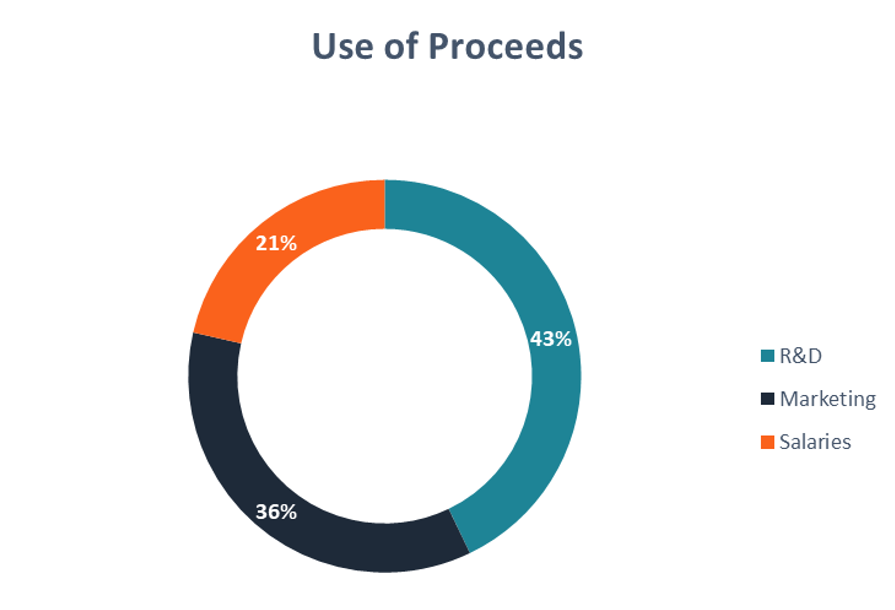
Alternatively, the use of proceeds can be presented in the form of graphs or charts. The graph format is particularly suitable for presentations shown to prospective investors. Generally, a pie chart and a donut chart are the primary options for a graphical representation, but other types of charts may also be used.
Importance of the Use of Proceeds Statement
In some cases, the use of proceeds statement can significantly affect a company’s ability to raise capital successfully. A properly created statement, with a reasonable allocation of money, can be an easy “convincer” for investors. Conversely, if a company fails to show a justifiable explanation of the allocation of funds, investors may not be interested in contributing capital.
Related Readings
CFI is the official provider of the Financial Modeling and Valuation Analyst (FMVA)™Become a Certified Financial Modeling & Valuation Analyst (FMVA)®CFI's Financial Modeling and Valuation Analyst (FMVA)® certification will help you gain the confidence you need in your finance career. Enroll today! certification program, designed to transform anyone into a world-class financial analyst.
To keep learning and developing your knowledge of financial analysis, we highly recommend the additional CFI resources below:
- Analysis of Financial StatementsAnalysis of Financial StatementsHow to perform Analysis of Financial Statements. This guide will teach you to perform financial statement analysis of the income statement,
- Capital Raising ProcessCapital Raising ProcessThis article is intended to provide readers with a deeper understanding of how the capital raising process works and happens in the industry today. For more information on capital raising and different types of commitments made by the underwriter, please see our underwriting overview.
- Debt Issuance FeesDebt Issuance FeesDebt issuance fees refer to expenses that the government or public companies incur in selling bonds. The expenses include registration fees
- Private Equity vs Venture Capital, Angel/Seed InvestorsPrivate Equity vs Venture Capital, Angel/Seed InvestorsCompare private equity vs venture capital vs angel and seed investors in terms of risk, stage of business, size & type of investment, metrics, management. This guide provides a detailed comparison of private equity vs venture capital vs angel and seed investors. It's easy to confuse the three classes of investors
-

Prime Rate Explained: Understanding Interest Rates for Businesses & Consumers
The term “prime rate” (also known as the prime lending rate or prime interest rate) refers to the interest rate that large commercial banks charge on loans and products held by their custo
-

Understanding Proceeds: Definition, Types & Calculation
Proceeds refers to the cash received from the sale of goods or assetsTypes of AssetsCommon types of assets include current, non-current, physical, intangible, operating, and non-operating. Correctly i
finance
- Understanding HOA Statements: A Comprehensive Guide
- Understanding Account Statements: A Comprehensive Guide
- Understanding Bank Statements: A Comprehensive Guide
- Statement of Retained Earnings: Definition & Analysis
- Understanding the Income Statement: A Comprehensive Guide
- Profit & Loss Statement (P&L): Definition & Key Components
- Understanding the Statement of Cash Flows: A Comprehensive Guide
- Understanding the Statement of Comprehensive Income: A Comprehensive Guide
- Choosing the Right Bank: A Comprehensive Guide
-
 Operating Ratio: Definition, Calculation & Importance
The operating ratio is a measure of efficiency that is used by management to determine day-to-day operational performance. This metric compares operating expenses, also known as OPEX, to net sales. Th...
-
 Understanding the Overnight Interest Rate: A Comprehensive Guide
The overnight rate refers to the interest rate that depository institutions (e.g., banks or credit unionsCredit UnionA credit union is a type of financial organization that is owned and governed by it...