
Compound (COMP): Decentralized Lending Explained
The difference with Compound’s platform is that the generated interest comes from other users that borrow funds and pay that interest for the loans. Unlike traditional financial institutions, once the funds are withdrawn, they immediately stop earning interest.
As of October 2020, Compound supports nine assets issued on Ethereum, including Tether (USDT), Dai, Wrapped Bitcoin (WBTC), and Basic Attention Token (BAT).
Quick Rise to Power?
Compound first entered the space in 2017, which was immediately backed by Coinbase Pro, one of the earliest projects to receive funding from Coinbase Ventures. The funding came from an $8 million seed round with the support of Andreessen Horowitz, Polychain Capital and Bain Capital Ventures also participated.
Coinbase Custody and Anchorage also support COMP and its cTokens, which other exchanges, including Cryptoexchange.com, Binance, FTX, and Poloniex have jumped on.
Enter COMP
Compound first launched its governance token, COMP on June 16, 2020. To incentivize the borrowing and lending behavior on Compound, it uses another native cryptocurrency it calls COMP to reward users each time they interact with a Compound market by borrowing, withdrawing, or repaying the asset.
Unique to its launch, it only took one day of trading for COMP to lead in the DeFi rankings, according to a CoinTelegraph report. Compound’s COMP was the start of the DeFi boom, which was monumental to DeFi enthusiasts as they watched the DeFi favorite, Maker (MKR) be dethroned.
As of June, COMP leads the DeFi rankings, despite its previous volatility of falling below $250 and eventually jumping 25% after it was listed on Binance.
As of 2020, over $500 million in assets were locked in the Compound protocol.
The Democracy
The vision of having truly decentralized governance is carried out through delegation. Through Compound, users can delegate their voting rights to an Ethereum address of their choice (a DeFi startup, VC fund, or another prominent crypto user in the space).
Like traditional democracies, users are given the option to delegate a candidate that they believe falls in alignment with their values. Addresses that have received delegations representing more than 1% of COMP’s supply can propose governance actions. In other words, not just anyone can just suggest changes. This helps prevent addresses with a little economic stake (or vision) in the network from proposing potentially risky, dangerous, or otherwise harmful actions at the expense of truly passionate users.
These “governance actions” become part of executable code that is eventually integrated into Compound once a majority vote is reached.
The “Timelock”
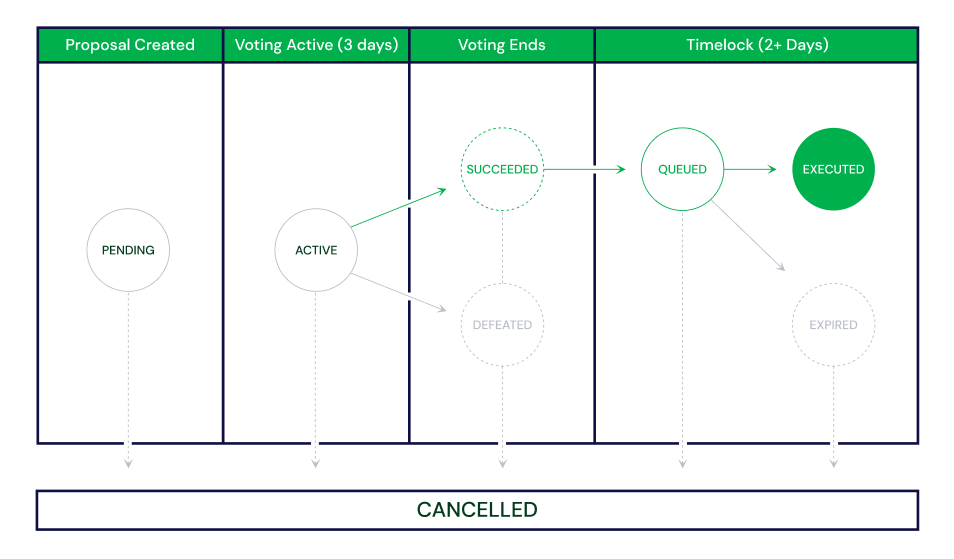
Once a proposal has been suggested, COMP holders then vote on it over a three-day period. If a proposal receives at least 400,000 votes (out of 10 million total potential votes once all COMP is distributed), and a majority of votes are “for” it, that governance action becomes queued in a two-day timelock, which is then activated.
The timelock allows users of the protocol to prepare for that change.
Issuing Tokens
In case you’re wondering why ‘governance tokens’ are instrumental here, remember that DeFi is about recognizing voting rights over matters like protocol upgrades or including new assets for borrowing and lending. This idea has continued to attract high-profile support.
Many believe the hype behind COMP to be attributed to a “new type of share equity”, which CoinTelegraph shared in an interview with Vadim Koleoshkin, the chief operations officer at Zerion, a DeFi interface provider.
Once funds are deposited into Compound, native tokens, called cTokens are issued in an equivalent value of ETH. Thus, a holder will receive cETH, which can then be used as collateral for a loan and spent while also earning interest.
-

DeFi Explained: A Beginner's Guide to Decentralized Finance
The Beginner’s Guide to Decentralized FinanceIf you’re diving deep into the world of cryptocurrency, you have probably heard the term “DeFi” used to describe a variety of new protocols and assets. Fi
-
0x: A Comprehensive Guide to Decentralized Ethereum Trading
What Is 0x? 0x is a decentralized exchange for trading ERC 20 tokens. (See also: What Is ERC 20 And What Does It Mean For Ethereum?). It is among the most high-profile examples of decentra
Fund information
- Understanding Workers' Compensation Hearings: A Step-by-Step Guide
- Compound Growth Rate: Definition & Calculation | [Your Brand]
- Compound Interest Explained: How It Works & Benefits
- Compound Interest Formula: Calculate & Understand Growth
- Simple vs. Compound Interest: Understanding the Difference
- Compound Options: A Comprehensive Guide to Investment Strategies
- Compound Interest: Understand the Power of Exponential Growth
- Compound (COMP): Earn & Borrow Crypto - A Comprehensive Guide
- Compound Interest Explained: How It Works & Benefits
-
DB(k) Plans: A Hybrid Retirement Solution for Employers & Employees
The DB(k) plan is a type of retirement plan that is available for employers. This type of retirement plan combines features from the 401(k) plan with features from a defined benefit pension plan...
-
 Understanding Regulation Z: Your Rights as a Borrower
Regulation Z is a consumer-protection regulation that compels lenders to disclose the cost of credit in a clear way for consumers. Whether you’re applying for a mortgage or dealing...