
Compound Interest Formula: Calculate & Understand Growth
To start, it’s important to understand first what compound interest is. Compound interest is taken from the initial – or principal – amount on a loan or a deposit, plus any interest that has already accrued. The compound interest formula is the way that such compound interest is determined.

Compound interest accrues over the period a loanConsumer LoanA consumer loan is a loan given to consumers to finance specific types of expenditures. This may be any type of loan made to a consumer by a creditor. The loan can be secured (backed by the assets of the borrower) or unsecured or a deposit is outstanding. How it accrues depends on how often it compounds. The compound interest will be higher, the more compounding periods there are. What exactly does that mean? If, for example, a $1,000 loan comes with a 2% semi-annual compounding interest rate, it will generate a more accrued compound interest than the same loan amount that is compounded at 4% annually.
Summary:
- Compound interest is based on the amount of the principal of a loan or deposit – and interest rate – which accrues in conjunction with how often the loan compounds: typically, compounding occurs either annually, semi-annually, or quarterly.
- The compound interest formula is the way that compound interest is determined.
- Compound interest is valuable for those who make deposits because it is an additional income for them the longer the deposit sits without withdrawals. It is valuable to lenders because it represents additional income earned on money lent.
How to Calculate Compound Interest
The compound interest formula is as follows:
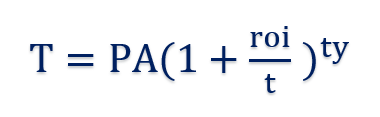
Where:
- T = Total accrued, including interest
- PA = Principal amount
- roi = The annual rate of interest for the amount borrowed or deposited
- t = The number of times the interest compounds yearly
- y = The number of years the principal amount has been borrowed or deposited
Practical Example
Let’s put some numbers into the above formula to make it clearer. For this example, let’s say that a $1,000 loan is offered, with an interest rateInterest RateAn interest rate refers to the amount charged by a lender to a borrower for any form of debt given, generally expressed as a percentage of the principal. of 5%, which is compounded semi-annually. If the loan is extended for five years, what would the balance for repayment be?
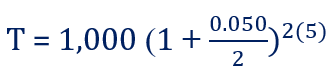
After five years, the total amount owed would be $1,280.08. The calculation would work in the same way when speaking of a $1,000 amount deposited into a bank receiving the same compounded interest. After five years, the total would be valued at $1,280.08.
It should be noted that in solving only for compound interest, the principal amount of the loan or deposit would need to be subtracted from the total.
Compound interest is of great importance for those who have deposited money or made an investment because it enables them to earn an increasing amount of income off of an initial investment. It is valuable to lendersTop Banks in the USAAccording to the US Federal Deposit Insurance Corporation, there were 6,799 FDIC-insured commercial banks in the USA as of February 2014. because it adds additional income on top of the amount lent to a borrower.
Related Readings
CFI offers the Financial Modeling & Valuation Analyst (FMVA)™Become a Certified Financial Modeling & Valuation Analyst (FMVA)®CFI's Financial Modeling and Valuation Analyst (FMVA)® certification will help you gain the confidence you need in your finance career. Enroll today! certification program for those looking to take their careers to the next level. To keep learning and advancing your career, the following CFI resources will be helpful:
- Annual Percentage YieldAnnual Percentage YieldThe annual percentage yield (APY) is a normalized interest rate based on the compounding period of one year. The APY provides a standardized representation of the underlying interest rates of financial products.
- Effective Annual Interest RateEffective Annual Interest RateThe Effective Annual Interest Rate (EAR) is the interest rate that is adjusted for compounding over a given period. Simply put, the effective
- Continuously Compounded InterestContinuously Compounded InterestContinuously compounded interest is interest that is computed on the initial principal, as well as all interest other interest earned. The idea is that the principal will receive interest at all points in time, rather than in a discrete way at certain points in time.
- Interest IncomeInterest IncomeInterest income is the amount paid to an entity for lending its money or letting another entity use its funds. On a larger scale, interest income is the amount earned by an investor’s money that he places in an investment or project.
-
Compound Interest Explained: How to Grow Your Wealth
What Is Compound Interest? Compound interest (or compounding interest) is the interest on a loan or deposit calculated based on both the initial principal and the accumulated interest from prev
-

Understanding Add-On Interest: How It Works & Loan Payments
Add-on interest refers to the calculation method of determining the total interest to be paid on a loan. Once the interest’s been added to the principal, the amount is divided by the number of m
finance
- Compound Growth Rate: Definition & Calculation | [Your Brand]
- Compound Interest Explained: How It Works & Benefits
- Nominal Interest Rate Explained: Definition & Implications
- Simple vs. Compound Interest: Understanding the Difference
- Swap Rate Explained: Understanding Fixed Exchange Rates in Derivatives
- Compound Interest: Understand the Power of Exponential Growth
- Compound Interest: Formula, Calculation & Powerful Growth Explained
- Understanding the Policy Interest Rate: Its Impact on the Economy
- Compound Interest Explained: How It Works & Benefits
-
 Short Interest Ratio: Understanding Investor Sentiment & Market Risk
The short interest ratio is a mathematical indicator of the average number of days it takes for short sellers to repurchase borrowed securities in the open marketOpen MarketAn open market is an econom...
-
 Unlock the Power of Compound Interest: Grow Your Wealth
With a compounding interest structure, your money works diligently for you in an investment program, continually feeding upon itself to grow at a substantially faster rate than with simple intere...