
Death Cross: Understanding Market Transitions & Trading Signals
The death cross is a chart patternTechnical Analysis - A Beginner's GuideTechnical analysis is a form of investment valuation that analyses past prices to predict future price action. Technical analysts believe that the collective actions of all the participants in the market accurately reflect all relevant information, and therefore, continually assign a fair market value to securities. that indicates the transition from a bull market to a bear market. This technical indicator occurs when a security’s short-term moving average (e.g., 50-day) crosses from above to below a long-term moving average (e.g., 200-day).
The chart below shows a death cross occurring in the NASDAQ 100 Index during the Dotcom crash of 2000.
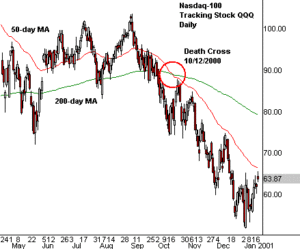
The indicator gets its name from the alleged strength of the pattern as a bearishBullish and BearishProfessionals in corporate finance regularly refer to markets as being bullish and bearish based on positive or negative price movements. A bear market is typically considered to exist when there has been a price decline of 20% or more from the peak, and a bull market is considered to be a 20% recovery from a market bottom. indication. In short, traders who believe in the pattern’s reliability say that a security is “dead” once this bearish moving average crossover occurs.
Connection to the Golden Cross
The death cross is the exact opposite of another chart pattern known as the golden cross.
The golden cross occurs when the 50-day moving average of a stock crosses above its 200-day moving average. The golden cross, in direct contrast to the cross of death, is a strong bullish market signal, indicating the start of a long-term uptrend.
Three Phases of Forming the Death Cross
There are three primary phases in the formation of the cross of death pattern.
The first phase involves the existing uptrend of a securityMarketable SecuritiesMarketable securities are unrestricted short-term financial instruments that are issued either for equity securities or for debt securities of a publicly listed company. The issuing company creates these instruments for the express purpose of raising funds to further finance business activities and expansion., when it begins to reach its peak as buying momentum tapers off. Then the price begins to fall as sellers gain the upper hand in the market.
The second phase is the decline in the security’s price to a point where the actual death cross occurs, with the 50-day moving average falling below the 200-day moving average. This downside shift of the 50-day average signals a new, bearish long-term trend in the market.
The final phase occurs with the continuation of the downward movement in the market. The new downtrend needs to be sustained in order for a genuine death cross to be deemed to have occurred. If the period of downward momentum is merely short-lived, and the stock turns back to the upside, then the cross of death is considered a false signal.
Determining the Strength of a Death Cross Signal
The death cross pattern is more useful to market analysts and traders when its signal is confirmed by other technical indicators. One of the most popular technical indicators to confirm a long-term trend change is trading volume. The bearish cross pattern is considered a more reliable signal if it occurs along with high trading volumes. Higher trading volume indicates more investors buying into (or rather, selling into) the idea of a major trend change.
Momentum indicators such as the MACD can also be used for confirmation. They work well because the momentum of a long-term trend often dies just a bit before the market makes its turn.
A Lagging Indicator
Some market analysts and traders put a limited amount of reliance on the death cross pattern because it is often a very lagging indicator. The downside moving average crossover may not occur until significantly after the point at which the trend has shifted from bullish to bearish. A security’s price may have already fallen a substantial amount before the crossing death signal.
To overcome this potential weakness from lagging behind price action, some analysts use a slight variation of the pattern. In this variation, a death cross is deemed to have occurred when the security’s price – rather than a short-term moving average – falls below the 200-day moving average. This event often occurs well in advance of the 50-day moving average crossover.
Other Variations
The 50-day and 200-day moving averages are those most commonly used to identify a death cross. However, some market analysts favor using other moving averages. One common variation of the death signal is a 20-day moving average downside cross of the 50-day moving average. Another variation substitutes the 100-day moving average in place of the 200-day moving average as the long-term average. These variations may work more effectively when there is a particularly wide separation between the 50- and 200-day moving averages. (because the further away the two averages are from each other, the more the crossover may lag behind price action.) Traders also look for the pattern on shorter time frames, using the four-hour or hourly charts rather than daily charts.
A Final Word on the Cross of Death
While there are naysayers to every technical indicator, the death cross is considered a significant chart pattern by many investorsInvesting: A Beginner's GuideCFI's Investing for Beginners guide will teach you the basics of investing and how to get started. Learn about different strategies and techniques for trading. Analysis shows the death cross pattern occurred in primary market indexes, accurately forecasting many major bear market downturns. A death cross pattern in the Dow Jones Industrial Average preceded the crash of 1929. A death cross occurred in the S&P 500 Index in May of 2008 – four months before the 2008 crash.
Related Readings
Thank you for reading CFI’s explanation of the Death Cross. CFI is the official provider of the global Financial Modeling & Valuation Analyst (FMVA)™Become a Certified Financial Modeling & Valuation Analyst (FMVA)®CFI's Financial Modeling and Valuation Analyst (FMVA)® certification will help you gain the confidence you need in your finance career. Enroll today! certification program, designed to help anyone become a world-class financial analyst. To keep advancing your career, the additional resources below will be useful:
- Long and Short PositionsLong and Short PositionsIn investing, long and short positions represent directional bets by investors that a security will either go up (when long) or down (when short). In the trading of assets, an investor can take two types of positions: long and short. An investor can either buy an asset (going long), or sell it (going short).
- McClellan OscillatorMcClellan Oscillator - Technical AnalysisThe McClellan Oscillator is a type of momentum oscillator. The McClellan Oscillator is calculated using exponential moving averages, and is designed to indicate the strength or weakness of price movement, rather than its direction.
- Speed Lines – Technical AnalysisSpeed Lines - Technical AnalysisSpeed lines are an analysis tool used to determine support and resistance levels. They are not intended to be used as a standalone technical indicator.
- Technical AnalysisTechnical Analysis - A Beginner's GuideTechnical analysis is a form of investment valuation that analyses past prices to predict future price action. Technical analysts believe that the collective actions of all the participants in the market accurately reflect all relevant information, and therefore, continually assign a fair market value to securities.
-

Decentralized Finance (DeFi): A Comprehensive Overview
DeFi is short for Decentralized Finance. DeFi describes decentralized lending, borrowing, and interest-bearing systems like Maker and Compound, most of which are Ethereum-based.
-

Jumbo CDs: Higher Rates & Deposits Explained
A jumbo CD is similar to a conventional CD although the former generally requires a higher deposit and accrues interest at a higher rate. A CD is a certificate of deposit that is offered by banks for
invest
- Death Cross: Understanding the Sell Signal & Technical Analysis
- Cross Guarantee: Definition, Purpose & Examples
- Cross Currency Settlement: A Comprehensive Guide
- Cross Currency Swaps: Definition, Mechanics & Benefits
- Cross-Currency Transactions: Definition & How They Work
- Cross Rates Explained: Understanding Currency Valuation
- Golden Cross: Understanding a Powerful Trading Signal
- Harami Cross: A Complete Guide to This Bullish Candlestick Pattern
- Understanding Cross-Holding: Risks & Implications
-
 Understanding the DU: Your Mortgage Approval Explained
DU in relation to a mortgage stands for Desktop Underwriter, which is a mortgage program used to analyze a borrower's application to see if it meets criteria set up by the governing agency of that...
-
 Graded Benefit Whole Life Insurance: A Comprehensive Overview
Not every applicant for life insurance is in perfect health. Though some might not be sick enough to be considered uninsurable, they may be too sick for a standard policy. At that point, an insurance ...