
Understanding Dealer Markets: How Market Makers Function
A dealer market is a financial market where dealers post prices they would be willing to buy and sell specific securitiesTrading SecuritiesTrading securities are securities purchased by a company for the purpose of realizing a short-term profit. The securities are issued within the company's industry, on their own account. Dealers act as “market makers” by adding liquidity and are able to create a market by posting their offer price and bid price electronically.
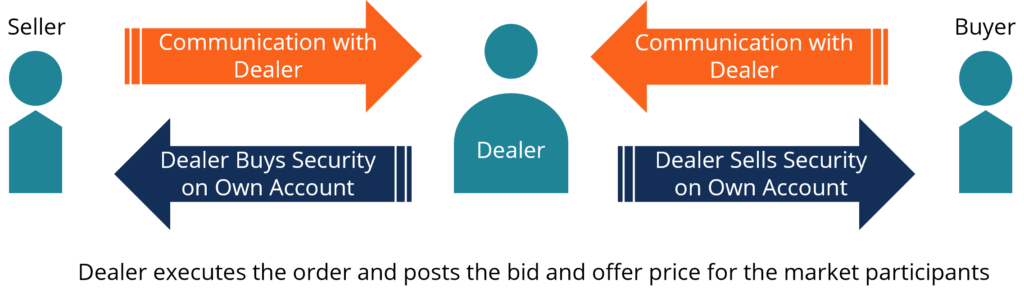
The dealer market is also referred to as an OTC (over-the-counter)Over-the-Counter (OTC)Over-the-counter (OTC) is the trading of securities between two counter-parties executed outside of formal exchanges and without the supervision of an exchange regulator. OTC trading is done in over-the-counter markets (a decentralized place with no physical location), through dealer networks. market. This means that financial instruments, such as securities, are traded directly between individuals, without the support of a private security dealer.
Summary
- A dealer market refers to a financial market where dealers post prices that they are willing to buy and sell securities for.
- Dealers become “market makers” by posting their bid and offer prices.
- The bid price is the price the dealer is willing to buy the security for, and the offer price is the price the dealer is willing to sell their security for.
What are Securities and Market Makers?
- Securities: A security is a tradeable asset that can be put on the market for financial gain. Notably, the validation of securities is generally electronic and is categorized into debt securities, equity securities, and derivatives.
- Market Maker: A market maker refers to a financial entity that performs transactions and ensures there is liquidity in the market. The market maker exchanges securities for their own account (principal trade) or their customer’s account (agency trades).
Bid Price vs. Offer Price
Within the dealer market, the dealer is able to act as a “market maker” and create a market by posting their bid price and offer price for securities.
- Bid Price: The price that the dealer is willing to buy the security for.
- Offer Price: The price that the dealer is willing to sell their security for.
Bid-Ask Spread with Example
Representing the tangible cost to investors, market makers use the “bid-ask spread” to control potential risk.
The bid-ask spread is the amount that the ask price differs from the bid price for a financial instrument in the market. In simpler terms, it is the difference between the highest price a buyer is willing to pay for a financial instrument and the lowest price a seller is willing to sell. The diagram below depicts the bid-ask spread.
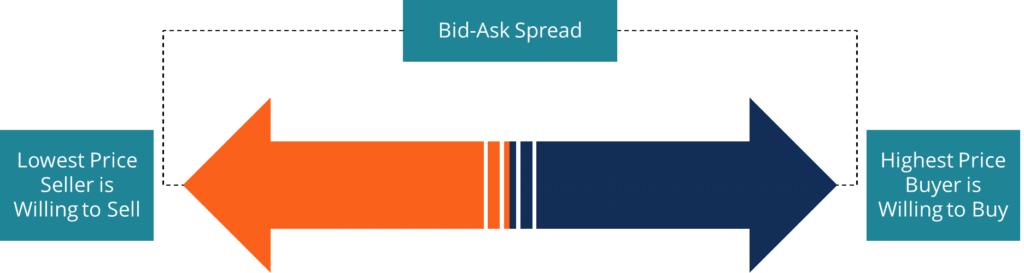
The bid-ask spread reflects how far off two market participants are from making a successful deal.
For example, the bid price of a security is $200, and the ask price for the same security is $215. In such a case, the bid-ask spread will be $15 because that is the difference between what the buyer is willing to pay and the price at which the seller is willing to sell.
Dealer Market vs. Auction Market
Dealer Market: This is a financial market that has multiple dealers buying and selling securities using their own account.
Here are some characteristics of the dealer market:
- Dealers act as market makers and set bid prices/offer prices.
- Quote-driven – the dealer executes the order and produces a bid and offer price for the market participants.
- The exchange of securities is executed through the dealer.
- There is no centralized trading floor since it is all completed electronically.
- A dealer market primarily consists of foreign exchanges and bonds.
- A prime example of a dealer market is NASDAQNasdaq Global Select MarketThe Global Select Market includes companies with the largest market capitalization within the Nasdaq Composite Index and comprises 1,200 stocks. It is one.
Auction Market: In contrast, the auction market is a financial market where buyers and sellers enter competitive auctions for financial instruments.
Here are some characteristics of the auction market:
- Buyers and sellers enter auctions.
- Bid and offer price is set by market participants.
- The execution of a trade only goes through if the market participant’s bid and offer prices match.
- There is a singular entity in the auction market that controls trade activity by matching the market participant’s bid and offer prices to ensure that a deal is made.
- There is a centralized trading floor.
- The auction market primarily consists of stocks.
- A prime example of an auction market is the New York Stock Exchange (NYSE).
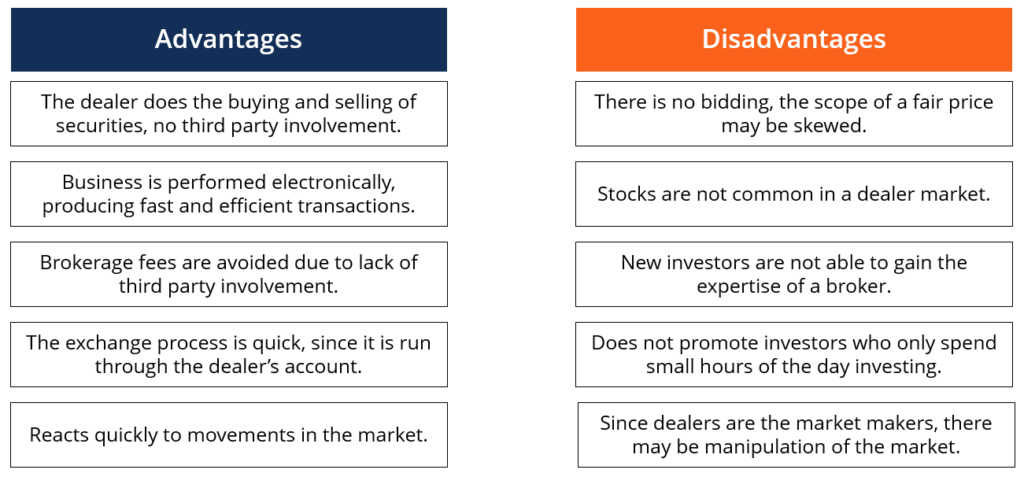
Advantages and Disadvantages of the Dealer Market
Related Readings
CFI offers the Commercial Banking & Credit Analyst (CBCA)™Program Page - CBCAGet CFI's CBCA™ certification and become a Commercial Banking & Credit Analyst. Enroll and advance your career with our certification programs and courses. certification program for those looking to take their careers to the next level. To keep learning and developing your knowledge base, please explore the additional relevant resources below:
- Market MakerMarket MakerMarket maker refers to a firm or an individual that engages in two-sided markets of a given security. It means that it provides bids and asks in tandem with
- Offering PriceOffering PriceThe offering price is the per share price of publicly issued securities set by an underwriter and at which the shares are available for purchase. Although
- Bid and AskBid and AskThe term bid and ask refers to the best potential price that buyers and sellers in the marketplace are willing to transact at.
- Auction MarketAuction MarketAn auction market is a market where the price is determined by the highest price the buyer is willing to pay (bids), and the lowest price the seller is
-

Understanding Market Sentiment: A Guide for Investors
The term market sentiment, also known as investor sentiment, refers to the general outlook or attitude of investors toward a particular security or the overall financial market. The optimism or pessim
-
![Market Timing: Strategies & How It Works | [Your Company Name]](https://www.etffin.com/article/uploadfiles/202110/2021100815253643_S.jpeg)
Market Timing: Strategies & How It Works | [Your Company Name]
Market timing refers to an investing strategy through which a market participant makes buying or selling decisions by predicting the price movements of a financial asset in the future. Investors follo
invest
- Understanding Auction Markets: How Prices Are Determined
- Depth of Market (DOM): Understanding Real-Time Order Book Data
- Understanding Divergence in Technical Analysis: A Guide
- Doji Candlestick Pattern: Meaning & Trading Signals
- Understanding Forward Prices: Definition & How They Work
- Understanding Frothy Markets: Risks & Opportunities
- High Close Trading Strategy: Definition, Risks & Legal Implications
- Understanding Market Support: What is 'Holding the Market'?
- Price Takers: Understanding Market Influence & Investor Types
-
 Understanding Market Manipulation: Definition, Tactics & SEC Role
Market manipulation refers to artificial inflation or deflation of the price of a security. Also known as price manipulation or stock manipulation, it involves the literal manipulation of a financial ...
-
 Understanding Market Risk: A Comprehensive Guide
The term market risk, also known as systematic risk, refers to the uncertainty associated with any investment decision. Price volatility often arises due to unanticipated fluctuations in factors that ...