
DTCC: Understanding the Depository Trust & Clearing Corporation
The Depository Trust and Clearing Corporation (DTCC) is a US-based corporation that acts as a centralized clearing and settlement company for different asset classes. It provides its market participants with a range of settlement services to facilitate obligations emanating from their trading activities in various investment markets.
Other than the post-settlement services, the DTCC provides custody to securities and tax-related services to its members. The corporation was established in 1999 with the combined roles of the National Securities Clearing Corporation (NSCC)National Securities Clearing Corporation (NSCC)The National Securities Clearing Corporation (NSCC) provides risk management, settlement, and clearing services to the U.S securities exchange market and the Depository Trust Company (DTC).
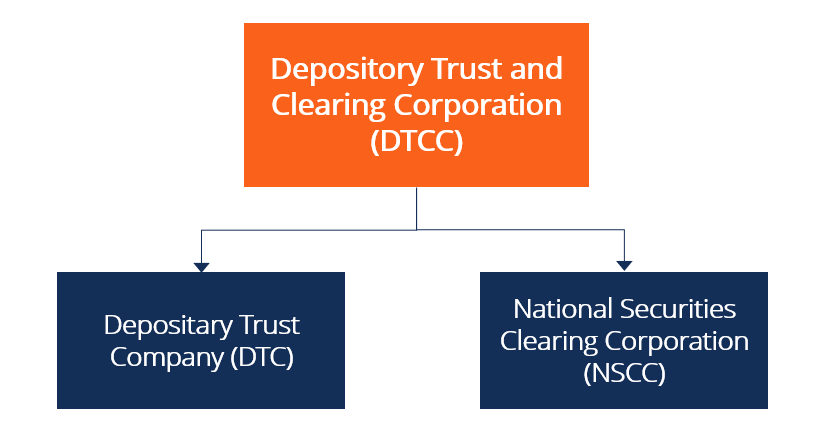
Both the NSCC and DTC are subsidiaries of the DTCC and are tasked with clearing trades to facilitate transactions and providing depository services to members, respectively. Principal users are the owners of the DTCC, implying that they are the dealer-brokers of transactions in the financial markets.
Summary
- The Depository Trust and Clearing Corporation (DTCC) is a user-owned cooperative that helps participants with clearing services of different asset classes.
- Clearing firms may earn profits in their intermediary role, such as security from a seller and cash from a buyer.
- The Depository Trust and Clearing Corporation (DTCC) consists of the Depositary Trust Company (DTC) and the National Securities Clearing Corporation (NSCC) as its subsidiaries to facilitate the movement of securities for net settlement.
How the Depository Trust and Clearing Corporation Works
The DTCC is involved in trillions of securities transactions each day. The corporation plays a central role in settling transactions between buyers and sellers of securities, reducing risks, and protecting the integrity of the global financial markets.
For example, when an investor orders securities through a professional broker, trade information is relayed to the NSCC or an equivalent clearing company for clearing services. At the end of a transaction, NSCC provides a report to the broker and any other professionals involved in the trade. The contents of the report include the amount due and the positions of the net securities after the trade.
The NSCC gives the DTCC the settlement guidelines. The DTCC ensures the smooth transfer of funds from the buyer to the seller. During the transaction, the broker is responsible for adjusting the client’s account appropriately. The entire cycle usually takes place the same day the transaction happens. The process is the same for retail investors, as it is for institutional investors.
The DTCC settles a large proportion of securities in the U.S. The successful completion of a securities transaction depends on the settlement step. The settlement process ensures the timely and proper execution of trades, contributing to investor confidence and minimal market risks. At the same time, effective trade execution gives investors confidence that they will not lose their funds to intermediaries, such as brokerage firmsBrokerageA brokerage provides intermediary services in various areas, e.g., investing, obtaining a loan, or purchasing real estate. A broker is an intermediary who.
The DTTC is responsible for clearing, settling, and disseminating sufficient information regarding various securities products – including alternative investment options, mortgage and government-backed securities, municipal and corporate bonds, and mutual funds.
Clearing companies may sometimes earn clearing fees because of their third-party role during a trade. For example, a clearing firm may receive securities from a seller or cash from a buyer. The clearinghouse then processes the exchange and earns allowance for the service.
The size of the fee is proportional to the type of instrument under trade, the size of the transaction, and the amount of service required. Thus, the more transactions that are conducted in a day, the higher the earnings generated on the same day. However, in the case of futures contractsFutures ContractA futures contract is an agreement to buy or sell an underlying asset at a later date for a predetermined price. It’s also known as a derivative because future contracts derive their value from an underlying asset. Investors may purchase the right to buy or sell the underlying asset at a later date for a predetermined price., clearing fees can accumulate since the per-contract fee is spread out over a long period based on the long-term position.
History of the Depository Trust and Clearing Corporation
The Depository Trust Company (DTC) came into existence in 1973 to improve security and reduce the increasing volume of paperwork after the volume of securities transactions grew rapidly in the U.S. during the late 1960s. Previously, the exchange of securities took place in physical form, with hundreds of messengers carrying checks and certificates. Such an exchange of security certificates was inefficient, difficult, and expensive.
The burden of paperwork became massive during the late 1960s when trading volumes on the New York Stock Exchange (NYSE) surged unexpectedly to 15 million shares per day. It resulted in stock certificates getting piled up unsystematically without being mailed or sometimes mailed to incorrect addresses.
The financial industry needed to provide security to the physical stock certificates while facilitating trade in a better way. To serve such purposes, the Central Certificate Service was formed in 1968 and the National Securities Clearing Corporation (NSCC) was established in 1976. Later, in 1999, DTC and NSCC were combined to form a holding company that came to be known as the Depository Trust and Clearing Corporation (DTCC).
DTC vs. NSCC
The Depositary Trust Company (DTC) is a subsidiary of the DTCC. It was established in 1973 to minimize costs and to facilitate the clearing and settlement of securities. It achieves its purpose by immobilizing securities and adjusting changes in the seller’s account.
The DTC increases efficiency to the corporate equities by retaining custody of active security issues. Also, it facilitates the movements of securities for net settlement by the NSCC and institutional-based net settlement, which often involve security and money transfers between brokers and custodians.
DTCC clearing services offered through its subsidiary, DTC, increases efficiencies in the market by reducing risks and providing settlement obligations to clients at the close of the day. DTC also offers a wide range of asset servicing for electronic registration and the transfer of services, corporate actions, and underwriting. The corporation is registered as a clearing company with the U.S. Security and Exchange CommissionSecurities and Exchange Commission (SEC)The US Securities and Exchange Commission, or SEC, is an independent agency of the US federal government that is responsible for implementing federal securities laws and proposing securities rules. It is also in charge of maintaining the securities industry and stock and options exchanges.
On the other hand, the National Securities Clearing Corporation (NSCC) was founded in 1976 to offer centralized clearing, information, settlement services, and risk management in the securities industry. The corporation further offers multilateral netting to enable brokers to offset purchasing and selling positions into a single unit payment obligation to minimize their capital requirements and exposure to risks.
The NSCC’S establishment came in the wake of high demand for paper stock certificates, causing the stock exchange to shut down once a week. As a result, multilateral netting was proposed, which involves several parties summing up transactions in a centralized zone instead of individual settlements.
The multilateral netting approach enables transactions without necessarily requiring multiple payment settlements and invoicing among the transacting parties. Currently, the corporation provides clearing and settlement services for every buyer and seller of securities. It helps minimize the value of payment by approximately 98% on a daily basis.
More Resources
CFI is the official provider of the global Commercial Banking & Credit Analyst (CBCA)™Program Page - CBCAGet CFI's CBCA™ certification and become a Commercial Banking & Credit Analyst. Enroll and advance your career with our certification programs and courses. certification program, designed to help anyone become a world-class financial analyst. To keep advancing your career, the additional resources below will be useful:
- Clearing HouseClearing HouseA clearing house acts as a mediator between any two entities or parties that are engaged in a financial transaction. Its main role is to ensure that the transaction goes smoothly, with the buyer receiving the tradable goods he intends to acquire and the seller receiving the right amount paid
- Depository Trust Company (DTC)Depository Trust Company (DTC)The Depository Trust Company (DTC), a US-based corporation, is a central securities depository accepting deposits from over 65 countries. It
- Risk ManagementRisk ManagementRisk management encompasses the identification, analysis, and response to risk factors that form part of the life of a business. It is usually done with
- National Automated Clearing House Association (NACHA)National Automated Clearing House Association (NACHA)The National Automated Clearing House Association (NACHA) is in charge of administering, developing, and governing the ACH Network.
-
Series 7 Exam: Your Comprehensive Guide for Securities Licenses
The Series 7 exam is formally known as the General Securities Representative Examination, and it is administered by the Financial Industry Regulatory Authority (FINRA). In the United States, financial
-

Depository Trust Company (DTC): Your Guide to Securities Clearing & Safekeeping
What Is the Depository Trust Company (DTC)? The Depository Trust Company (DTC) is one of the world's largest securities depositories. Founded in 1973 and based in New York City, the DTC is
invest
- Understanding Depositories: Secure Storage for Financial Securities
- Australian Securities Exchange (ASX): Your Guide to Australia's Stock Market
- Depository Trust Company (DTC): Central Securities Depository Explained
- Hong Kong Exchanges and Clearing (HKEX): A Comprehensive Overview
- Understanding the NSCC: Risk Management for U.S. Securities Markets
- SEBI: Understanding India's Securities and Exchange Board
- SEC Explained: Your Guide to the U.S. Securities Regulator
- SIPC: Protecting Your Investments - A Comprehensive Guide
- 1933 Securities Act: Protecting Investors & Market Integrity
-
 Understanding the Secondary Market: A Guide for Investors
The secondary market is where investors buy and sell securities from other investors (think of stock exchangesStock MarketThe stock market refers to public markets that exist for issuing, buying and s...
-
SIPC: Protecting Your Investments - A Comprehensive Overview
The Securities Investor Protection Corporation (SIPC) is a nonprofit company that works under a federal mandate. This organization was created in 1970, and it is not a government organization. T...