
Series 7 Exam: Your Comprehensive Guide for Securities Licenses
The Series 7 exam is formally known as the General Securities Representative Examination, and it is administered by the Financial Industry Regulatory Authority (FINRA). In the United States, financial professionals are required to take and pass the exam to obtain a license to trade security products, such as corporate securities, municipal fund securitiesMunicipal BondA municipal bond refers to a bond or fixed income security that is issued by a government municipality, township, or state to finance its governmental, investment company products, etc.
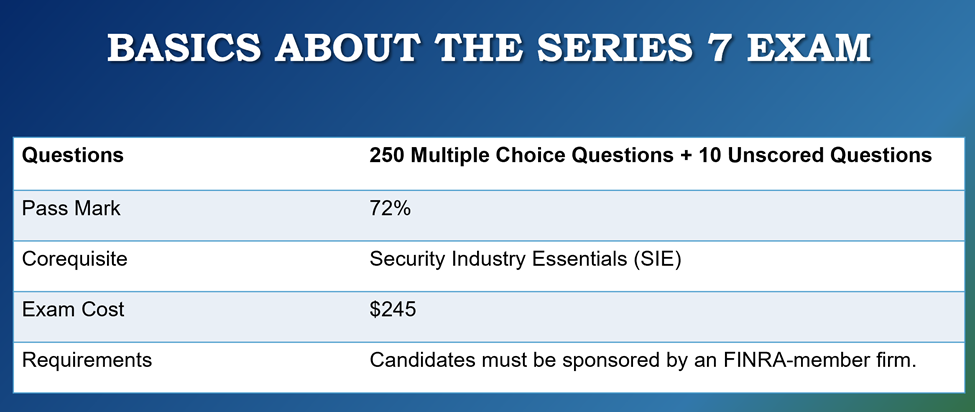
A majority of employers in the financial services industry require potential employees to have passed the Series 7 exam as one of the entry requirements. In October 2018, FINRA enacted a prerequisite exam known as the Securities Industry Essentials (SIE) exam to evaluate a candidate’s knowledge of basic financial concepts.
Summary
- The Series 7 exam is an exam and license that gives successful candidates the authority to sell all types of securities such as stocks and bonds, except commodities and futures.
- It is an entry-level requirement for stockbrokers who want to buy and sell securities in the United States.
- The exam comprises 125 multiple-choice questions, and candidates are required to score at least 72% to pass.
Understanding the Series 7 Exams
The Series 7 exam is a licensing exam for stockbrokers and other financial services professionals who are involved in the trading of securities, such as stocks and bonds, except commodities and futuresFutures ContractA futures contract is an agreement to buy or sell an underlying asset at a later date for a predetermined price. It’s also known as a derivative because future contracts derive their value from an underlying asset. Investors may purchase the right to buy or sell the underlying asset at a later date for a predetermined price.. The exam tests a candidate’s knowledge of the functions of a broker, such as the sale of corporate securities, investment company products, government securities, options, variable annuities, packaged securities, direct participation programs, and municipal securities.
Professionals who pass the exam become officially registered representatives of the Financial Industry Regulatory AuthorityFinancial Industry Regulatory Authority (FINRA)The Financial Industry Regulatory Authority (FINRA) acts as a self-regulatory organization for securities firms operating in the United States., and it also increases their employability in the financial services industry. The Series 7 exam does not cover real estate properties or insurance products. To sell real estate and insurance products, brokers must take other exams and licenses.
Apart from being equipped with industry knowledge, finance practitioners who pass the Series 7 exam are required to abide by stricter standards compared to unlicensed brokers. FINRA requires licensed brokers to uphold the highest standards so that their clients receive the best service.
Series 7 Exam Requirements
Effective October 1, 2018, FINRA introduced the Securities Industry Essentials (SIE) exam, which candidates must pass before sitting for the Series 7 exam. The SIE is an introductory exam for entry-level brokers. It tests common topics, such as regulatory agenciesSecurities and Exchange Commission (SEC)The US Securities and Exchange Commission, or SEC, is an independent agency of the US federal government that is responsible for implementing federal securities laws and proposing securities rules. It is also in charge of maintaining the securities industry and stock and options exchanges and how they function, acceptable and unacceptable industry practices, product knowledge, and fundamentals of securities trading. The SIE exam does not require potential candidates to be sponsored by a FINRA member firm.
One of the requirements provided by FINRA for Series 7 exam candidates is that they must be sponsored by a member firm. The sponsoring firm must file Form U4 – i.e., Uniform Application for Security Industry Registration – for a candidate to be enrolled for the Series 7 exam.
The sponsoring firm is also required to cover the Series 7 exam fee. Both the SIE and the Series 7 exam are corequisites, meaning that candidates must pass both exams to get a securities trading license. Potential candidates can opt to take both exams in any order, as long as they pass both exams within the prescribed period.
Series 7 Exam Structure
The Series 7 exam comprises 125 multiple-choice questions that candidates are required to complete within 3 hours and 45 minutes. It means that the candidate is allowed one minute and 48 seconds per question. The passing score for the exam is 72%, which candidates must achieve to obtain a practicing license. The cost of the exam is $245 – a reduction from the previous $305 exam fee.
Before October 1, 2018, candidates were required to complete 250 questions within six hours, with the exam fee being $305. Candidates were only required to pass the Series 7 exam since there was no SIE exam. After the new Series 7 exam format was adopted, the test is now shorter and fairly priced. Also, candidates must pass both SIE and Series 7 exams to become licensed brokers.
Upon completion of the Series 7 exam, FINRA does not award physical certificates to successful candidates. Instead, potential employers can access the proof of exam completion on FINRA’s Central Registration Depository (CRD). The Series 7 exam also serves as a prerequisite to other securities exams, such as Series 24, Series 26, and Series 31.
Attempts Allowed for the Series 7 Exam
If a candidate does not pass the Series 7 exam on their first attempt, FINRA allows them to re-take the exam after 30 days. There is no limit on the number of times a candidate can attempt to pass the exam, but there are time restrictions for candidates who’ve taken the exam several times.
For the first three attempts, a candidate is required to wait at least 30 days before sitting for the exam again. After three unsuccessful attempts, the candidate is required to wait at least six months to re-take the exam.
Additional Resources
CFI offers the CapitalProgram Page - CMSAEnroll in CFI's CMSA® program and become a certified Capital Markets &Securities Analyst. Advance your career with our certification programs and courses. Markets & Securities Analyst (CMSA)®Program Page - CMSAEnroll in CFI's CMSA® program and become a certified Capital Markets &Securities Analyst. Advance your career with our certification programs and courses. certification program for those looking to start or advance their careers to the next level. If you enjoyed our article on Series 7 and are interested in learning more about security products, the following resources and courses will be helpful:
- Introduction to Capital Markets (free course)
- Prime Services and Securities Lending (course preview)
- Direct Securities vs. Indirect SecuritiesDirect SecurityDirect security is typically collateral that can be used to secure a loan. Securities can be broadly divided into two distinct types: asset securities and
- Continuing Professional Education (CPE)Continuing Professional Education (CPE)Continuing Professional Education (CPE) is a requirement for Certified Public Accountants (CPAs), one that is designed to help maintain their competency and skill sets as providers of professional services. As part of ongoing requirements to maintain the CPA designation
-
Sharpe Ratio: Calculate & Interpret Investment Performance
Named after American economist, William Sharpe, the Sharpe Ratio (or Sharpe Index or Modified Sharpe Ratio) is commonly used to gauge the performance of an investment by adjusting for its risk.The hig
-

Tone at the Top: Defining Leadership & Ethical Corporate Culture
Tone at the top, commonly referred to in auditing, is used to define a company’s management and board of director’s leadershipLeadership TraitsLeadership traits refer to personal qualities
finance
- Understanding NASD & FINRA Licenses: A Comprehensive Guide
- Current Ratio: Definition, Calculation & Financial Health
- Understanding Depositories: Secure Storage for Financial Securities
- FINRA: Protecting Investors and Regulating the U.S. Securities Industry
- Understanding Forward Rates: A Comprehensive Guide
- Hope Credit: Understanding Your Post-Secondary Education Tax Credit
- Understanding the Secondary Market: A Guide for Investors
- Australian Securities Exchange (ASX): Your Guide to Australia's Stock Market
- 1933 Securities Act: Protecting Investors & Market Integrity
-
 Reserve Ratio Explained: Understanding Bank Reserves
The reserve ratio – also known as bank reserve ratio, bank reserve requirement, or cash reserve ratio – is the percentage of deposits a financial institution must hold in reserve as cash. ...
-
 Understanding the Retention Ratio: Reinvesting for Growth
The retention ratio (also known as the net income retention ratio) is the ratio of a company’s retained income to its net incomeNet IncomeNet Income is a key line item, not only in the income st...