
1933 Securities Act: Protecting Investors & Market Integrity
The 1933 Securities Act was the first major federal securities law passed following the stock market crash of 1929. The law is also referred to as the Truth in Securities Act, the Federal Securities Act, or the 1933 Act. It was enacted on May 27, 1933 during the Great Depression.
President Roosevelt stated that the law was aimed at correcting some of the wrongdoings that led to the exploitation of the public. The wrongdoings included insider tradingInsider TradingInsider trading refers to the practice of purchasing or selling a publicly-traded company’s securities while in possession of material information that is, the sale of fraudulent securities, secretive and manipulative trading to drive up share prices, and other acts that some financial institutions and professional stock tradersSix Essential Skills of Master TradersJust about anyone can become a trader, but to be one of the master traders takes more than investment capital and a three-piece suit. Keep in mind: there is a sea of individuals looking to join the ranks of master traders and bring home the kind of money that goes with that title. engaged in, to the disadvantage of ordinary individual investors.
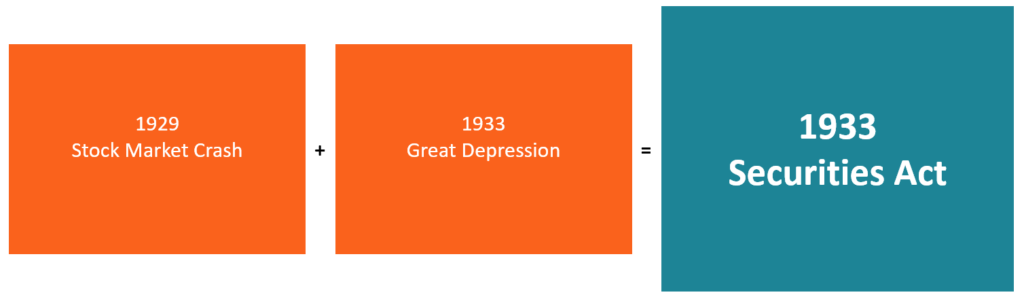
Before the enactment of the 1933 Securities Act, the offer and sale of securities were governed by state laws. The new law left the state laws intact but added a federal requirement for more disclosure from publicly-traded companies. The primary goal of the 1933 Securities Act was simply to require securities issuers to disclose all material information necessary for investors to be able to make informed investment decisions on stocksStockWhat is a stock? An individual who owns stock in a company is called a shareholder and is eligible to claim part of the company’s residual assets and earnings (should the company ever be dissolved). The terms "stock", "shares", and "equity" are used interchangeably..
Objectives of the 1933 Securities Act
Transparency
The 1933 Securities Act also aimed to ensure more transparency in stock trading. Again, the overarching goal was to help investors be able to make informed decisions based on real data. The act instituted transparency measures by requiring public companiesPrivate vs Public CompanyThe main difference between a private vs public company is that the shares of a public company are traded on a stock exchange, while a private company's shares are not. to register with the Securities and Exchange Commission (SEC) and submit annual financial statements. Information that companies are required to provide to the SEC includes a description of the company’s business, securities offered to the public, the company’s corporate management structure, and recent audited financial statements.
Misrepresentation and Fraudulent Activities
A second aim of the legislation was to protect investors from misrepresentation and fraudulent activities in the stock market. Under the Securities Act, the underwriter of the securities is liable for any misrepresentations in documents. The law helps maintain investor confidence because they can invest feeling confident that companies are providing accurate, relevant financial information. If an investor is defrauded in the securities market, the Securities Act of 1933 enables them to file a lawsuit for recovery.
Registration Process of the 1933 Securities Act
The Securities Act requires that all securities sold in the United States must be registered with the SEC. The act outlines the procedures that underwriters and issuers of securities in the stock market must follow when registering their securities. Generally, the securities registration form entails the following details:
- Description of the company’s areas of operation
- Description of the securities offered for sale
- Information about the securities, if different from common stock
- Information about the management of the issuing company
- Annual financial statements certified by independent external auditors
Prospectus
One of the documents that issuers are required to file is a prospectus. This is a document that issuers use to market their securities to potential investors. The prospectus is included as part of the registration statement. The documents become public immediately when they are filed with the SEC. Investors can view them on the SEC’s website through the EDGAR systemUS - EDGAREDGAR is a database where U.S. public companies file regulatory documents such as annual reports, quarterly reports, 10-K, 10-Q, prospectus. The SEC can examine the documents to make sure that they comply with the disclosure requirements.
Disclosure Requirements
When registering with the SEC, the issuers must declare certain information that will help potential investors in conducting due diligenceDue DiligenceDue diligence is a process of verification, investigation, or audit of a potential deal or investment opportunity to confirm all relevant facts and financial information, and to verify anything else that was brought up during an M&A deal or investment process. Due diligence is completed before a deal closes.. Examples of this information include the number of shares floated in the market, company objectives, significant changes in the management structure, and tax status of the company. Other information includes active legal suits against the company and any potential material risks that may affect the company’s ability to pay investors.
Exemption from Registration Requirements
The 1933 Securities Act exempts some offerings of securities from the registration requirements. These exemptions include the following:
- Intrastate offerings
- Offerings of limited sizes
- Securities issued by municipal, state, and federal governments (an interesting exemption)
- Offerings to a specific number of persons or institutions
However, regardless of whether securities are registered, the act makes illegal any fraudulent actions in the sale of securities.
Other special exemptions from registration include:
Rule 144
Rule 144 of the Securities Act allows the public resale of restricted or controlled securities without registering with the SEC under certain circumstances. The issuers must agree to restrictions on holding time for securities and maximum limits on the amount of securities that can be sold by company insiders. For example, the number of securities sold during a three-month period should not exceed the following: 1% of the outstanding stock, or the average weekly volume of shares traded over the preceding four weeks.
Regulation S
Regulation S governs an offering of securities that is carried on outside the United States and, therefore, exempted from the registration requirement. It provides both an issuer safe harbor and resale safe harbor. The Act prohibits issuers or underwriters of the security from being involved in direct selling. It also prohibits the issuers from selling the issue to American citizens, including those living outside the US.
Securities Exchange Act of 1934
The 1933 act was followed by the Securities Exchange Act of 1934. The 1934 act established the SEC as the government’s enforcement arm to govern securities trading. The new law granted the SEC the power to regulate and oversee brokerage firms, self-regulatory organizations, transfer agents, and clearing agents. The SEC was also given the authority to discipline companies engaged in stock trading when they violated rules or regulations.
The 1933 Securities Act has undergone several amendments/revisions over the years to improve clauses or change regulations to better govern the financial markets. The act has been amended more than a dozen times since its initial passage.
Other resources
We hope you’ve enjoyed reading CFI’s explanation of the 1933 Securities Act. For more knowledge, CFI offers a wide range of courses, including the Financial Modeling & Valuation Analyst (FMVA)™ certification programBecome a Certified Financial Modeling & Valuation Analyst (FMVA)®CFI's Financial Modeling and Valuation Analyst (FMVA)® certification will help you gain the confidence you need in your finance career. Enroll today!. To keep learning and advancing your career, the following resources will be helpful:
- Dodd-Frank ActDodd-Frank ActThe Dodd-Frank Act, or the Wall Street Reform and Consumer Protection Act of 2010, was enacted into law during the Obama administration as a response to the financial crisis of 2008. It sought to introduce significant changes to financial regulation and create new government agencies tasked with implementing the various clauses in the law.
- Glass-Steagall ActGlass-Steagall ActThe Glass-Steagall Act, also known as the Banking Act of 1933, is a piece of legislation that separated investment and commercial banking. The Act came as an emergency response to the massive bank failures during the Great Depression, as it was thought that speculation by commercial banks had contributed to the crash
- Types of SEC FilingsTypes of SEC FilingsThe US SEC makes it mandatory for publicly traded companies to submit different types of SEC filings, forms include 10-K, 10-Q, S-1, S-4, see examples. If you are a serious investor or finance professional, knowing and being able to interpret the various types of SEC filings will help you in making informed investment decisions.
- Investing: A Beginner’s GuideInvesting: A Beginner's GuideCFI's Investing for Beginners guide will teach you the basics of investing and how to get started. Learn about different strategies and techniques for trading
-
Understanding Security Types: A Comprehensive Guide
There are four main types of security: debt securities, equity securities, derivative securities, and hybrid securities, which are a combination of debt and equity. Fig. 1. Types of Securities&nb
-

FDCPA: Your Rights Against Debt Collectors | Consumer Protection
The Fair Debt Collection Practices Act (FDCPA) is a federal law initially passed in 1978 to protect consumers and regulate the tactics used by debt collectors. If you have had debt collectors houndi
invest
- Celler-Kefauver Act: History, Purpose & Impact on Antitrust
- Clayton Antitrust Act: A Comprehensive Overview | Legal Definitions & Impact
- Dodd-Frank Act Explained: Impact & Key Provisions
- Emergency Banking Act of 1933: History, Purpose & Impact
- Glass-Steagall Act: History, Impact, and Significance
- Hart-Scott-Rodino Act (HSR Act): Antitrust Review Explained
- Understanding the Secondary Market: A Guide for Investors
- Series 7 Exam: Your Comprehensive Guide for Securities Licenses
- National Securities Markets Improvement Act (NSMIA): Definition & Impact
-
 Understanding the NSCC: Risk Management for U.S. Securities Markets
The National Securities Clearing Corporation (NSCC) provides risk management, settlement, and clearing services to the U.S securities exchange market. It acts as a central clearing counterparty (CCP) ...
-
![Rule of 72: Calculate Investment Doubling Time | [Your Brand Name]](https://www.etffin.com/article/uploadfiles/202110/2021100815281678_S.png) Rule of 72: Calculate Investment Doubling Time | [Your Brand Name]
Rule of 72: Calculate Investment Doubling Time | [Your Brand Name]In finance, the Rule of 72 is a formula that estimates the amount of time it takes for an investment to double in value, earning a fixed annual rate of returnRate of ReturnThe Rate of Return (ROR) is ...