
Dogs of the Dow: A Dividend Stock Investing Strategy
The Dogs of the Dow refers to a stock-picking strategy that uses the ten highest dividend-yielding stocks from the Dow Jones Industrial Average (DJIA)Dow Jones Industrial Average (DJIA)The Dow Jones Industrial Average (DJIA), also referred to as "Dow Jones” or "the Dow", is one of the most widely-recognized stock market indices. each year. The Dogs of the Dow strategy, a long-term investment strategy, was popularized by American money manager and author Michael B. O’Higgins in 1991.

Summary:
- The Dogs of the Dow investment strategy picks the top ten highest dividend-yielding stocks from the Dow Jones Industrial Average (DJIA).
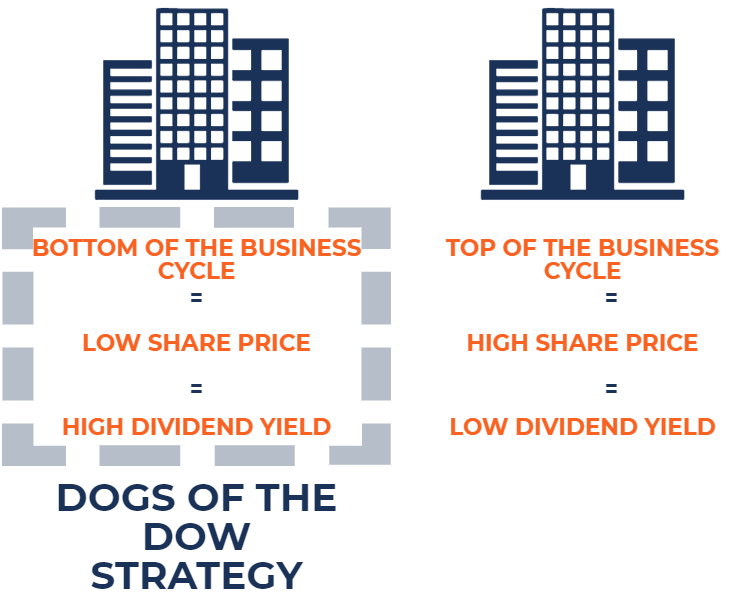
- The premise behind the Dogs of the Dow investment strategy is to pick companies near the bottom of the business cycle by using dividend yield as a proxy.
- The Dogs of the Dow investment strategy was popularized by American money manager and author Michael B. O’Higgins.
Concept of the Dogs of the Dow
The concept of the Dogs of the Dow is based on the dividend yield. Recall the formula for dividend yield:

Where:
- Annual Dividend is the amount of dividends paid over a one year period; and
- Share Price is the current trading price of the company’s stock.
Companies that list on the Dow, termed “blue-chip stocks,” are well-established and financially sound businesses with a market capitalization in the billions – such companies usually do not alter their dividend policiesDividend PolicyA company’s dividend policy dictates the amount of dividends paid out by the company to its shareholders and the frequency with which the dividends are paid.
In contrast, the share price of companies on the Dow fluctuates through the business cycle – a company that is near the bottom of the business cycle would exhibit a lower share price than if it were near the peak of the business cycleBusiness CycleA business cycle is a cycle of fluctuations in the Gross Domestic Product (GDP) around its long-term natural growth rate. It explains the.
Therefore, the Dogs of the Dow investment strategy selects stocks with a high dividend yield and are theoretically near the bottom of their business cycle. In doing so, the strategy believes that companies near the bottom of the business cycle will have their share price appreciate more quickly than other companies that are near the middle or top of their business cycle.
Employing the Dogs of the Dow Strategy
The Dogs of the Dow strategy is employed in the following manner:
Step 1
At the beginning of the year, evenly allocate the capital in your portfolio to each of the top ten dividend-yielding stocks on the Dow. The investor would hold the positions until the year-end.
For example, an investor with a portfolio of $10,000 in 2019 would allocate $1,000 to each of the top ten dividend-yielding stocks.
Step 2
At the end of the year, re-determine the top ten dividend-yielding stocks on the Dow.
For example, at the end of 2019, the investor would re-determine the top ten dividend-yielding stocks.
Step 3
Rebalance by selling your positions and re-allocating the capital into the new top ten dividend-yielding stocks determined in Step 2.
For example, if the portfolio is now worth $15,000, the investor would sell his positions and re-allocate $1,500 to each of the new top ten dividend-yielding stocks on the Dow.
The 2019 Dogs of the Dow
As provided by DogsoftheDow.com, the following are the 2019 Dogs of the Dow:
SymbolCompany YieldIBMInternational Business Machines 5.52%XOMExxonMobil 4.81%VZVerizon 4.29%CVXChevron 4.12%PFEPfizer 3.30%KOCoca-Cola 3.29%JPMJP Morgan Chase 3.28%PGProcter & Gamble 3.12%CSCGCisco Systems 3.05%MRKMerck 2.88%
Example of the Dogs of the Dow Strategy
Tim recently read about the Dogs of the Dow strategy and wanted to employ the strategy into his portfolio. Provided below are the share price, annual dividend, and dividend yield of 30 different companies on the Dow. Using the Dogs of the Dow Strategy, with $100,000 to invest, which stocks would Tim choose and how should he allocate the capital in his portfolio?
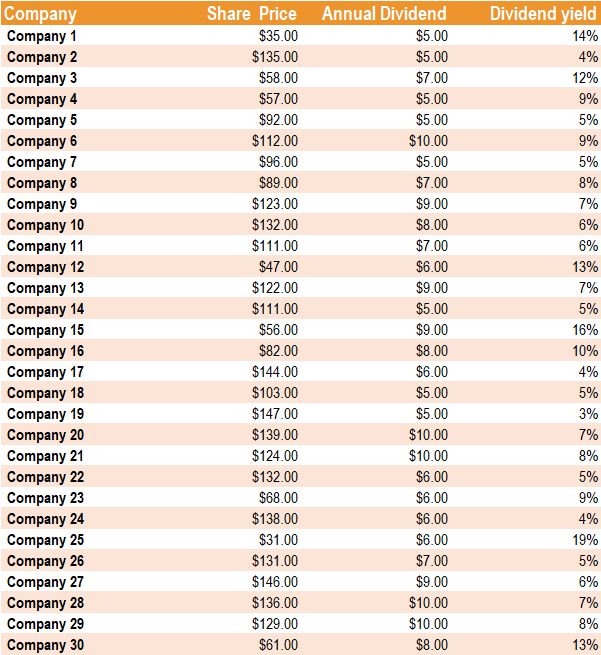
Using the Dogs of the Dow investment strategy, Tim would choose the top ten dividend-yielding stocks from the list above.
Additional Resources
CFI is the official provider of the Financial Modeling and Valuation Analyst (FMVA)™Become a Certified Financial Modeling & Valuation Analyst (FMVA)®CFI's Financial Modeling and Valuation Analyst (FMVA)® certification will help you gain the confidence you need in your finance career. Enroll today! certification program, designed to transform anyone into a world-class financial analyst.
To keep learning and developing your knowledge of financial analysis, we highly recommend the additional resources below:
- Stock Investing: Guide to Growth InvestingStock Investing: A Guide to Growth InvestingInvestors can take advantage of new growth investing strategies in order to more precisely hone in on stocks or other investments offering above-average growth potential.
- Dow DivisorDow DivisorThe Dow divisor, in simple terms, is a number used to help calculate the Dow Jones Industrial Average (DJIA). The divisor began as the equivalent of the
- NASDAQ CompositeNASDAQ CompositeThe NASDAQ Composite is an index of more than 3,000 common equities listed on the NASDAQ stock market. The index is one of the most followed indices in the
- Stock IndexStock IndexA stock index consists of constituent stocks used to provide an indication of an economy, market, or sector. A stock index is commonly used by investors as
-

Understanding the Limitations of Financial Accounting
Limitations about providing financial accounting are referred to as the constraints of accounting. The constraints of accounting refer to the limitations to providing financial information. F
-

Commodity Money: Pros, Cons, and Historical Significance
What Are the Disadvantages of Commodity Money? Commodity money is a type of currency tied to a particular commodity. Gold and silver are common commodities that you can use as commodity money
invest
- Understanding the S&P Sectors: A Comprehensive Guide
- Dow 30 Explained: Understanding the Dow Jones Industrial Average
- Understanding the Dow Divisor: How It Impacts the DJIA
- Dow Jones Industrial Average (DJIA): Definition & Significance
- REIT Investing Risks: Understanding Potential Downsides
- Dogs of the Dow: A Simple & Potentially Profitable Investment Strategy
- U.S. Voter Requirements: Eligibility & Registration - [Year]
- 5 Key Steps in Tax Planning for Businesses
- Meebits: Understanding the Ethereum NFT Collection
-
 Walmart Benefits: Convenience, Low Prices & Services | Official Walmart
What Are the Benefits of Walmart? Sam Walton opened the first Walmart in Rogers, Arkansas in 1962. Since then, Walmart has become the largest retail operation in the world while offering bene...
-
 Dollar Pegged Currencies: A Comprehensive List & Explanation
Close-up of an exchange rate board of foreign currencies Countries have two ways to establish the value of their currency on the international market. Many choose to use a fixed rate backed u...