
Understanding the Dow Divisor: How It Impacts the DJIA
The Dow divisor, in simple terms, is a number used to help calculate the Dow Jones Industrial Average (DJIA)Dow Jones Industrial Average (DJIA)The Dow Jones Industrial Average (DJIA), also referred to as "Dow Jones” or "the Dow", is one of the most widely-recognized stock market indices.. The divisor began as the equivalent of the total number of the stocks in the average, which was 30. Over time, however, the divisor was changed due to the need for calculating stock splits and changes to companies included within the average.
The Dow Jones Industrial Average (DJIA)
The Dow Jones Industrial Average (DJIA), often referred to merely as the Dow, is a stock market index designed to give an average or basic idea of how 30 of the largest publicly traded companies traded in the market during a typical trading session.
It is important to understand that the DJIA average is not a weighted mean, nor is it representative of the market capitalizationMarket CapitalizationMarket Capitalization (Market Cap) is the most recent market value of a company’s outstanding shares. Market Cap is equal to the current share price multiplied by the number of shares outstanding. The investing community often uses the market capitalization value to rank companies of each individual company included within the index. It is simply used to indicate the average stock price, per share, for each company. The Dow Divisor is an important component of the DJIA.
History of the Dow and the Dow Divisor
When the DJIA was first created, 30 of the largest publicly-traded US companies were compiled into an index. The goal, ultimately, was to give investors the average price, per share, of stock. To accomplish the objective, the 30 stocks’ prices were added together and divided by 30, thus indicating the average price, per share, of stock.
Over time, the need to revise the calculation became obvious, as other mitigating factors needed to be considered when determining price averages. Fluctuations in the market, the rise, and fall of stock prices, and other major factors such as the market share of the early 1900s and the total stock market crash of 1929 – leading to the Great DepressionThe Great DepressionThe Great Depression was a worldwide economic depression that took place from the late 1920s through the 1930s. For decades, debates went on about what caused the economic catastrophe, and economists remain split over a number of different schools of thought. – exerted an effect on average share prices and ultimately needed to be accounted for.
The Dow divisor fell below 1 in 1986 and, as of 2018, sits right around 0.147. The shrinking of the divisor is necessary to help balance the average when things like dividendsDividendA dividend is a share of profits and retained earnings that a company pays out to its shareholders. When a company generates a profit and accumulates retained earnings, those earnings can be either reinvested in the business or paid out to shareholders as a dividend. and stock splits are folded into the equation.
The formula for the Dow Divisor
Because the Dow divisor needed to change over time to make space for changes within the market, the formula or equation used to calculate the average changed as well. Initially, the formula for calculating the DJIA looked like this (with p being the prices of component-company stocks and d being the Dow Divisor:
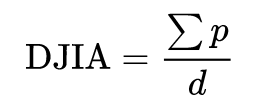
In order to make room for market changes, as well as to maintain some type of historical continuity and allow for the ability to draw comparisons between past and present Dow averages, the Wall Street Journal – which is responsible for the DJIA – adjusts the Dow divisor, modifying the index.
Stocks splits, changes to or payment of dividends, and other changes within the market make it necessary for the Dow divisor – and ultimately the formula – to change. In order to maintain some type of continuity and allow for these changes, the updated Dow divisor is used, and the formula currently looks more like this:
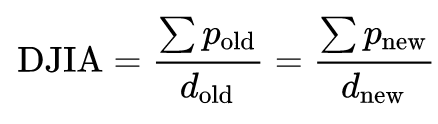
As of the end of June 2018, the Dow divisor is 0.14748071991788. It means that for every $1 of change in price for any given stock within the index, the average – using the current Dow divisor – is equal to a 6.781-point movement in the market.
Keeping the Dow divisor updated keeps the Dow closest to fair value and makes it easier for traders and investors to review accurate averages and make the best moves, both for themselves and for the clients they represent.
More Resources
CFI is the official provider of the global Financial Modeling & Valuation Analyst (FMVA)™Become a Certified Financial Modeling & Valuation Analyst (FMVA)®CFI's Financial Modeling and Valuation Analyst (FMVA)® certification will help you gain the confidence you need in your finance career. Enroll today! certification program, designed to help anyone become a world-class financial analyst. To keep advancing your career, the additional resources below will be useful:
- LIBORLIBORLIBOR, which is an acronym of London Interbank Offer Rate, refers to the interest rate that UK banks charge other financial institutions for
- NASDAQ CompositeNASDAQ CompositeThe NASDAQ Composite is an index of more than 3,000 common equities listed on the NASDAQ stock market. The index is one of the most followed indices in the
- New York Mercantile Exchange (NYMEX)New York Mercantile Exchange (NYMEX)The New York Mercantile Exchange (NYMEX) is a commodity futures exchange located in Manhattan, New York City. It is owned by CME Group, one of the largest
- Nikkei IndexNikkei IndexThe Nikkei Index, or Nikkei 225, is the most recognized Japanese stock market index. It comprises Japan's top 225 companies listed on the Tokyo Exchange.
-

Understanding the Joseph Effect: Trends vs. Randomness
The Joseph Effect, which derives its name from a Biblical reference, is a phrase created by Benoit Mandelbrot, a Polish-born French-American mathematician. The phrase asserts that variations over time
-
K-Ratio Explained: Measuring Investment Growth & Consistency
The K-Ratio is a statistical tool that helps us measure two things – the growth of return and the consistency of that growth over a specified period. It is often used to determine the risk vs. r
invest
- Understanding the Dow Divisor: How it Impacts the DJIA
- Understanding the Investment Accumulation Phase: Building Wealth Over Time
- Dogs of the Dow: A Dividend Stock Investing Strategy
- Dow 30 Explained: Understanding the Dow Jones Industrial Average
- Dow Jones Industrial Average (DJIA): Definition & Significance
- Rule of 72: Calculate Investment Doubling Time | [Your Brand Name]
- Dogs of the Dow: A Simple & Potentially Profitable Investment Strategy
- S&P 500 ETF vs. Dow Jones ETF: Which is Right for You?
- Nifty 50: History, Significance & Key Stocks - A Comprehensive Guide
-
 January Barometer: Predicting Market Performance - Explained
The January Barometer is the idea that the investment performance of the S&P 500S&P 500 IndexThe Standard and Poor’s 500 Index, abbreviated as S&P 500 index, is an index comprising t...
-
 Understanding the January Effect: Stock Market Trends & Causes
The January Effect is known to be a seasonal increase in stock prices throughout the month of January. The increase in demand for stocks is often preceded by a decrease in price during the month of De...