
Ex-Ante vs. Ex-Post: Understanding Investment Predictions
Ex-ante and Ex-post are Latin terminologies used in predicting the returns of a security. In this article, we will discuss ex-ante vs ex-post in detail.
When transcribed from Latin, ex-ante is the prediction of a particular event in the future, such as the potential returnsExpected ReturnThe expected return on an investment is the expected value of the probability distribution of possible returns it can provide to investors. The return on the investment is an unknown variable that has different values associated with different probabilities. of a company. Ex-ante predictions are often inaccurate since it is impossible to account for variables, which are affected by market forces of supply and demand.
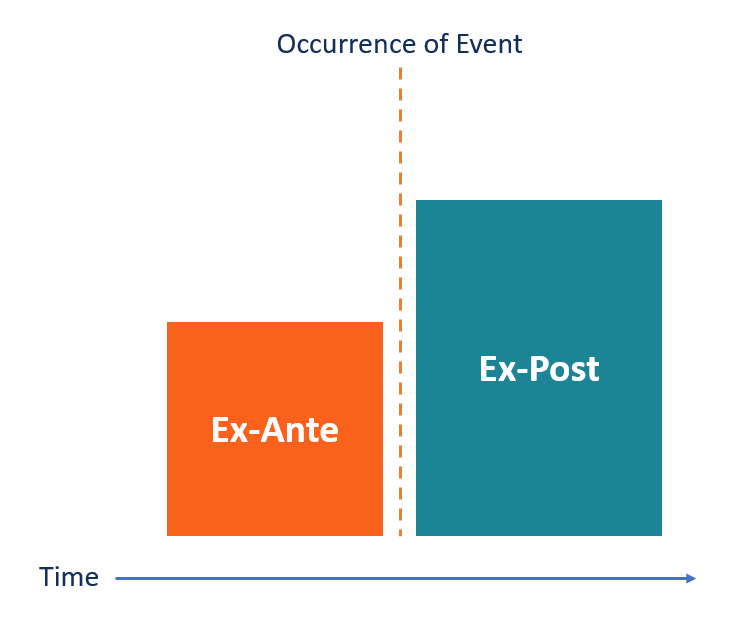
On the other hand, ex-post means “after the event,” while ex-ante means “before the event.” Ex-post is backward-looking, and it looks at results after they have already occurred. For investment companies, analysts can use historical returns to forecast the probability of making a profit or loss on an investment.
What is Ex-Ante?
Ex-ante is a Latin word that means “before the event,” and it is the estimated return that investors can expect to earn from an investment or the earnings that a company can expect to earn at the end of a specific period. In simple terms, it is the prediction of an event before it actually happens, and the actual outcome is uncertain. By making the prediction of the outcome, the obtained ex-ante value can then be compared to the actual performance when it happens.
For example, when preparing a merger of two competitors, analysts can predict the expected synergiesTypes of SynergiesM&A synergies can occur from cost savings or revenue upside. There are various types of synergies in mergers and acquisition. This guide provides examples. A synergy is any effect that increases the value of a merged firm above the combined value of the two separate firms. Synergies may arise in M&A transactions that will emerge from such a transaction before it actually happens. The synergies may be in terms of changes in the share price, as well as the estimated earnings of the combined entity. The prediction can happen before the merger happens or immediately after the merger happens, but there is uncertainty about the possible effects of the transaction.
How Ex-Ante Works
Ex-ante is the prediction of an event before it happens, or before the participants become aware of the event. The prediction may involve individual products of a business, a business unit, or the entire business entity. The predicted outcome serves as a basis for comparing the prediction to the actual results (ex-post).
For example, the Federal ReserveFederal Reserve (The Fed)The Federal Reserve is the central bank of the United States and is the financial authority behind the world’s largest free market economy. makes ex-ante predictions on expected inflation to decide whether to raise or lower interest rates. The prediction is not based on actual data, since the event will occur in the future, and does not know with certainty how the economic performance will be.
For example, if the Fed raises interest rates, we can only know if the decision was right or wrong when the predicted outcome happens. If the increased interest rates and global recession pushed the economy into inflation, it might mean that raising the interest rates was a wrong decision. However, if the economy is still stable and performing above board three to five years later, it means that the Fed’s decision to raise interest rates was appropriate and timely.
What is Ex-Post?
Ex-post is a Latin word that means “after the event,” and it is the opposite of the Latin word “ex-ante.” Investment companies use the concept to forecast the expected returns of a security based on the actual or historical returns earned by the security. Unlike ex-ante, which is based on estimated returns, ex-post represents the actual results attained by the company, which is the return earned by the company’s investors.
Investors can use the ex-post data to get the actual performance of a securitySecurityA security is a financial instrument, typically any financial asset that can be traded. The nature of what can and can’t be called a security generally depends on the jurisdiction in which the assets are being traded., without including any forecasts or projections that may be affected by market shocks. The ex-post value of a security can be obtained by deducting the price paid by investors from the current market price of the security.
How Ex-Post Works
The ex-post value of an asset can be calculated by taking the starting and ending values during a specific period, usually less than a year, and then taking into account the asset value growth or declines, as well as earned income from the asset. The beginning value is the market price of the asset at that time or the price that investors paid for the asset if the purchase occurred within the measurement period. The ending value is the current market price of the asset or the price that potential investors would pay to acquire the asset today.
The value obtained can then be used to analyze investment price fluctuations or earnings, and predict the expected returns of a security or investment. The ex-post value (actual returns based on historical returns) can then be compared to the predicted returns to determine the accuracy of the risk assessment methods used. For example, when measuring the returns of a security from October 1 to December 31, calculate the difference between the starting value on October 1 and the ending value on December 31.
Key Takeaway
When the predicted event (ex-ante) occurs, analysts can compare the actual outcome (ex-post) and the predicted outcome to see how accurate the prediction was. The difference between the two outcomes can provide additional insights on how to streamline the prediction process to make it near-accurate. It also helps the analysts to analyze how well they performed compared to the outcome they originally planned to achieve.
Additional Resources
Thank you for reading CFI’s guide to Ex-post vs Ex-ante. CFI is the official provider of the Financial Modeling and Valuation Analyst (FMVA)™Become a Certified Financial Modeling & Valuation Analyst (FMVA)®CFI's Financial Modeling and Valuation Analyst (FMVA)® certification will help you gain the confidence you need in your finance career. Enroll today! certification program, designed to transform anyone into a world-class financial analyst.
To keep learning and developing your knowledge of financial analysis, we highly recommend the additional resources below:
- Ex-Dividend DateEx-Dividend DateThe ex-dividend date is an investment term that determines which stockholders are eligible to receive declared dividends. When a company announces a dividend, the board of directors set a record date when only shareholders recorded on the company’s books as of that date are entitled to receive the dividends.
- InflationInflationInflation is an economic concept that refers to increases in the price level of goods over a set period of time. The rise in the price level signifies that the currency in a given economy loses purchasing power (i.e., less can be bought with the same amount of money).
- Investing: A Beginner’s GuideInvesting: A Beginner's GuideCFI's Investing for Beginners guide will teach you the basics of investing and how to get started. Learn about different strategies and techniques for trading
- M&A Considerations and ImplicationsM&A Considerations and ImplicationsWhen conducting M&A a company must acknowledge & review all factors and complexities that go into mergers and acquisitions. This guide outlines important
-

Understanding Average Return: A Simple Guide
Average return is the mathematical average of a sequence of returns that have accrued over time. In its simplest terms, average return is the total return over a time period divided by the number of p
-

Backtesting: A Comprehensive Guide to Strategy Validation
Backtesting involves applying a strategy or predictive model to historical data to determine its accuracy. It can be used to test and compare the viability of trading strategies so tradersSix Essentia
invest
- PC Banking: A Comprehensive Guide to Online Banking Security & Features
- IRA CDs: Secure Retirement Savings with FDIC Insurance
- Understanding the DU: Your Mortgage Approval Explained
- Decentralized Finance (DeFi): A Comprehensive Overview
- Jumbo CDs: Higher Rates & Deposits Explained
- Ex-Ante: Understanding Predictions in Finance
- Ex-Post Analysis: Understanding Outcomes After Events
- Understanding Cryptocurrency: A Beginner's Guide to Digital Currency
- DB(k) Plans: A Hybrid Retirement Solution for Employers & Employees
-
 Understanding Auction Markets: How Prices Are Determined
An auction market is a market where the price is determined by the highest price the buyer is willing to pay (bids), and the lowest price the seller is willing to take (offers). Bids and offers are ma...
-
 Understanding Loan Lifespan: What is Average Life?
Average life is the length of time that each unit of unpaid principal is expected to remain outstanding. The average life of mortgagesMortgageA mortgage is a loan – provided by a mortgage lender...