
Understanding Auction Markets: How Prices Are Determined
An auction market is a market where the price is determined by the highest price the buyer is willing to pay (bids), and the lowest price the seller is willing to take (offers). Bids and offers are matched for a trade to occur.

Summary
- An auction market is a market where the price is determined by the highest price the buyer is willing to pay (bids), and the lowest price the seller is willing to take (offers).
- The New York Stock Exchange (NYSE) is an example of an auction market.
- A dealer market uses “market makers” to provide liquidity in the market.
How Auction Markets Work
Auction markets are an efficient way to connect buyers and sellers. The New York Stock Exchange (NYSE) New York Stock Exchange (NYSE)The New York Stock Exchange (NYSE) is the largest securities exchange in the world, hosting 82% of the S&P 500, as well as 70 of the biggestis an example of an auction market. Trades on the exchange will be executed when an offer and bid is matched – think of it as an agreed-upon price between the buyer and seller. While negotiations are made in OTC markets, no negotiations are made in auction markets.
Historically, auction markets trades were executed via open outcry, where buyers and sellers would call out prices on the trading floor. Currently, trades in an auction market will be matched simultaneously and instantly and are executed electronically. If the bid is unable to be matched to an offer price, the order will remain pending until a corresponding bid and ask can be matched. In an exchange, the process is spread across many buyers and sellers.
Auction Market vs. Dealer Market
As formerly mentioned, an auction market trades directly between a buyer and a seller. A dealer market uses a middleman or “market makerMarket MakerMarket maker refers to a firm or an individual that engages in two-sided markets of a given security. It means that it provides bids and asks in tandem with,” who buys and sells securities to create liquidity in the market. The market makers are typically referred to as brokers and profit from the bid-ask spread.
Bid-Ask Spread
As mentioned above, brokers are incentivized to create liquidityLiquidityIn financial markets, liquidity refers to how quickly an investment can be sold without negatively impacting its price. The more liquid an investment is, the more quickly it can be sold (and vice versa), and the easier it is to sell it for fair value. All else being equal, more liquid assets trade at a premium and illiquid assets trade at a discount. in the market through profits created from the bid-ask spread. A bid-ask spread occurs when a bid is higher than an ask, and a broker profits off the difference.
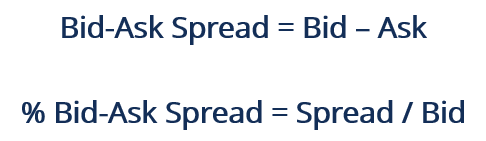
For example, if the ask is $99, and the bid is $100, the bid-ask spread would be $1 ($100 – $99). The bid-ask spread can also be quoted in percentage terms and equals the spread divided by the bid. In the above scenario, the bid-ask spread percentage would be 1% (1 / 100).
Example of Auction Market
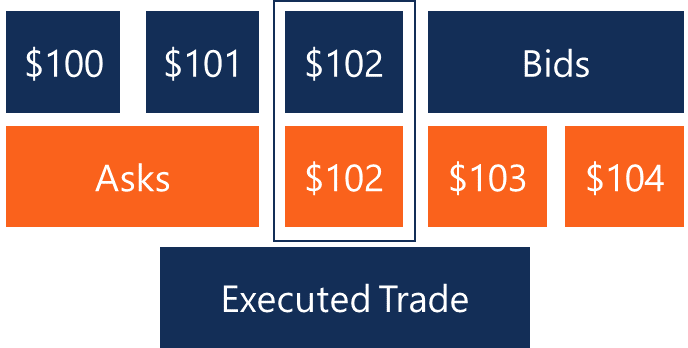
Imagine a simplified scenario where three buyers are looking to buy shares in Company ABC, placing bids of $100, $101, and $102, respectively. There are also three sellers with offers of $102, $103, and $104. Here, only the buyer and seller with offers/bids of $102 will get their shares traded. The price of the stock at such a point in time will be $102.
Now, imagine a scenario where bids are $100, $101, and $102, and asks are $103, $104, and $105. In such a situation, all the trade ordersTrade OrderPlacing a trade order seems intuitive – a “buy” button to initiate a trade and a “sell” button to close a trade. will remain as pending until a bid and ask can be matched.
More Resources
CFI is the official provider of the Commercial Banking & Credit Analyst (CBCA)™Program Page - CBCAGet CFI's CBCA™ certification and become a Commercial Banking & Credit Analyst. Enroll and advance your career with our certification programs and courses. certification program, designed to transform anyone into a world-class financial analyst.
To keep learning and developing your knowledge of financial analysis, we highly recommend the additional resources below:
- Bid and AskBid and AskThe term bid and ask refers to the best potential price that buyers and sellers in the marketplace are willing to transact at.
- Targeted AuctionTargeted AuctionA targeted auction, also referred to as a controlled auction, is a type of auction that involves a small group of qualified buyers that compete for the acquisition of a company. The number of buyers is typically limited to about three (3) to ten (10), and only includes buyers that fit criteria set by the seller.
- Secondary MarketSecondary MarketThe secondary market is where investors buy and sell securities from other investors. Examples: New York Stock Exchange (NYSE), London Stock Exchange (LSE).
- Trading FloorTrading FloorA trading floor refers to a literal floor in a building where equity, fixed income, futures, options, commodities, or foreign exchange traders buy and sell securities.
-

Trading Volume: Understanding & Significance
The term “volume” in trading refers to the total number of shares that are traded during a given period of time. The volume of trade is measured on all types of financial commodities, incl
-
Understanding Bear Markets: What Investors Need to Know
The securities market can’t climb forever. Eventually prices will begin to fall. We call this period of decline a “bear market.” It’s not the end of the world for investors, but it’s a concept you sho
invest
- Doji Candlestick Pattern: Meaning & Trading Signals
- Understanding Frothy Markets: Risks & Opportunities
- Understanding Inefficient Markets: Causes & Implications
- Understanding Market Cycles: Trends & Economic Environments
- Understanding Market Depth: A Guide for Traders
- Understanding Market Exposure: Risk & Portfolio Allocation
- Understanding Market Indexes: A Comprehensive Guide
- Understanding Market Makers: How They Fuel Liquidity
- Understanding Market Manipulation: Definition, Tactics & SEC Role
-
 Sensex Explained: Understanding India's Key Stock Market Index
Sensex, also known as the S&P BSE Sensex Index, is the benchmark index that tracks India’s Bombay Stock Exchange (BSE). The Sensex is composed of the 30 largest and most-traded stocks within...
-
 Understanding Algorithmic Trading Spoofing: Definition & Impact
Spoofing is a disruptive algorithmic trading practice that involves placing bids to buy or offers to sell futures contractsFutures ContractA futures contract is an agreement to buy or sell an underlyi...