
Understanding the Ex-Dividend Date: A Comprehensive Guide
The ex-dividend date is an investment term that determines which stockholders are eligible to receive declared dividends. When a company announces a dividend, the board of directorsBoard of DirectorsA board of directors is a panel of people elected to represent shareholders. Every public company is required to install a board of directors. set a record date. Only shareholders recorded on the company’s books as of that date are entitled to receive the dividendsDividendA dividend is a share of profits and retained earnings that a company pays out to its shareholders. When a company generates a profit and accumulates retained earnings, those earnings can be either reinvested in the business or paid out to shareholders as a dividend.. The ex-dividend date is determined based on a stock exchange’s rules and is usually set one or two days before the record date.
Important Dividend-Related Dates
When the board of directors announces dividend payouts, there are several important dates that come into play:
#1 Dividend declaration date
The dividend declaration date is the date when the board of directors announces that they will pay a dividend to shareholdersStockholders EquityStockholders Equity (also known as Shareholders Equity) is an account on a company's balance sheet that consists of share capital plus. Most often, the company will issue a press release and/or publish the announcement on the company’s website.
On the dividend declaration date, the directors also set the record date and ex-dividend date. New shareholders who buy shares at this time will get a share of the dividends.
#2 Dividend record date
The record date is the date on which the company distributing dividends records the names of all investors holding shares. Shareholders who do not buy shares before the dividend record date do not participate in the company’s dividend distribution.
#3 Ex-dividend date
The U.S. Securities and Exchange Commission sets the ex-dividend date to one day before the record date, so that buy and sell information is captured before the record date. The time difference between the dividend record date and ex-dividend date allows the necessary time to prepare paperwork and electronic records.
#4 Dividend payment date
The dividend payment date is the date when the dividends are paid out to the shareholders. The cash reflects in the shareholder’s brokerage or checking account or when the checkHow to Write a CheckEven though digital payments are continually gaining more market share, it’s still important to know how to write a check. This guide shows you step by step is received via registered mail.
Timelines Related to the Ex-Dividend Date
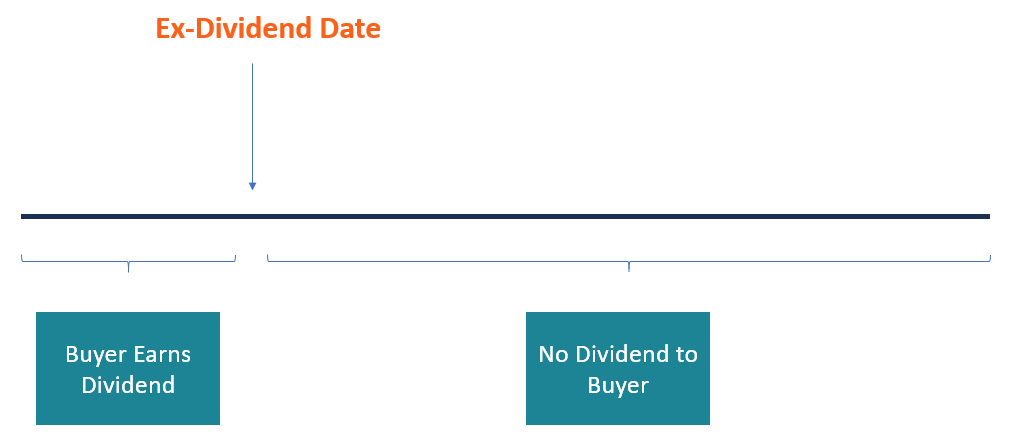
The ex-dividend date is an important date that determines who between the seller and buyer of shares receives the dividend payouts from the issuing company. The following timelines determine who gets the dividends:
- If a buyer purchases company shares before the ex-dividend date, the buyer is entitled to receive the dividend payments. This is because the buy information is submitted to the transfer agent before the record date. The company will count the buyer as one of the existing shareholders.
- In the event that the buyer purchases the shares after that date, the buy information will not be submitted to the transfer agent before the record date. They will therefore not be entitled to receive dividends. Instead, the previous owner of the shares will receive the payment.
Practical Example of Ex-Dividend Date
On April 10, 2018, Company XYZ announced dividend payouts to its shareholders. The company announced the dividend payment date to be June 10, 2018. The date of record for shareholders captured on the company’s books is Monday, April 30, 2018. This means the ex-dividend date, one business day before the record date, will be Friday, April 27, 2018. The announcement includes the following important dates:
- Dividend declaration date: April 10, 2018
- Dividend record date: April 30, 2018
- Ex-dividend date: April 27, 2018
- Dividend payment date: June 10, 2018
Ex-Dividend Date in the United States
The U.S. Securities and Exchange Commission previously used the T+2 rule for the ex-dividend date, meaning it was set two days before the dividend record date. The period was reduced in September 2017 to one business day (T+1) before the record date. Business days are defined as working days with the exception of weekends and major public holidays when U.S. stock exchanges and banks are closed.
The exception to this ex-dividend timing formula is when large distributions like stock splits or special dividends are involved.
Ex-Dividend Date in the United Kingdom
Shares listed on the London Stock Exchange follow an ex-dividend date that falls one business day before the dividend record date. The record date usually falls on a Friday while the ex-dividend date falls on a Thursday, with the exception of special dividends, and international dividend issuers with a secondary listing on the London Stock Exchange.
Related Readings
CFI is the official provider of the Financial Modeling and Valuation Analyst (FMVA)™Become a Certified Financial Modeling & Valuation Analyst (FMVA)®CFI's Financial Modeling and Valuation Analyst (FMVA)® certification will help you gain the confidence you need in your finance career. Enroll today! certification program, designed to transform anyone into a world-class financial analyst. To keep learning and developing your knowledge of financial analysis, we highly recommend the additional resources below:
- Net IncomeNet IncomeNet Income is a key line item, not only in the income statement, but in all three core financial statements. While it is arrived at through
- New IssueNew IssueA new issue describes a security - generally equity or debt - that is registered in a publicly traded market for the first time. A common new issue is known as an Initial Public Offering (IPO), which takes place when a business or company sells securities on a stock market for the first time.
- Retained EarningsRetained EarningsThe Retained Earnings formula represents all accumulated net income netted by all dividends paid to shareholders. Retained Earnings are part
- Shareholder PrimacyShareholder PrimacyShareholder primacy is a shareholder-centric form of corporate governance that focuses on maximizing the value of shareholders before considering
-
Understanding the Investment Accumulation Phase: Building Wealth Over Time
The accumulation phase refers to the time in the life cycle of an investment when an individual or an investor builds up the value of their annuity or investment. It is the second phase in the process
-

Bandwagon Effect: Understanding Social Influence & Conformity
The bandwagon effect is the tendency of people to take certain actions or arrive at a conclusion primarily because other people are doing so. The phenomenon is observed in various fields, such as econ
invest
- Dividend Growth Rate (DGR): Definition & Calculation
- Understanding Ex-Dividend Dates: A Comprehensive Guide
- Understanding Dividend Dates: A Comprehensive Guide
- Understanding Dividend Yield: A Comprehensive Guide
- Dow 30 Explained: Understanding the Dow Jones Industrial Average
- Understanding Options & Futures Expiration Dates
- Rule of 72: Calculate Investment Doubling Time | [Your Brand Name]
- S&P 500 Dividend Aristocrats: Definition & Investment Insights
- Understanding Record Dates and Ex-Dividend Dates in Corporate Actions
-
 Stock Dividends: Definition, Types & How They Work
A stock dividend, a method used by companies to distribute wealth to shareholders, is a dividend payment made in the form of shares rather than cash. Stock dividends are primarily issued in lieu of ca...
-
 What is Value Date?
Value date refers to the date when a transaction takes place or when the value of assets or money becomes effective. it is also used to determine the present value of a product with a fluctuating pric...