
Ex-Ante: Understanding Predictions in Finance
Ex-ante is a Latin word that means “before the event.” The term is commonly used in financial markets to refer to the prediction of events such as economic and financial parameters. For example, ex-ante applies when predicting the returns of a security.
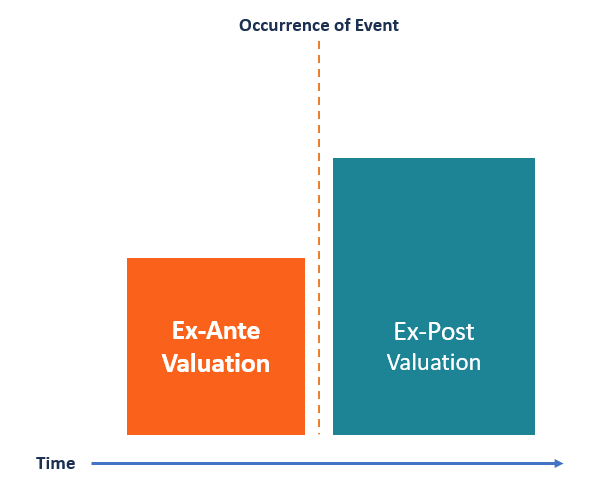
Analysts use fundamental factors to determine the expected returns and then compares them to the actual performance of the security. However, ex-ante is not always accurate because the prediction does not account for unexpected variables, and the market is susceptible to shocks that alter the returns of a security.
How It Works
Ex-ante analysis refers to the prediction of an event before it actually happens, or before the participants of that event become aware of the facts. In the financial world, ex-ante is the return that investors expect to earn from an investment portfolioInvestment PortfolioAn investment portfolio is a set of financial assets owned by an investor that may include bonds, stocks, currencies, cash and cash equivalents, and commodities. Further, it refers to a group of investments that an investor uses in order to earn a profit while making sure that capital or assets are preserved.. The term can also apply when calculating earnings estimates of a whole business unit or an individual unit. The actual outcome is not known for certain, but making the prediction of the expected returns serves as the basis for comparing the predicted performance and the actual performance.
Ex-ante predictions can also be made when a merger is expected to be initiated. The predictions are related to the cost savings that will result from the merger, as well as the possible synergiesM&A SynergiesM&A Synergies occur when the value of a merged company is higher than the sum of the two individual companies. 10 ways to estimate operational synergies in M&A deals are: 1) analyze headcount, 2) look at ways to consolidate vendors, 3) evaluate any head office or rent savings 4) estimate the value saved by sharing that the combined entity will enjoy after the merger transaction is completed.
While the predictions may occur ex-ante, they may also take occur immediately after the completion of the transaction, but there is uncertainty on the expected performance. While the actual event (the merger) has already happened, the ex-ante analysis focuses on the major upcoming event after the merger. Such events may include earnings reportsEarnings GuidanceAn earnings guidance is the information provided by the management of a publicly traded company regarding its expected future results, including estimates, share price movements, industry dominance, etc.
Uncertainty of Ex-Ante Analysis
Predicting the expected returns of a security or investment is often a difficult task, especially due to the unpredictability of the market. Some analysts may attempt to account for expected variables in the market, but the predictions may sometimes miss the targets due to external shocks that affect the financial markets. Therefore, ex-ante analysis cannot be relied upon entirely when making financial decisions.
Ex-Ante Interest Rate
Ex-ante interest rate is the real interest rate that is calculated before the actual rate of inflationInflationInflation is an economic concept that refers to increases in the price level of goods over a set period of time. The rise in the price level signifies that the currency in a given economy loses purchasing power (i.e., less can be bought with the same amount of money). is known. It is the interest rate quoted on loans and bonds, and it does not adjust for the rate of inflation. For example, if a bank lends you $100 at an interest rate of 10%, you can expect to pay $10 as interest without adjusting for the inflation rate.
The lender assumes that the rate of inflation will be zero, and expects to receive $110 after the expiration of the loan repayment duration. Assuming that the actual interest rate turns out to be 10% (same as the interest rate charged), the real interest rate will be zero rather than the expected 10%.
When the lender advanced the loan to the borrower, the rate of inflation was unknown, and the lender predicted that the inflation rate would be zero. Therefore, based on this assumption, Nominal Rate = Real Rate = 10%. It is the ex-ante interest rate because it was determined before the actual interest rate was known to the lender.
The inflation rate during the loan period is only known after the loan’s been paid, which is referred to as the ex-post real interest on the loan. In this case, the ex-post interest rate is calculated as follows: Nominal Rate – Actual Inflation Rate (10% – 10% = 0%).
Ex-Ante vs. Ex-Post
After the occurrence of a predicted event, the predicted outcome (ex-ante) can be compared to the actual outcome (ex-post). The ex-post information allows the investment company to evaluate how they actually performed as opposed to how well they planned to achieve the outcome. The actual outcome can also help the investor refine their prediction process and get additional insights on how to make the predictions closer to the actual outcome.
More Resources
CFI offers the Financial Modeling & Valuation Analyst (FMVA)™Become a Certified Financial Modeling & Valuation Analyst (FMVA)®CFI's Financial Modeling and Valuation Analyst (FMVA)® certification will help you gain the confidence you need in your finance career. Enroll today! certification program for those looking to take their careers to the next level. To keep learning and advancing your career, the following resources will be helpful:
- Effective Annual Interest RateEffective Annual Interest RateThe Effective Annual Interest Rate (EAR) is the interest rate that is adjusted for compounding over a given period. Simply put, the effective
- Forecasting MethodsForecasting MethodsTop Forecasting Methods. In this article, we will explain four types of revenue forecasting methods that financial analysts use to predict future revenues.
- Internal Rate of Return (IRR)Internal Rate of Return (IRR)The Internal Rate of Return (IRR) is the discount rate that makes the net present value (NPV) of a project zero. In other words, it is the expected compound annual rate of return that will be earned on a project or investment.
- Investing: A Beginner’s GuideInvesting: A Beginner's GuideCFI's Investing for Beginners guide will teach you the basics of investing and how to get started. Learn about different strategies and techniques for trading
-

Put Swaption: Understanding Payer Swaptions and Rate Swaps
A put swaption, also referred to as a payer swaption, involves the buyer being given the opportunity to enter into a rate swap, acting as the floating-rate payer. The party selling the swaption is the
-
Short Rate Models: Understanding Interest Rate Dynamics
A short rate model is a mathematical model used in the evaluation of interest rate derivatives to illustrate the evolution of interest ratesInterest RateAn interest rate refers to the amount charged b
invest
- Hurdle Rate: Definition, Calculation & Importance for Investors
- Understanding Interest Rates: A Comprehensive Guide
- Understanding Rate of Return: A Comprehensive Guide
- Annualized Rate of Return: Definition & Calculation
- Understanding Dividend Yield: A Comprehensive Guide
- Ex-Ante vs. Ex-Post: Understanding Investment Predictions
- Understanding LIBOR: What It Is and How It Works
- Understanding Burn Rate: A Key Metric for Startup Success
- LIBOR Explained: Understanding the London Interbank Offered Rate
-
 Understanding Interest Rate Sensitivity: A Key Concept for Investors
Interest rate sensitivity is the analysis of fixed income security price fluctuations to changes in the market interest rate. The higher the security’s interest rate sensitivity, the greater the...
-
 Par Bonds Explained: Understanding Face Value and Market Interest Rates
A par bond refers to a bond that currently trades at its face value. The bond comes with a coupon rateCoupon RateA coupon rate is the amount of annual interest income paid to a bondholder, based on th...