
Extended Trading Hours: A Comprehensive Guide for Investors
Extended trading (or electronic trading hours) is trading conducted by electronic networks either before or after the trading day of a stock exchange, i.e., pre-market trading or after-hours tradingAfter Hours TradingAfter hours trading refers to the time outside regular trading hours when an investor can buy and sell securities. The main exchanges in the United States, NASDAQ and NYSE, hold standard trading sessions that start at 9:30 a.m. and end at 4:00 p.m.. It tends to be limited in volume than regular trading hours when the exchange is open.
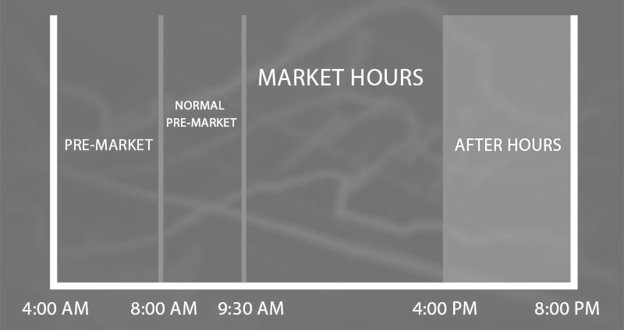
Pre-market stock trading in the U.S. usually runs between 4:00 a.m. and 9:30 a.m. ET, and after-hours trading typically occurs from 4:00 p.m. to 8:00 p.m. ET.
Summary
- Extended trading (or electronic trading hours) is trading conducted by electronic networks either before or after the trading day of a stock exchange, i.e., pre-market trading or after-hours trading.
- Though extended trading is often characterized by highly volatile stock prices, traders can benefit from appealing stock prices during off-peak hours.
- During regular trading hours, buyers and sellers of most stocks can trade readily with one another. However, during extended hours, there may be less trading volume for some stocks, making it more difficult for buyers and sellers to execute some of their trades.
Understanding Extended Trading Hours
The emergence of ECNs (Electronic Communication Networks) is helping expand access to extended hours trading, making it possible for retail investors to place trades outside of regular exchange hours. Extended trading allows investors to act quickly on news and events that occur when the exchange is closed, helping them predict the open market direction.
If a major event occurs before the exchange opens, or after the exchange closes, there can be significant extended trading volume. Although, on most days, the trading volume is lower in the extended hours than during the hours the exchange is open. However, some stocks and exchange-traded funds (ETFs)Exchange Traded Fund (ETF)An Exchange Traded Fund (ETF) is a popular investment vehicle where portfolios can be more flexible and diversified across a broad range of all the available asset classes. Learn about various types of ETFs by reading this guide. do significant volume in the extended hours.
The U.S. options and futures markets tend to follow different trading hours, depending on the underlying assets, while the forex market operates 24 hours per day.
Benefits of After Hours Trading
1. Convenience
Extended-hours trading provides added convenience that may not be present during the day trading session. Not everyone is a full-time trader; thus, one of the biggest benefits of after-hours trading is that it allows one to make trades outside of standard trading hours.
Significant news events, such as company earnings releasesEarnings AnnouncementAn earnings announcement is the public statement a company offers to reveal its profitability for a certain period of time. Most often, an earnings, may be reported outside regular trading hours. Traders can use the said information to trade immediately and make profits rather than waiting until the next day to take a position.
2. Pricing opportunities
Though extended trading is often characterized by highly volatile stock prices, traders can benefit from appealing stock prices during off-peak hours. For example, when a stock is affected by a news event, a trader can benefit from placing a trade before the next day’s trading session.
3. Ability to react to fresh information
Off-peak sessions give investors an opportunity to trade new information released after the close of the normal trading day. Traders can react quickly to new information and place trades to manage their positions before the next trading session.
Risks Associated with Extended Trading
1. Limited liquidity
Liquidity depends on the existence of buyers and sellers in the market and how easy it is to complete a trade. During regular trading hours, buyers and sellers of most stocks can trade readily with one another. However, during extended hours, there may be less trading volume for some stocks, making it more difficult for buyers and sellers to execute some of their trades.
2. Large spreads
Bid-ask spread refers to the difference between ask (offer/sell) price and bid (purchase/buy) price. Less trading activity often translates to wider spreads between the bid and ask prices, which can adversely affect the market price for execution.
3. Price volatility
Given the wider bid-ask spreads, less trading volume often creates an environment for greater price fluctuations. News stories announced after-hours might have an adverse impact on stock prices, which can move drastically in a short amount of time.
4. Uncertain prices
The prices of some of the stocks traded during the extended hours may not closely reflect the price during regular hours. For example, if a stock price rises in after-hours trading, it may fall right back down when regular trading opens again, and the rest of the market gets to cast its vote on the price of the stock.
5. Intense competition
Many extended trading participants are large institutional investorsInstitutional InvestorAn institutional investor is a legal entity that accumulates the funds of numerous investors (which may be private investors or other legal entities) to with access to more capital and resources. Hence, during after hours, individual investors may be at a disadvantage as they are forced to compete against large institutional investors with large amounts of capital to invest in stocks.
More Resources
CFI is the official provider of the global Capital Markets & Securities Analyst (CMSA)®Program Page - CMSAEnroll in CFI's CMSA® program and become a certified Capital Markets &Securities Analyst. Advance your career with our certification programs and courses. certification program, designed to help anyone become a world-class financial analyst. To keep advancing your career, the additional resources below will be useful:
- Alternative Trading System (ATS)Alternative Trading System (ATS)An Alternative Trading System (ATS) is a North American term that refers to a trading venue that matches buyers and sellers for transactions.
- Day TradingDay TradingThe main attribute of day trading is that the purchasing and selling of securities occurs within the same trading day.
- LiquidityLiquidityIn financial markets, liquidity refers to how quickly an investment can be sold without negatively impacting its price. The more liquid an investment is, the more quickly it can be sold (and vice versa), and the easier it is to sell it for fair value. All else being equal, more liquid assets trade at a premium and illiquid assets trade at a discount.
- Volume of TradeVolume of TradeVolume of trade, also known as trading volume, refers to the quantity of shares or contracts that belong to a given security traded on a daily basis
-

Basis Trading: Definition, Strategy & How It Works
Basis trading is a financial arbitrage trading strategy that involves the trading of a financial instrument, such as a financial derivative or a commodityCommoditiesCommodities are another class of as
-

Circuit Breakers: Understanding Trading Halts & Market Stability
A circuit breaker is a regulatory instrument that halts the trading of a securityStockWhat is a stock? An individual who owns stock in a company is called a shareholder and is eligible to claim part o
invest
- After Hours Trading Explained: A Comprehensive Guide
- CFD Trading Explained: A Comprehensive Guide for Investors
- Day Trading Explained: Strategies, Risks & How It Works
- Proprietary Trading: A Comprehensive Guide for Investors
- Quantitative Trading: A Deep Dive into Models & Analysis
- Spread Trading: A Comprehensive Guide to Relative Value Trading
- Trading Authorization: Empowering Your Broker & Account Security
- Trading Channels: Understanding Uptrends & Downtrends
- Extended Trading Explained: Strategies & Opportunities
-
 Understanding Trading Sessions: A Comprehensive Guide
What Is a Trading Session? A trading session is a period of time that matches the primary daytime trading hours for a given locale. This phrase will refer to different hours, depending on the m...
-
 Understanding After-Hours Trading: Opportunities & Strategies
Many people are accountable to a daily routine, generally based on regular business hours. When the workday is done, many of them turn off their working mindset until the next workday starts. It’s ...