
Front Running: Definition, Risks & Legal Implications
Front running is the illegal practice of purchasing a securityPublic SecuritiesPublic securities, or marketable securities, are investments that are openly or easily traded in a market. The securities are either equity or debt-based. based on advance non-public information regarding an expected large transaction that will affect the price of a security. Front running is considered as a form of market manipulation and insider trading because a person who commits a front running activity expects security’s price movements based on the non-public information. However, some forms of the front running, such as index front running, are not illegal.
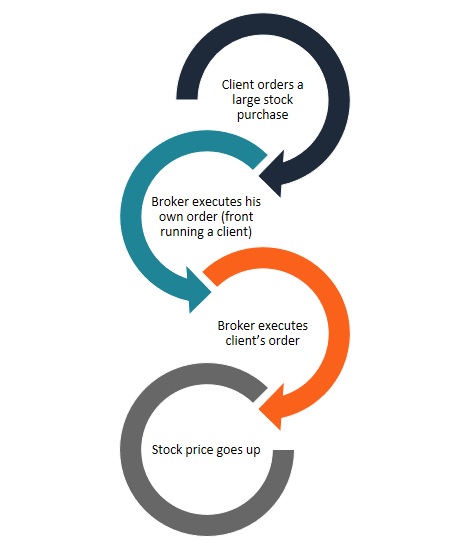
Examples of Front Running
#1 Anticipating large future transactions
Front running is usually committed by brokersTypes of Markets - Dealers, Brokers, ExchangesMarkets include brokers, dealers, and exchange markets. Each market operates under different trading mechanisms, which affect liquidity and control. The different types of markets allow for different trading characteristics, outlined in this guide or brokerage firms and is considered the most common kind of front running. A broker receives an order from a client to purchase 100,000 shares in Company A. The broker knows that the large buy transaction is likely to drive up the price of the company’s stock. Thus, he decides to purchase for himself 2,000 shares in Company A before executing the client’s order.
He buys 2,000 shares at $10 per share and then executes the client’s order. Immediately after the execution of the client’s order, the stock price jumps to $13 per share. Then, the broker sells his 2,000 shares at $13 per share, earning a profit of $6,000. In such a scenario, the broker commits unethical and illegal activity by breaching his fiduciary dutyRevlon RuleThe Revlon Rule addresses conflicts of interest where the interests of the board of directors conflict with their fiduciary duty. to his client.
#2 Anticipating news affecting the price of a security
An individual possessing non-public knowledge of an upcoming event that will affect the price of a security can execute a trade before the information is provided to the public. For example, an analyst prepares an investment recommendationInvestment TeaserAn Investment Teaser is a one- or two-page professional document that is used to introduce an acquisition or investment opportunity to strategic or financial buyers. The teaser is an important document in the transaction process as it is the first document that prospective buyers see report about Tesla Inc. The report is still to be distributed to the clients, and the analyst knows that the report states a strong BUY recommendation.
Anticipating that after the publication of the report, many investors will buy Tesla’s stock and the stock’s price will increase, the analyst decides to buy the company’s stock before the report becomes available to the public. Thus, the analyst will make a profit after the stock price increases.
#3 Index front running
Index front running is not illegal and is utilized as a trading strategy. Index funds, which shadow the market indices, are becoming extremely significant in financial markets. Whenever a new stock is added to a market index (e.g., S&P 500), the announcement is made before the stock is actually added.
For example, S&P 500 announces that Hi-Tech Inc. will be added to the index in the next day. The next day, high-frequency tradersMomentum InvestingMomentum investing is an investment strategy aimed at purchasing securities that have been showing an upward price trend or short-selling securities that may quickly purchase the company’s shares before the index funds are able to buy the company’s stock. The index funds will push the stock price up because of the large volume of their orders. Therefore, the high-frequency traders profit from the front running the index funds.
Additional resources
Thank you for reading CFI’s explanation of front running. CFI is the official provider of the Financial Modeling & Valuation AnalystBecome a Certified Financial Modeling & Valuation Analyst (FMVA)®CFI's Financial Modeling and Valuation Analyst (FMVA)® certification will help you gain the confidence you need in your finance career. Enroll today! designation for financial analysts. To continue learning and advancing your career, these additional resources will be helpful:
- Insider TradingInsider TradingInsider trading refers to the practice of purchasing or selling a publicly-traded company’s securities while in possession of material information that is
- Long and Short PositionsLong and Short PositionsIn investing, long and short positions represent directional bets by investors that a security will either go up (when long) or down (when short). In the trading of assets, an investor can take two types of positions: long and short. An investor can either buy an asset (going long), or sell it (going short).
- Stock Investment StrategiesStock Investment StrategiesStock investment strategies pertain to the different types of stock investing. These strategies are namely value, growth and index investing. The strategy an investor chooses is affected by a number of factors, such as the investor’s financial situation, investing goals, and risk tolerance.
- Trading MechanismsTrading MechanismsTrading mechanisms refer to the different methods by which assets are traded. The two main types of trading mechanisms are quote driven and order driven trading mechanisms
-
Banker's Acceptance: Definition, Function & Key Features
A banker’s acceptance refers to a financial instrument that represents a promised future payment from a bank. It states the name of the entity to which the funds need to be transferred, along wi
-
Barrier Options: Understanding and Trading Strategies
A barrier option is a type of derivative option contract, the payoff of which depends on the value of the underlying asset. In other words, the payoff only comes into effect if the asset underlying th
invest
- PC Banking: A Comprehensive Guide to Online Banking Security & Features
- IRA CDs: Secure Retirement Savings with FDIC Insurance
- Understanding the DU: Your Mortgage Approval Explained
- Decentralized Finance (DeFi): A Comprehensive Overview
- Jumbo CDs: Higher Rates & Deposits Explained
- Understanding Cryptocurrency: A Beginner's Guide to Digital Currency
- DB(k) Plans: A Hybrid Retirement Solution for Employers & Employees
- Understanding Regulation Z: Your Rights as a Borrower
- DeFi Explained: A Beginner's Guide to Decentralized Finance
-
 Understanding Average Return: A Simple Guide
Average return is the mathematical average of a sequence of returns that have accrued over time. In its simplest terms, average return is the total return over a time period divided by the number of p...
-
 Backtesting: A Comprehensive Guide to Strategy Validation
Backtesting involves applying a strategy or predictive model to historical data to determine its accuracy. It can be used to test and compare the viability of trading strategies so tradersSix Essentia...