
Barrier Options: Understanding and Trading Strategies
A barrier option is a type of derivative option contract, the payoff of which depends on the value of the underlying asset. In other words, the payoff only comes into effect if the asset underlying the barrier option’s reached or exceeded a predetermined price specified in the option contractOptions: Calls and PutsAn option is a derivative contract that gives the holder the right, but not the obligation, to buy or sell an asset by a certain date at a specified price..
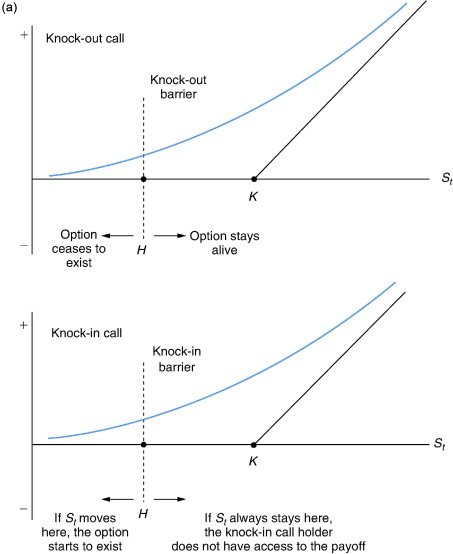
A barrier option can expire worthless (knock-out option) should the price of the underlying asset exceed a certain price, thus limiting profit for the option holder and limiting losses for the option writer (seller). The barrier option can be a knock-in option, which means it lacks any value until the moment the underlying asset strikes a particular price.
How Does a Barrier Option Work?
A barrier option is considered an exotic optionExotic OptionsExotic options are the classes of option contracts with structures and features that are different from plain-vanilla options (e.g., American or European options). Exotic options are different from regular options in their expiration dates, exercise prices, payoffs, and underlying as as it comes with more features than regular American and European options. Barrier options are also referred to as path-dependent options since their value fluctuates along with the value of the underlying assets.
The option can be exercised when the price of the underlying asset crosses a predetermined price point barrier.
Classification of Barrier Options
Barrier options are classified into the following:
1. Knock-in barrier option
A knock-in barrier option is a barrier option where the associated rights commence once an underlying asset reaches a certain price. It means the holder can exercise the option only at and after the moment the price hits a particular level in the open market.
If the knock-in price level is hit anytime during the life of the barrier option’s contract, then it becomes a vanilla option and is priced appropriately. If the knock-in price level is never reached, the knock-in barrier option expires worthless.
Knock-in barrier options are further classified into up-and-in or down-and-in options. In an up-and-in barrier option, the option contract starts only when the price of the underlying asset exceeds the predetermined price barrier. Conversely, if it is a down-and-in barrier option, it turns valid as the underlying asset value drops below the initially set barrier price.
2. Knock-out barrier option
As far as knock-out barrier options are concerned, their validity ceases when the underlying asset hits a barrier during the time horizon of the contract. Knock-out barrier options can also be further decomposed into up-and-out or down-and-out options.
An up-and-out option stops existing when the underlying security moves above the barrier that was set above the initial price of the underlying security.
A down-and-out option stops existing when the underlying security moves below the barrier that was set below the initial price of the underlying security. If an asset underlying the barrier option strikes the barrier anytime during the option’s life, the option is terminated or knocked out.
Examples of Barrier Options
Let us look at two examples of barrier options in action:
Assume an investor is purchasing an up-and-in call optionCall OptionA call option, commonly referred to as a "call," is a form of a derivatives contract that gives the call option buyer the right, but not the obligation, to buy a stock or other financial instrument at a specific price - the strike price of the option - within a specified time frame. with a strike price of $40 and a barrier price of $50. The current underlying asset’s price is $50. The barrier option will be invalid until the underlying stock exceeds the price level of $65.
The investor pays for the option, which means he will lose money if the barrier option expires worthless. It will expire worthless if the underlying asset’s value will not reach and move above $65 during the life of the option contract.
Now, assume a trader obtained an up-and-out put optionPut OptionA put option is an option contract that gives the buyer the right, but not the obligation, to sell the underlying security at a specified price (also known as strike price) before or at a predetermined expiration date. It is one of the two main types of options, the other type being a call option.. The barrier of the put option is $30, and the strike price is $27. The underlying security is now trading at $23.
The security rises above $30, and thus, the option ceases to exist. It becomes worthless even if it only briefly surpassed the $30 threshold.
Additional Resources
CFI is the official provider of the Commercial Banking & Credit Analyst (CBCA)™Program Page - CBCAGet CFI's CBCA™ certification and become a Commercial Banking & Credit Analyst. Enroll and advance your career with our certification programs and courses. certification program, designed to transform anyone into a world-class financial analyst.
In order to help you become a world-class financial analyst and advance your career to your fullest potential, these additional resources will be very helpful:
- American vs European vs Bermudan OptionsAmerican vs European vs Bermudan OptionsThere are different types of options that differ in terms of their exercise restrictions. Let’s explore American vs European vs Bermudan options to find out
- HedgingHedgingHedging is a financial strategy that should be understood and used by investors because of the advantages it offers. As an investment, it protects an individual’s finances from being exposed to a risky situation that may lead to loss of value.
- Rolling LEAP OptionsRolling LEAP OptionsRolling LEAP options refers to extending the trading duration of stock options to the next trading period. Investors rollover options to manage a winning or losing position. In a losing position, they extend the time to hopefully prevent losses before they close the position.
- Strike PriceStrike PriceThe strike price is the price at which the holder of the option can exercise the option to buy or sell an underlying security, depending on
-

Understanding Non-Equity Options: A Comprehensive Guide
A non-equity option is an option with an underlying asset that is something other than common stock. In most cases, non-equity options include indexes and commodities as underlying assets. It’s
-

Put Options Explained: A Comprehensive Guide for Investors
A put option is an option contract that gives the buyer the right, but not the obligation, to sell the underlying security at a specified price (also known as strike priceStrike PriceThe strike price
invest
- What is a Stock Option?
- Call Options: A Comprehensive Guide for Investors
- Currency Option Bonds: Understanding Flexible Investments
- Understanding Delta: A Key Risk Measure in Derivatives
- Understanding Digital Options: A Comprehensive Guide for Traders
- Understanding Gamma in Finance: A Comprehensive Guide
- Understanding Option Premiums: A Comprehensive Guide
- Compound Options: A Comprehensive Guide to Investment Strategies
- Understanding Option Spreads: A Risk Management Strategy
-
 Naked Puts: Definition, Strategy & Risks - Investopedia
A naked put refers to a situation where an investor sells a put option without already having an equivalent short position in the option’s underlying security. It is one of the ways that an inve...
-
 Understanding Near-The-Money Options: A Comprehensive Guide
Near-the-money means that an option contract’s stock price is close to its strike priceStrike PriceThe strike price is the price at which the holder of the option can exercise the option to buy ...