
Understanding Frothy Markets: Risks & Opportunities
A frothy market, a common Wall Street jargon, refers to a market condition where asset prices are notably detached from their true intrinsic valueIntrinsic ValueThe intrinsic value of a business (or any investment security) is the present value of all expected future cash flows, discounted at the appropriate discount rate. Unlike relative forms of valuation that look at comparable companies, intrinsic valuation looks only at the inherent value of a business on its own.. Simply put, a frothy market is a market that is exhibiting unsustainable rapid price appreciation. If unresolved, it precedes a market bubble and a subsequent market bubble burst (market crash).

Summary
- A frothy market refers to a market condition where the underlying assets exhibit unsustainable rapid price appreciation.
- It occurs when market participants are overconfident in existing market conditions and bid up the underlying asset prices to a point where it is decoupled from its true intrinsic value.
- Key signs of a frothy market include: (1) asset prices rising in a parabolic manner over a short time period on no basis and (2) asset prices rising regardless of perceived valuation.
The Popularization of the Term ‘Frothy Market’
The origin of the term “frothy market” is undetermined, but it was popularized by then-Federal Reserve Chair Alan Greenspan in his description of the U.S. housing market in 2005. Since then, the term’s increasingly been used by market participants and the media.
In an April 2021 press conference, Federal Reserve Chair Jerome Powell used the same term – stating that “we are seeing things in the capital markets Capital MarketsCapital markets are the exchange system platform that transfers capital from investors who want to employ their excess capital to businessesthat are a bit frothy.”
Understanding a Frothy Market
A frothy market typically occurs when market participants are overconfident in existing market conditions and, as a result, bid up the underlying asset prices to a point where it is decoupled from its true intrinsic value.
It is important to note that the true intrinsic value of assets is unobservable, so there is not a benchmark to compare against to determine the level of existing market froth.
Key signs of a frothy market include: (1) asset prices rising in a parabolic manner over a short time period, and (2) asset prices rising regardless of their perceived valuation.
Practical Example
Special purpose acquisition companies (SPACs) started to become extremely popular in the markets in 2020 due to it being seen as an attractive go-public route for private companies versus an initial public offering (IPO)Initial Public Offering (IPO)An Initial Public Offering (IPO) is the first sale of stocks issued by a company to the public. Prior to an IPO, a company is considered a private company, usually with a small number of investors (founders, friends, family, and business investors such as venture capitalists or angel investors). Learn what an IPO is.
A number of high-profile SPAC deals, such as the Virgin Galactic and DraftKings deals, attract significant investor interest, causing market participants to significantly bid up the prices of SPACs.
The following shows the SPAC Index, which is a benchmark for the performance of a broad universe of SPACs, from July 30, 2020, to June 15, 2021.
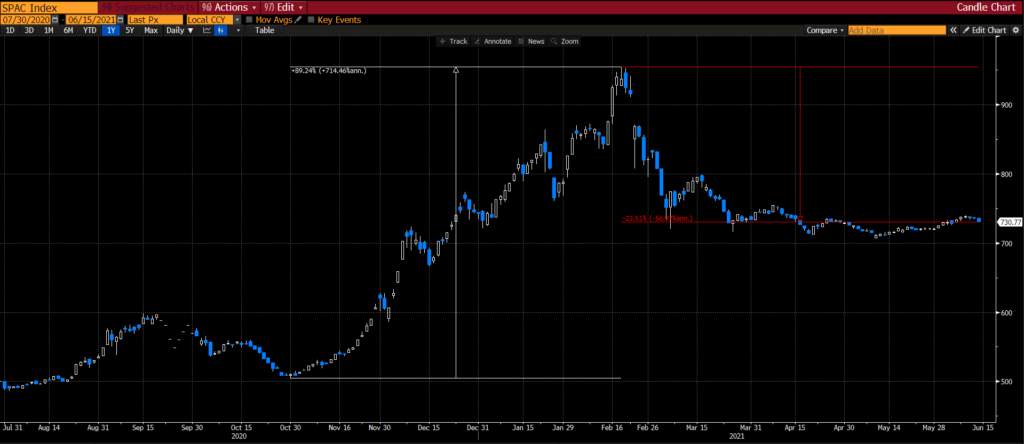
The SPAC universe had shown some signs of frothiness – rising nearly 90% from October 30 to February 21 (a four-month period). Subsequently, SPACs faced a sharp correction, falling nearly 25% over the next couple of months.
Frothy Market as a Precursor to a Market Bubble
Continued market frothiness, if unresolved, is a common precursor to a market bubble. A market bubble, in the context of a frothy market, can be characterized as a market that is continually exhibiting unsustainable rapid price appreciation.
In the transition from a frothy market to a market bubble, investor confidence is at an exorbitantly high level, and asset prices are being bid up to relatively high record levels.
Two notable examples of a market bubble were the 2000 dot-com bubble and the 2008 U.S. housing bubble.
Frothy Market in the News
On February 10, 2021, an article was published on CNBC outlining that the stock market was inching towards a frothy environment. In the article, CNBC’s Jim Cramer cited the following signs of a frothy market: (1) people are getting too greedy (i.e., investor overconfidence) and (2) stocks going through enormous rallies that are disconnected from the underlying fundamentals.
Related Readings
CFI offers the Capital Markets & Securities Analyst (CMSA)®Program Page - CMSAEnroll in CFI's CMSA® program and become a certified Capital Markets &Securities Analyst. Advance your career with our certification programs and courses. certification program for those looking to take their careers to the next level. To keep learning and advance your career, the following resources will be helpful:
- Stock Market CrashStock Market CrashA stock market crash refers to a drastic, often unforeseen, drop in the prices of stocks in the stock market. The sudden drop in stock prices
- Price AppreciationPrice AppreciationPrice appreciation in real estate refers to the increase in the value of a real estate property over a period of time. One of the goals of investing in real
- Dotcom BubbleDotcom BubbleThe dotcom bubble is a stock market bubble that was caused by speculation in dotcom or internet-based businesses from 1995 to 2000.
- Main Street vs. Wall StreetMain Street vs. Wall Street“Main Street vs Wall Street” is used to describe the contrast of general consumers, investors, or small local businesses with large investment corporations
-

Trading Volume: Understanding & Significance
The term “volume” in trading refers to the total number of shares that are traded during a given period of time. The volume of trade is measured on all types of financial commodities, incl
-
Understanding Bear Markets: What Investors Need to Know
The securities market can’t climb forever. Eventually prices will begin to fall. We call this period of decline a “bear market.” It’s not the end of the world for investors, but it’s a concept you sho
invest
- Understanding Auction Markets: How Prices Are Determined
- Doji Candlestick Pattern: Meaning & Trading Signals
- Understanding Inefficient Markets: Causes & Implications
- Understanding Market Cycles: Trends & Economic Environments
- Understanding Market Depth: A Guide for Traders
- Understanding Market Exposure: Risk & Portfolio Allocation
- Understanding Market Indexes: A Comprehensive Guide
- Understanding Market Makers: How They Fuel Liquidity
- Understanding Market Manipulation: Definition, Tactics & SEC Role
-
 Sensex Explained: Understanding India's Key Stock Market Index
Sensex, also known as the S&P BSE Sensex Index, is the benchmark index that tracks India’s Bombay Stock Exchange (BSE). The Sensex is composed of the 30 largest and most-traded stocks within...
-
 Understanding Algorithmic Trading Spoofing: Definition & Impact
Spoofing is a disruptive algorithmic trading practice that involves placing bids to buy or offers to sell futures contractsFutures ContractA futures contract is an agreement to buy or sell an underlyi...