
Understanding Mortgage Servicing Rights (MSR): A Comprehensive Guide
Mortgage servicing rights (MSR) are a specific arrangement where a third party promises to collect mortgage payments on behalf of a lender in exchange for a fee.

Mortgage Servicing Rights Explained
A mortgage is a form of a loan or debt instrument that is secured by the collateralCollateralCollateral is an asset or property that an individual or entity offers to a lender as security for a loan. It is used as a way to obtain a loan, acting as a protection against potential loss for the lender should the borrower default in his payments. of a piece of real estate property. If a party wishes to purchase property but lacks enough funds to purchase the property, a lender can offer the purchaser a mortgage loan.
Mortgage loans are used to pay for the property; however, the borrower now owes the lender the principal (amount borrowed) and interest (compensation for lending). The lender is secured because if the borrower defaults or unable to repay the loan, the lender can take possession of the property and sell it to cover its loss.
As mortgage payments are made over the term of a mortgage, there are associated administrative duties and tasks known as mortgage servicing rights. The tasks include the following:
- Collecting monthly payments
- Allocating principalPrincipal PaymentA principal payment is a payment toward the original amount of a loan that is owed. In other words, a principal payment is a payment made on a loan that reduces the remaining loan amount due, rather than applying to the payment of interest charged on the loan. and interest to each payment
- Managing insurance fees
- Managing property tax payments
A mortgage lender may outsource the tasks to a third party in exchange for a fee. The third-party will then collect monthly payments, allocate the principal and interest, manage insurance fees, etc. on behalf of the mortgage lender. It is important to note that the third party maintains the right to collect the payments but does not keep the payments. The payments must still be sent back to the original mortgage lender.
For the borrower, the substance of the original contractual arrangement with the lender remains the same. The only difference would be that the borrower is now sending payments to a third-party instead of the lender. In addition, the point of contact for information about the mortgage would be the third-party company as well.
Practical Example
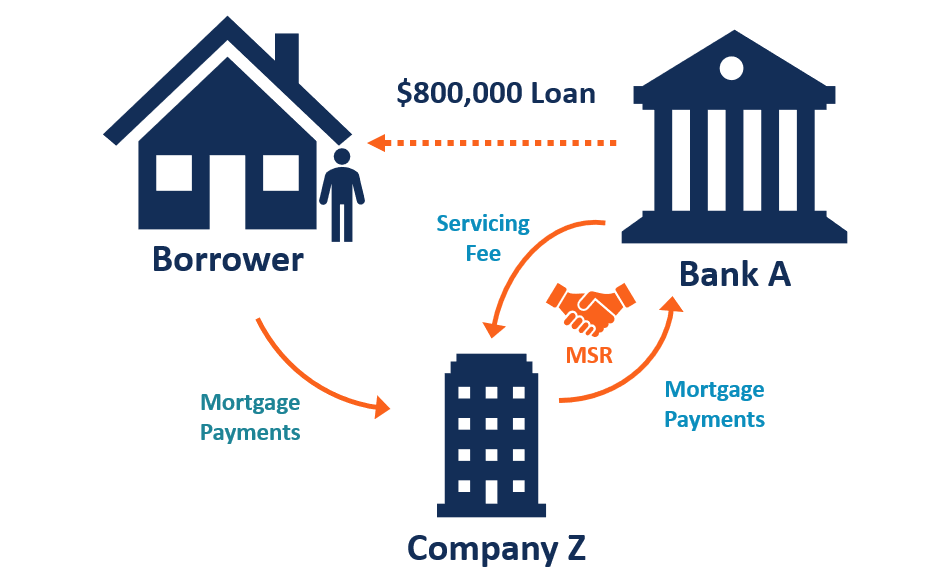
As an example, consider an individual who wishes to purchase a $1,000,000 property. The individual puts a down payment of $200,000 and borrows the remaining $800,000 in the form of a mortgage loan from Bank A. The mortgage term is over 25 years, and the individual pays a fixed interest rate of 5%.
Each month, the individual sends the mortgage lender a payment with the principal and interest included. However, within ten years, the mortgage lender does not wish to hire employees to process mortgage payments anymore.
The mortgage lender proceeds to transfer its mortgage servicing rights to a third-party company, Company Z. Through the arrangement, Company Z will collect the mortgage payments on behalf of Bank A from the individual. Bank A will compensate Company Z for their services with a flat feeService ChargeA service charge, also called a service fee, refers to a fee collected to pay for services that relate to a product or service that is being purchased..
Importance of MSRs
Most banks and mortgage lenders originate a very high volume of mortgages to many different individual borrowers. Therefore, it can become very costly and time-consuming for the mortgage lenders to service each of the loans.
By transferring mortgage servicing rights, it allows banks and mortgage lenders to devote more resources to their primary business of originating and disbursing new mortgage loans.
In addition, the third-party servicing company can earn a profit without having to bear any risk of owning mortgage loans – they simply specialize in the collection of payments and other mortgage servicing activities.
Performance of MSRs
Mortgage servicing rights represent a significant revenue source for many independent mortgage banking companies and community banks.
Given the dynamic interest rate environments, mortgage servicing rights create a natural hedge or protection on the supply side of the mortgage lending business. When interest ratesInterest RateAn interest rate refers to the amount charged by a lender to a borrower for any form of debt given, generally expressed as a percentage of the principal. rise, there are fewer prepayments, and the value of mortgage servicing rights increases. However, when interest rates are low, the prepayment speed increases, and the value of mortgage servicing rights decrease.
Prepayments are when a borrower decides to pay back more than the required principal according to a loan agreement. When interest rates are low, borrowers may wish to prepay their loans quickly so that they can refinance at a lower interest rate. The reverse is true when interest rates are high; borrowers will not want to prepay their loans and refinance at a higher interest rate. It poses a risk to mortgage lenders, which they can offload to a third party with mortgage servicing rights.
Additional Resources
CFI offers the Commercial Banking & Credit Analyst (CBCA)™Program Page - CBCAGet CFI's CBCA™ certification and become a Commercial Banking & Credit Analyst. Enroll and advance your career with our certification programs and courses. certification program for those looking to take their careers to the next level. To keep learning and developing your knowledge base, please explore the additional relevant resources below:
- Administrative Services Only (ASO)Administrative Services Only (ASO)Administrative Services Only (ASO) is a plan provided to administer employee health claims. ASO involves hiring an external services provider, called third-
- Debt Service Reserve Account (DSRA)Debt Service Reserve Account (DSRA)The Debt Service Reserve Account (DSRA) is a reserve account used to pay debt, when available funds are below the necessary amount.
- Loan ServicingLoan ServicingLoan servicing is the way a finance company (a lender) goes about collecting principal, interest, and escrow payments that are due or overdue.
- Success FeeSuccess FeeIn finance, a success fee is a commission paid to an advisor (typically an investment bank) for successfully completing a transaction. The fee is contingent on successfully helping the client achieve their goal, and thus aligns the interests of the client and the advisor. Typically a percentage of the deal value
-
![Defensive Industries: Stability in Economic Uncertainty | [Your Company Name]](https://www.etffin.com/article/uploadfiles/202110/2021100815224423_S.jpeg)
Defensive Industries: Stability in Economic Uncertainty | [Your Company Name]
Defensive industries comprise businesses that are relatively stable or relatively immune to economic fluctuations, i.e., economic expansions and recessionsRecessionRecession is a term used to signify
-

Understanding Financial Derivatives: A Comprehensive Guide
Derivatives are financial contracts whose value is linked to the value of an underlying assetTypes of AssetsCommon types of assets include current, non-current, physical, intangible, operating, and no
invest
- Mortgage Reinscription in Louisiana: What You Need to Know
- Understanding Mortgage Clauses: Protecting Lender Interests
- Understanding the DU: Your Mortgage Approval Explained
- Understanding Dissenters' Rights: Protecting Shareholder Value
- Non-Recourse vs. Recourse Loans: Understanding the Difference
- Understanding Registration Rights: Investor Protection & SEC Compliance
- Non-Renounceable Rights: Understanding Shareholder Options
- Pro-Rata Rights: Understanding Investor Participation in Funding Rounds
- Mortgage Bonds: Understanding Real Estate-Backed Investments
-
 Understanding Bonds: A Comprehensive Guide for Investors
Bonds are fixed-income securitiesTrading & InvestingCFIs trading & investing guides are designed as self-study resources to learn to trade at your own pace. Browse hundreds of articles on trad...
-
 Understanding Commodities: A Beginner's Guide to Investing
Commodities are another class of assets just like stocks and bondsBondsBonds are fixed-income securities that are issued by corporations and governments to raise capital. The bond issuer borrows capit...