
Pro-Rata Rights: Understanding Investor Participation in Funding Rounds
Pro-rata participation rights, or pro-rata investing rights, guarantee existing investors the right to participate in future fundraising activities. Pro-rata participation rights allow private investors to maintain and/or expand their share of a business by participating in future funding roundsVenture Capital InvestingVenture capital investing is a type of private equity investing that involves investment in a business that requires capital. The business often requires capital for initial setup (or expansion). Venture capital investing may be done at an even earlier stage known as the "idea phase".. As a result, the rights allow private investors to protect against a loss of control stemming from an inflow of new investors.
How They Work
Consider the following example: A private equity investorPrivate Equity vs Venture Capital, Angel/Seed InvestorsCompare private equity vs venture capital vs angel and seed investors in terms of risk, stage of business, size & type of investment, metrics, management. This guide provides a detailed comparison of private equity vs venture capital vs angel and seed investors. It's easy to confuse the three classes of investors just put in $10 million into a tech start-up for a 25% share of the business. If the investor is guaranteed pro-rata participation rights, then he is given the right to participate in future rounds of funding where the investor can choose to maintain his 25% share or to increase his share beyond 25%.
Pro-rata participation rights don’t guarantee that an investor will be able to maintain and/or expand their share of the business. It simply guarantees that an investor will be given the opportunity to maintain and/or expand their share of the business. For example, an investor with such rights might get priced out by other investors in future funding rounds. The rights are typically offered to investors who are willing to commit larger amounts of capital.
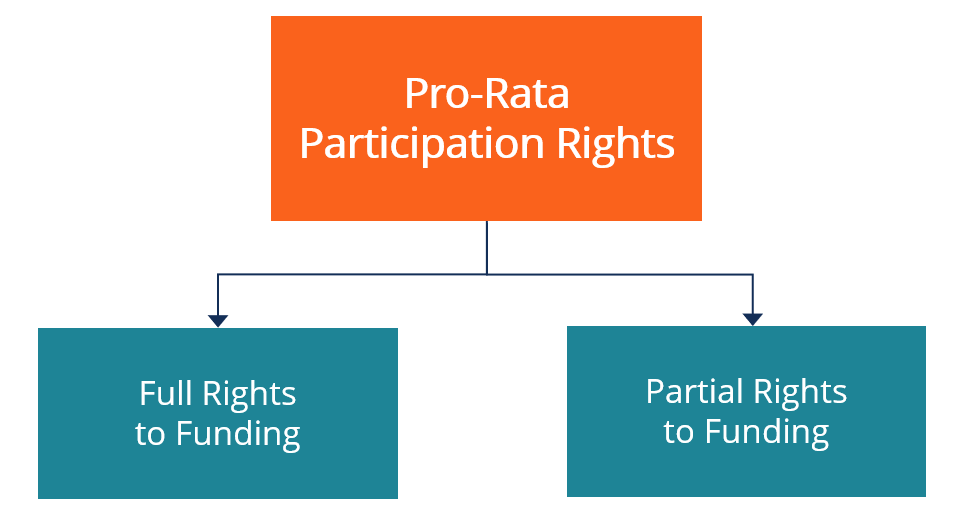
Types of Pro-Rata Participation Rights
1. Full Rights to Funding
Full pro-rata participation rights give private investors the right to increase their share of a business by taking part in future fundraising activities.
2. Partial Rights to Funding
Partial pro-rata participation rights give private investors the right to maintain their share of a business by taking in part in future fundraising activities.
Illustrative Example – Pro-Rata Participation Rights
A tech startup raises $10 million capital in its first round of funding. A private investor put in $100,000 for a 1% share in the start-up. The tech start-up also guaranteed partial pro-rata participation rights for its next round of funding to all investors who put in at least $50,000 in the first round and full pro-rata participation rights for its next round of funding to all investors who put in at least $2,500,000 in the first round.
After increasing its capital to $15 million, the start-up holds another round of funding for $5 million. Let us calculate what amount the private investor is entitled to buy.
At the start of the second round of funding, the investor owns 1% of a $15 million business. Therefore, the investor’s initial $100,000 investment increases by 50%. It is not surprising given that the business has grown by 50%. If the investor chooses to not participate in the second round of funding, he would own $150,000 of a $20-million business or 0.75%.
Pro-rata participation rights guarantee the investor the right to maintain his 1% share in the business. It means that the investor has the right to $50,000 (or 1% of the second round of funding) to maintain his 1% share of the business.
Consider a second private investor who invested $5 million for a 50% share in the same tech startup. At the start of the second round of funding, the investor owns 50% (or $7.5 million) of the $15-million business. The investor has the right to take part in the next round of funding and increase his share of the business. If the investor purchases the entire amount, he will increase his share in the business by 25% from 50% to 62.5%.
Related Readings
CFI is the official provider of the Financial Modeling and Valuation Analyst (FMVA)™ Become a Certified Financial Modeling & Valuation Analyst (FMVA)®CFI's Financial Modeling and Valuation Analyst (FMVA)® certification will help you gain the confidence you need in your finance career. Enroll today!certification program, designed to transform anyone into a world-class financial analyst.
To keep learning and developing your knowledge of financial analysis, we highly recommend the additional resources below:
- Capital Raising ProcessCapital Raising ProcessThis article is intended to provide readers with a deeper understanding of how the capital raising process works and happens in the industry today. For more information on capital raising and different types of commitments made by the underwriter, please see our underwriting overview.
- Private Equity FundsPrivate Equity FundsPrivate equity funds are pools of capital to be invested in companies that represent an opportunity for a high rate of return. They come with a fixed
- Seed FinancingSeed FinancingSeed financing (also known as seed capital, seed money, or seed funding) is the earliest stage of the capital-raising process of a startup. Seed financing is a type of equity-based financing. In other words, investors commit their capital in exchange for an equity interest in a company.
- Series A FinancingSeries A FinancingSeries A financing (also known as series A round or series A funding) is one of the stages in the capital-raising process by a startup. Essentially, the series A round is the second stage of startup financing and the first stage of venture capital financing.
-

Understanding Business Structures: A Comprehensive Guide
There are different types of businesses to choose from when forming a company, each with its own legal structure and rules. Typically, there are four main types of businesses: Sole ProprietorshipsSole
-

Essential Business Metrics: 35 KPIs to Drive Growth & Profitability
Companies can improve their profitability in three ways: generate more revenue for a given cost, generate the same revenue for a lower cost or both. All methods require measuring and tracking operatio
invest
- Understanding Business Metrics: Key Performance Indicators & KPIs
- Understanding Material Participation Tests: IRS Requirements
- Non-Operating Assets: Definition, Examples & Financial Impact
- Understanding Registration Rights: Investor Protection & SEC Compliance
- Non-Renounceable Rights: Understanding Shareholder Options
- Understanding Fixed Charges: A Comprehensive Guide
- Understanding Business Overheads: Costs & Examples
- Business Operations: Definition, Activities & Optimization
- Exit Strategies: Planning Your Business's Future
-
 Understanding Bank Business Segments: Retail, Wholesale & Wealth Management
A bank’s major business segments are retail banking, wholesale banking, and wealth managementPrivate Wealth ManagementPrivate wealth management is an investment practice that involves financial ...
-
 Special Drawing Rights (SDRs): Explained | IMF
Special Drawing Rights, often referred to as SDRs, are an interest-bearing international reserve asset used by the International Monetary FundInternational Monetary Fund (IMF)The International Monetar...