
Understanding the Morningstar Sustainability Rating: A Guide for Investors
The Morningstar Sustainability Rating is a consistent and objective way for investors to evaluate mutual fundsMutual FundsA mutual fund is a pool of money collected from many investors for the purpose of investing in stocks, bonds, or other securities. Mutual funds are owned by a group of investors and managed by professionals. Learn about the various types of fund, how they work, and benefits and tradeoffs of investing in them and exchange-traded funds (ETFs) based on their environmental, social, and corporate governance (ESG) impact.
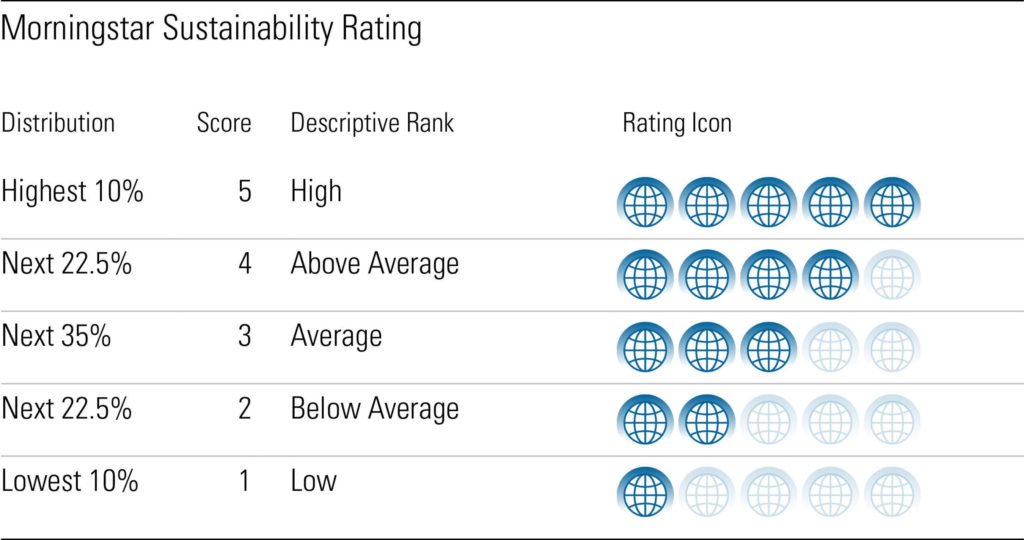
Implemented in 2016, the Morningstar Sustainability Rating is a rating out of five globes, instead of stars. It indicates whether the fund or investment is rated as the lowest (one globe), below average (two globes), average (three globes), above average (four globes), or highest (five globes) among its comparable industry group. Users can find sustainability ratings on the Morningstar website’s fund quote pages. The ratings are reissued monthly.
Environmental, Social, and Governance (ESG)
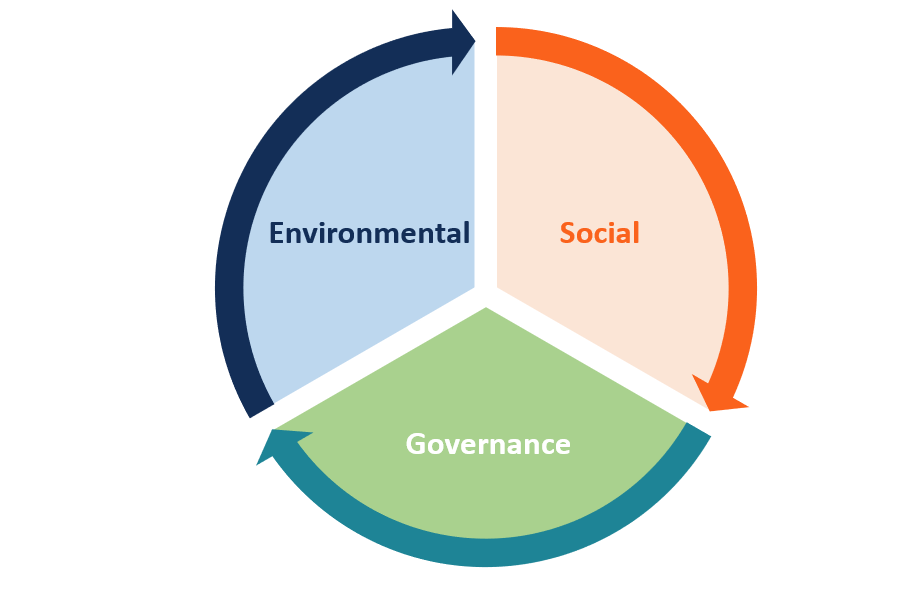
Environmental, social, and governanceESG (Environmental, Social and Governance)ESG is the acronym for Environmental, Social, and Governance, the three broad categories of interest for what is termed socially responsible investors. are the three primary factors when measuring sustainability and the societal impact of investments. Investors are becoming more conscious of ESG factors when making investments, and some would argue that companies with a higher consideration for ESG factors tend to outperform companies that do not.
Environmental
Environmental concerns are focused on areas such as climate change and sustainabilitySustainabilitySustainability is basically the ability to provide for the needs of the current generation using available resources without causing the future generations. Often, they include consideration of externalities, such as carbon emissions from fossil fuels and diminishing the finite raw materials of the planet.
Social
Social concerns are focused on areas such as diversity, human rights, consumer protection, and animal welfare.
Governance
Corporate governance concerns are focused on areas such as management structureCorporate StructureCorporate structure refers to the organization of different departments or business units within a company. Depending on a company’s goals and the industry, employee relations, executive compensation, and employee compensation.
Morningstar Sustainability Rating Explained
Morningstar implemented the sustainability rating system due to the increased prominence of responsible investing and sustainable investing.
The rating system is based on two components that are developed by Sustainalytics, a subsidiary company of Morningstar. Sustainalytics specializes in rating listed companies based on their ESG performance. The two components evaluated are:
- ESG Scores
- ESG Controversies
ESG Scores
Funds are given an ESG score based on evaluating the underlying companies’ preparedness, disclosure, and performance. Companies within the fund’s portfolio are graded on a scale of 0 to 100 that is relative to other companies within the global industry peer group.
Based on the scoring system, a score of 0 is the worst possible score, a score of 50 is an average score, and the score of 100 is the best possible score.
ESG Controversies
ESG controversies include research that identifies companies within the funds that have been involved with incidents that negatively impact stakeholders, the environment, or the company’s operations. They can include things such as:
- Legal troubles (discrimination or scandal lawsuits)
- Environmental damage (oil spills)
- Fraudulent behavior (accounting fraud)
Sustainalytics provides a controversy rating from one to five on companies and provides an associated assessment as well.
Conditions
In order for Morningstar to give a mutual fund or an ETFExchange Traded Fund (ETF)An Exchange Traded Fund (ETF) is a popular investment vehicle where portfolios can be more flexible and diversified across a broad range of all the available asset classes. Learn about various types of ETFs by reading this guide. a sustainability rating, at least half of the fund’s assets under management (AUM) must come with a company ESG score. The Morningstar Sustainability Rating then takes the score of the portfolio and reduces any points that arise from ESG controversies.
Morningstar Sustainability Rating Insights
According to Morningstar, the mutual funds and ETFs that maintain higher sustainability ratings are of a higher-quality and are more sustainable long-term holdings. Therefore, these funds allocate capital to companies that are more favored, less volatile, and maintain a wide economic moat.
With the Morningstar Sustainability Rating, investors can find the ideal investment funds for their individual risk-return profiles while still maintaining a portfolio tilt towards socially responsible investing.
Socially Responsible Investing/Sustainable Investing
Socially responsible investing is known as sustainable, ethical, or “green” investing. It involves the consideration of various ESG factors within an investment strategy that seeks to both increase financial returns, but also to promote positive environmental/social changes in the world while maintaining transparent and effective corporate governance.
Under the investing philosophy, practitioners emphasize ESG concerns to identify higher-quality companies. Essentially, companies that are profitable, but also consider the best interests of society regarding ESG factors, are more sustainable long term, and therefore, will achieve higher risk-adjusted returns in the long run.
Related Readings
CFI offers the Commercial Banking & Credit Analyst (CBCA)™Program Page - CBCAGet CFI's CBCA™ certification and become a Commercial Banking & Credit Analyst. Enroll and advance your career with our certification programs and courses. certification program for those looking to take their careers to the next level. To keep learning and advancing your career, the following resources will be helpful:
- Corporate Social Responsibility (CSR)Corporate Social Responsibility (CSR)Corporate social responsibility (CSR) refers to strategies that companies put into action as part of corporate governance that are designed to
- Environmental LiabilityEnvironmental LiabilityEnvironmental liability refers to the potential environmental costs that a buyer incurs when purchasing or leasing an asset. The liabilities arise when a
- GreenwashingGreenwashingGreenwashing is where a firm spends money advertising and marketing that their goods or services are environmentally friendly when, in fact, they are not
- Negative ExternalitiesNegative ExternalitiesNegative externalities occur when the product and/or consumption of a good or service exerts a negative effect on a third party independent
-

Understanding the January Effect: Stock Market Trends & Causes
The January Effect is known to be a seasonal increase in stock prices throughout the month of January. The increase in demand for stocks is often preceded by a decrease in price during the month of De
-

Understanding the Joseph Effect: Trends vs. Randomness
The Joseph Effect, which derives its name from a Biblical reference, is a phrase created by Benoit Mandelbrot, a Polish-born French-American mathematician. The phrase asserts that variations over time
invest
- Lipper vs. Morningstar Ratings: A Comprehensive Comparison
- CAMELS Rating System: Understanding Bank Financial Health
- Understanding the Investment Accumulation Phase: Building Wealth Over Time
- Dow 30 Explained: Understanding the Dow Jones Industrial Average
- Understanding Morningstar Risk Ratings: A Comprehensive Guide
- Rule of 72: Calculate Investment Doubling Time | [Your Brand Name]
- Understanding Insurance Rating Systems: A Comprehensive Guide
- ESG Investing: A Comprehensive Guide to Environmental, Social, and Governance Factors
- Understanding ESG Governance: The 'G' Factor in Sustainable Investing
-
 Understanding Implied Rates: A Comprehensive Guide
The implied rate is an interest rate that expresses the difference between the forward/future rate and the spot rate. It serves as a useful tool for comparing returns across different assets and can b...
-
 January Barometer: Predicting Market Performance - Explained
The January Barometer is the idea that the investment performance of the S&P 500S&P 500 IndexThe Standard and Poor’s 500 Index, abbreviated as S&P 500 index, is an index comprising t...