
Understanding Over-the-Counter (OTC) Markets
Over-the-counter (OTC) is the trading of securitiesMarketable SecuritiesMarketable securities are unrestricted short-term financial instruments that are issued either for equity securities or for debt securities of a publicly listed company. The issuing company creates these instruments for the express purpose of raising funds to further finance business activities and expansion. between two counterparties executed outside of formal exchanges and without the supervision of an exchangeStock MarketThe stock market refers to public markets that exist for issuing, buying and selling stocks that trade on a stock exchange or over-the-counter. Stocks, also known as equities, represent fractional ownership in a company regulator. OTC trading is done in over-the-counter markets (a decentralized place with no physical location), through dealer networks.
Contrary to trading on formal exchanges, over-the-counter trading does not require the trading of only standardized items (e.g., clearly defined range of quantity and quality of products). Also, prices are not always published to the public. OTC contracts are bilateral, and each party could face credit riskCredit RiskCredit risk is the risk of loss that may occur from the failure of any party to abide by the terms and conditions of any financial contract, principally, concerns regarding its counterparty.
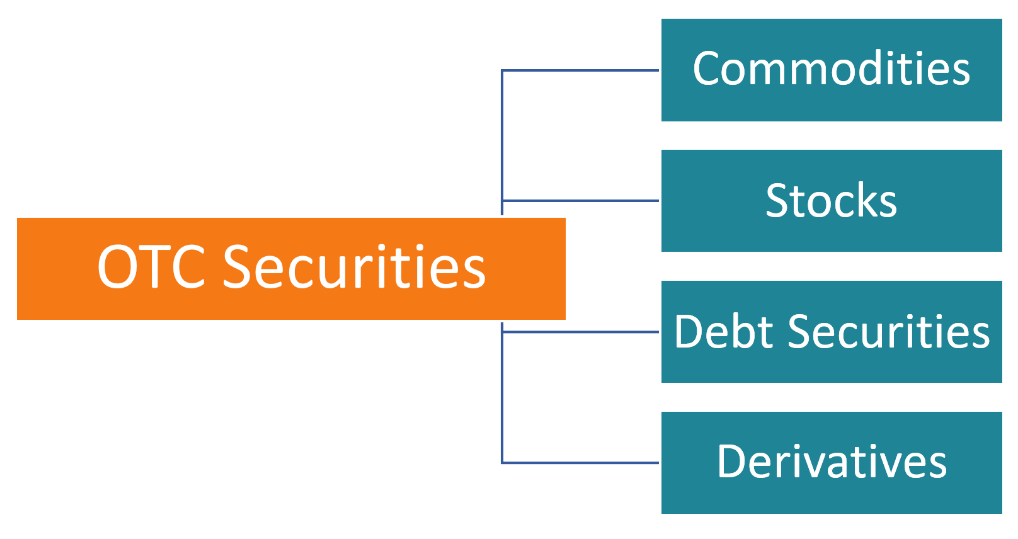
OTC Securities
OTC securities comprise a wide range of financial instruments and commodities. Financial instruments traded over-the-counter include stocksStockWhat is a stock? An individual who owns stock in a company is called a shareholder and is eligible to claim part of the company’s residual assets and earnings (should the company ever be dissolved). The terms "stock", "shares", and "equity" are used interchangeably., debt securities, and derivatives. Stocks that are traded over-the-counter usually belong to small companies that lack the resources to be listed on formal exchanges. However, sometimes even large companies’ stocks are traded over-the-counter.
Derivatives represent a substantial part of over-the-counter trading, which is especially crucial in hedging risks using derivatives. The lack of limitations on the quantity and quality of traded items allows the parties involved in the trading to tailor the specifications of the contracts in the transaction to the risk exposure. Thus, these instruments could be used for a “perfect hedge.”
OTC Networks
In the United States, over-the-counter trading of stocks is carried out through networks of market makers. The two well-known networks are managed by the OTC Markets Group and the Financial Industry Regulation Authority (FINRA). These networks provide quotation services to participating market dealers. The trades are executed by dealers online or via telephone.
The Importance of OTC in Finance
While over-the-counter markets remain an essential element of global finance, OTC derivatives possess exceptional significance. The greater flexibility provided to market participants enables them to adjust derivative contracts to better suit their risk exposure.
Also, OTC trading increases overall liquidity in financial markets, as companies that cannot trade on the formal exchanges gain access to capital through over-the-counter markets.
However, OTC trading is exposed to numerous risks. One of the most significant is counterparty risk – the possibility of the other party’s default before the fulfillment or expiration of a contract. Moreover, the lack of transparency and weaker liquidity relative to the formal exchanges can trigger disastrous events during a financial crisis. The flexibility of derivative contracts design can worsen the situation. The more complicated design of the securities makes it harder to determine their fair value. Thus, the risk of speculation and unexpected events can hurt the stability of the markets.
For example, notorious CDOs and synthetic CDOs that caused a significant impact on the global financial crisis in 2007-2008 were traded only in the OTC markets.
Related Readings
CFI is the global provider of Financial Modeling & Valuation Analyst (FMVA)™Become a Certified Financial Modeling & Valuation Analyst (FMVA)®CFI's Financial Modeling and Valuation Analyst (FMVA)® certification will help you gain the confidence you need in your finance career. Enroll today! certification program and career advancement tools for finance professionals. To learn more and take your skills to the next level, explore the additional resources below:
- Investing: A Beginner’s GuideInvesting: A Beginner's GuideCFI's Investing for Beginners guide will teach you the basics of investing and how to get started. Learn about different strategies and techniques for trading
- Restricted Trading ListRestricted Trading ListSecurities are placed on a bank's restricted list when the bank is engaged with the company on non-public activity, such as mergers and acquisitions work, affiliate ownership, or underwriting activities or other distribution of the issuer's (the company's) securities.
- Trading MechanismsTrading MechanismsTrading mechanisms refer to the different methods by which assets are traded. The two main types of trading mechanisms are quote driven and order driven trading mechanisms
- Types of Markets – Dealers, Brokers, ExchangesTypes of Markets - Dealers, Brokers, ExchangesMarkets include brokers, dealers, and exchange markets. Each market operates under different trading mechanisms, which affect liquidity and control. The different types of markets allow for different trading characteristics, outlined in this guide
-

Understanding Auction Markets: How Prices Are Determined
An auction market is a market where the price is determined by the highest price the buyer is willing to pay (bids), and the lowest price the seller is willing to take (offers). Bids and offers are ma
-
Understanding Loan Lifespan: What is Average Life?
Average life is the length of time that each unit of unpaid principal is expected to remain outstanding. The average life of mortgagesMortgageA mortgage is a loan – provided by a mortgage lender
invest
- PC Banking: A Comprehensive Guide to Online Banking Security & Features
- IRA CDs: Secure Retirement Savings with FDIC Insurance
- Understanding the DU: Your Mortgage Approval Explained
- Decentralized Finance (DeFi): A Comprehensive Overview
- Understanding Over-the-Counter (OTC) Trading: A Comprehensive Guide
- OTCQX Explained: The Premium OTC Stock Market
- Understanding OTC Stocks: Buying and Selling Over-the-Counter Securities
- Understanding the Risks of OTC Stock Trading
- Understanding Cryptocurrency: A Beginner's Guide to Digital Currency
-
 Anchoring Bias: Understanding How First Impressions Influence Decisions
Anchoring bias occurs when people rely too much on pre-existing information or the first information they find when making decisions. For example, if you first see a T-shirt that costs $1,200 – ...
-
 Arbitrage Explained: Understanding and Capitalizing on Price Differences
Arbitrage is the strategy of taking advantage of price differences in different markets for the same assetTypes of AssetsCommon types of assets include current, non-current, physical, intangible, oper...