
Arbitrage Explained: Understanding and Capitalizing on Price Differences
Arbitrage is the strategy of taking advantage of price differences in different markets for the same assetTypes of AssetsCommon types of assets include current, non-current, physical, intangible, operating, and non-operating. Correctly identifying and. For it to take place, there must be a situation of at least two equivalent assets with differing prices. In essence, arbitrage is a situation where a traderThe Winning Mindset of a TraderBeing a master trader is not just about formulating better strategies and analysis but is also about developing a winning mindset. can profit from the imbalance of asset prices in different marketsTypes of Markets - Dealers, Brokers, ExchangesMarkets include brokers, dealers, and exchange markets. Each market operates under different trading mechanisms, which affect liquidity and control. The different types of markets allow for different trading characteristics, outlined in this guide. The simplest form of arbitrage is purchasing an asset in the market where the price is lower and simultaneously selling the asset in the market where the asset’s price is higher.
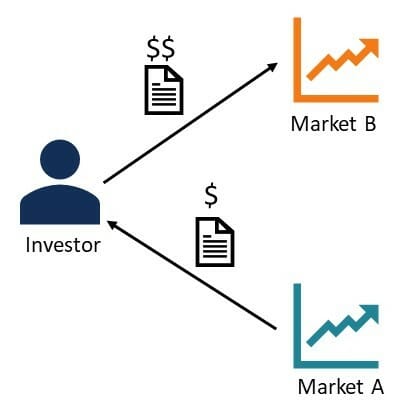
Arbitrage is a widely used trading strategy, and probably one of the oldest trading strategies to exist. TradersSales and Trading Salary GuideIn this sales and trading salary guide, we cover jobs in the sales and trading sector and their corresponding average salaries for 2018. Sales and trading are among the primary functions of an investment bank. who engage in the strategy are called arbitrageurs.
The concept is closely related to the market efficiency theoryEfficient Markets HypothesisThe Efficient Markets Hypothesis is an investment theory primarily derived from concepts attributed to Eugene Fama's research work.. The theory states that for markets to be perfectly efficient, there must be no arbitrage opportunities – all equivalent assets should converge to the same price. The convergence of the prices in different markets measures market efficiency.
Both the Capital Asset Pricing Model (CAPM)Capital Asset Pricing Model (CAPM)The Capital Asset Pricing Model (CAPM) is a model that describes the relationship between expected return and risk of a security. CAPM formula shows the return of a security is equal to the risk-free return plus a risk premium, based on the beta of that security and the Arbitrage Pricing TheoryArbitrage Pricing TheoryThe Arbitrage Pricing Theory (APT) is a theory of asset pricing that holds that an asset’s returns can be forecasted with the linear relationship of an explain that arbitrage opportunities occur due to the mispricing of assets. If the opportunities are fully explored, the prices of equivalent assets should converge.
Arbitrage Examples
A Simple Example
Warren Buffett at 6 years old saw that he could profit from arbitrage. He would purchase a 6-pack of Coca-Cola for 25¢ and sell each bottle for 5¢ in his neighborhood, profiting 5¢ per pack. Young Warren Buffett saw that he could profit from the difference in the price of a six-pack versus what people were willing to pay for a single bottle.
A More Complex Example
A very common example of arbitrage opportunities is with cross-border listed companies. Let’s say an individual owns stock in Company ABC, listed on Canada’s TSX, that is trading at $10.00 CAD. At the same time, the ABC stock listed on the NYSE trades at $8.00 USD. The current CAD/USD exchange rate is 1.10. A trader could purchase shares on the NYSE for $8.00 USD and sell shares on the TSX for $10.00 CAD. This would give him a profit of $1.09 USD per share.
Necessary Trading Conditions
Arbitrage may occur if the following conditions are met:
- Asset price imbalance: This is the primary condition of arbitrage. The price imbalance can take various forms:
- In different markets, the same asset is traded at different prices.
- Assets with similar cash flowsCash FlowCash Flow (CF) is the increase or decrease in the amount of money a business, institution, or individual has. In finance, the term is used to describe the amount of cash (currency) that is generated or consumed in a given time period. There are many types of CF are traded at different prices.
- An asset with a known future price currently traded at a price different from the expected valueExpected ReturnThe expected return on an investment is the expected value of the probability distribution of possible returns it can provide to investors. The return on the investment is an unknown variable that has different values associated with different probabilities. of the future cash flows.
- Simultaneous trade execution: The purchase and sale of identical or equivalent assets should be executed simultaneously to capture the price differences. If the transactions are not executed simultaneously, the trade will be exposed to significant risks.
Trading with Arbitrage
Even though this a simple strategy very few – if any – investment funds Mutual FundsA mutual fund is a pool of money collected from many investors for the purpose of investing in stocks, bonds, or other securities. Mutual funds are owned by a group of investors and managed by professionals. Learn about the various types of fund, how they work, and benefits and tradeoffs of investing in themrely solely on such a strategy. This fact can be explained by the difficulties associated with exploiting the commonly short-lived situation. With the rise of electronic trading, which can execute trade orders within a fraction of a second, mispriced asset differences occur for a minuscule amount of time. The improved trading speed has, in this sense, improved the efficiency of markets.
In addition, equal assets with different prices generally show a small difference in price, smaller than the transaction costs of an arbitrage trade would be. This effectively negates the arbitrage opportunity.
Arbitrage is generally exploited by large financial institutions because it requires significant resources to identify the opportunities and execute the trades. They are often performed with the use of complex financial instruments, such as derivative contracts and other forms of synthetic instruments, to find equivalent assets. Derivative trading frequently involves margin trading and a large amount of cash required to execute the trades.
Paintings are alternative assetsAlternative Investment Market (AIM)The Alternative Investment Market (AIM) was launched on 19 June 1995 as a sub-exchange market of the London Stock Exchange (LSE). The market was designed to with a subjective value and tend to give rise to arbitrage opportunities. For example, one painter’s paintings might sell cheaply in one country but in another culture, where their painting style is more appreciated, sell for substantially more. An art dealer could arbitrage by buying the paintings where they are cheaper and selling them in the country where they bring a higher price.
Related Readings
CFI is the official global provider of the Financial Modeling and Valuation Analyst (FMVA)™Become a Certified Financial Modeling & Valuation Analyst (FMVA)®CFI's Financial Modeling and Valuation Analyst (FMVA)® certification will help you gain the confidence you need in your finance career. Enroll today! designation, a leading financial analyst certification program. To continue learning and advancing your financial career, these additional resources will be helpful:
- Buying on MarginBuying on MarginMargin trading or buying on margin means offering collateral, usually with your broker, to borrow funds to purchase securities. In stocks, this can also mean purchasing on margin by using a portion of profits on open positions in your portfolio to purchase additional stocks.
- Long and Short PositionsLong and Short PositionsIn investing, long and short positions represent directional bets by investors that a security will either go up (when long) or down (when short). In the trading of assets, an investor can take two types of positions: long and short. An investor can either buy an asset (going long), or sell it (going short).
- Momentum InvestingMomentum InvestingMomentum investing is an investment strategy aimed at purchasing securities that have been showing an upward price trend or short-selling securities that
- Investing: A Beginner’s GuideInvesting: A Beginner's GuideCFI's Investing for Beginners guide will teach you the basics of investing and how to get started. Learn about different strategies and techniques for trading
-

Understanding Regulation Z: Your Rights as a Borrower
Regulation Z is a consumer-protection regulation that compels lenders to disclose the cost of credit in a clear way for consumers. Whether you’re applying for a mortgage or dealing
-

DeFi Explained: A Beginner's Guide to Decentralized Finance
The Beginner’s Guide to Decentralized FinanceIf you’re diving deep into the world of cryptocurrency, you have probably heard the term “DeFi” used to describe a variety of new protocols and assets. Fi
invest
- PC Banking: A Comprehensive Guide to Online Banking Security & Features
- Understanding the Nuances of the Current Economic Recession
- Arbitrage Pricing Theory (APT): A Comprehensive Overview
- Arbitrageurs: Understanding Market Inefficiencies & Profit Opportunities
- Cash and Carry Arbitrage: Definition, Strategy & Examples
- Reverse Cash and Carry Arbitrage: A Comprehensive Guide
- Triangular Arbitrage: Definition, Strategy & How It Works
- Volatility Arbitrage: A Deep Dive into Options Trading Strategies
- Understanding Cryptocurrency: A Beginner's Guide to Digital Currency
-
DB(k) Plans: A Hybrid Retirement Solution for Employers & Employees
The DB(k) plan is a type of retirement plan that is available for employers. This type of retirement plan combines features from the 401(k) plan with features from a defined benefit pension plan...
-
 Understanding Investors: Types and Strategies for Long-Term Wealth
Investing is a key part of building long-term financial stability. But what is an investor? As you dive into this new world, you’ll discover that there are many differen...