
Understanding Order Books: A Guide for Traders
An order book is a list of orders that presents different offers from buyers and sellers for a specific security. It shows the prices and volumes that people in the market are willing to buy and sell the security for.

Order books were originally used in stock exchanges but are now becoming popular in cryptocurrency trading as well (i.e., BitcoinBitcoinBitcoin is the forerunner of the cryptocurrency market. Operating on blockchain technology, Bitcoin is set to disrupt the currency market. Invented in 2008). The books are usually electronic, making them available online for traders worldwide.
An order book is a useful instrument for traders and financial analystsFinancial Analyst Job DescriptionThe financial analyst job description below gives a typical example of all the skills, education, and experience required to be hired for an analyst job at a bank, institution, or corporation. Perform financial forecasting, reporting, and operational metrics tracking, analyze financial data, create financial models because it provides instant and valuable market pricing information over the recorded security.
Components of an Order Book
The outline of an order book can vary between the recorded securities. However, it usually consists of several components, as listed below:
1. Buyer’s side and seller’s side
An order book is a market price recorder. Therefore, it includes a buyer’s side and a seller’s side – the two major participants in a market.
2. Bid and ask
Instead of using a buyer’s side and a seller’s side, some order books use the terms “bid” and “ask.” Buyers are the ones who “bid” for a certain number of shares at a specified price, and sellers “ask” for a specific price for their shares.
As a rule of thumb, the buyer’s side (bid) is on the left, and the seller’s side (ask) is on the right, colored green and red, respectively.
3. Prices
An order book records the value interest of both sides. The number in the buyer’s or seller’s columns represents the amount they are bidding or asking for and at what price.
4. Total
The total columns are the cumulative amounts of the specific security sold from different prices.
5. Visual demonstration
Normally, an order book comes with a table of numbers consisting of prices and total amounts from two sides. To better represent the relationship between buyers and sellers, most of the order books come with a visual demonstration as well. It can be in the form of a line chart or others. In this way, the reader can quickly achieve an overall understanding of market demand and supplySupply and DemandThe laws of supply and demand are microeconomic concepts that state that in efficient markets, the quantity supplied of a good and quantity.
Practical Example
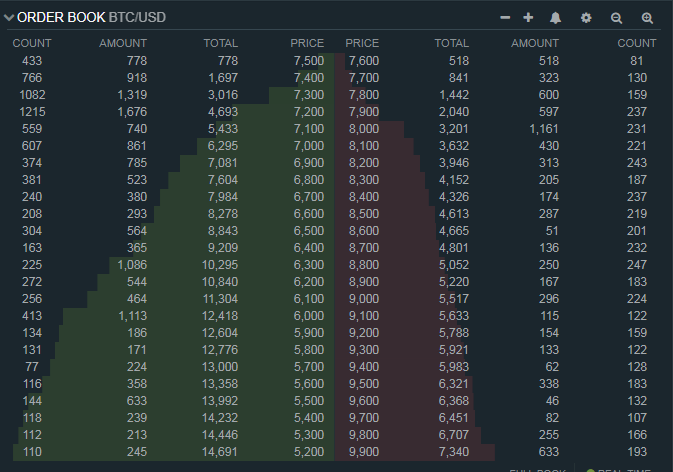
The image above showcases the buyers on the left (bid) and the sellers on the right (ask).
Example: On the buyer’s side, 778 units are being sold at a price of 7,500. On the seller’s side, 518 units are being sold at 7,600. The order book is filled with units being sold at other varying price levels as well.
We can see that the total amount is accumulated depending on different price levels. For instance, on the buyer’s side, at a price level of 6,872, the amount is 49,500. It is added by the previous bidding offer of 20,000, and the current one at 29,500 (20,000 + 29,500 = 49,500).
Order Book – Advantages
An order book shows the buy and sell prices in real-time (constantly being updated). It allows market participants to make informed decisions. Moreover, it helps market participants understand the market trends and dynamics over time.
Order Book – Uses
With the instant market update characteristic of an order book, orders can be matched automatically depending on the trader’s preference.
The most common example is the order being fulfilled based on the current market demand and supply. The order is being bought or sold according to the current market price.
Another example is when a trader employs limit order strategies. In such a case, traders can set a certain price level at which they want to buy and sell the security. When the market price moves to the set price, the order will be completed automatically.
Conclusion
An order book is a useful tool for traders. Learning how to read it can help traders tremendously in understanding the market they’re currently trading in or about to enter. Studying the order book in the long term enables traders to know whether or not the market of a security is healthy. The more information traders can learn about the market, the more informed decisions they can make about their orders.
Related Readings
CFI is the official provider of the global Commercial Banking & Credit Analyst (CBCA)®Program Page - CBCAGet CFI's CBCA™ certification and become a Commercial Banking & Credit Analyst. Enroll and advance your career with our certification programs and courses. certification program, designed to help anyone become a world-class financial analyst. To keep advancing your career, the additional resources below will be useful:
- Spot PriceSpot PriceThe spot price is the current market price of a security, currency, or commodity available to be bought/sold for immediate settlement. In other words, it is the price at which the sellers and buyers value an asset right now.
- Trade OrderTrade OrderPlacing a trade order seems intuitive – a “buy” button to initiate a trade and a “sell” button to close a trade.
- Investing: A Beginner’s GuideInvesting: A Beginner's GuideCFI's Investing for Beginners guide will teach you the basics of investing and how to get started. Learn about different strategies and techniques for trading
- Trading MechanismsTrading MechanismsTrading mechanisms refer to the different methods by which assets are traded. The two main types of trading mechanisms are quote driven and order driven trading mechanisms
-

Prediction Markets: Understanding How They Work & Their Applications
A prediction market or betting market is an exchange-traded market where individuals can bet on the outcome of a variety of events with an unknown future. The events range from future commodity prices
-

Understanding Quote-Driven Markets: A Guide for Investors
A quote-driven market is a type of secondary market trading structure where investors trade with dealers. Nearly all bonds, currenciesCurrencyCurrency refers to money, that which is used as a medium o
invest
- Understanding Auction Markets: How Prices Are Determined
- Doji Candlestick Pattern: Meaning & Trading Signals
- Understanding Frothy Markets: Risks & Opportunities
- Understanding Held Orders: A Quick Guide for Traders
- Understanding Inefficient Markets: Causes & Implications
- Market Orders: A Comprehensive Guide for Investors
- Understanding Trade Execution: A Comprehensive Guide
- Understanding Trade Order Timing: A Comprehensive Guide
- Market Value vs. Book Value: Understanding the Difference
-
 Understanding Market Sentiment: A Guide for Investors
The term market sentiment, also known as investor sentiment, refers to the general outlook or attitude of investors toward a particular security or the overall financial market. The optimism or pessim...
-
![Market Timing: Strategies & How It Works | [Your Company Name]](https://www.etffin.com/article/uploadfiles/202110/2021100815253643_S.jpeg) Market Timing: Strategies & How It Works | [Your Company Name]
Market Timing: Strategies & How It Works | [Your Company Name]Market timing refers to an investing strategy through which a market participant makes buying or selling decisions by predicting the price movements of a financial asset in the future. Investors follo...