
Understanding the Primary Market: A Comprehensive Guide
The primary market is the financial market where new securitiesPublic SecuritiesPublic securities, or marketable securities, are investments that are openly or easily traded in a market. The securities are either equity or debt-based. are issued and become available for trading by individuals and institutions. The trading activities of the capital marketsEquity Capital Market (ECM)The equity capital market is a subset of the capital market, where financial institutions and companies interact to trade financial instruments are separated into the primary market and secondary market.
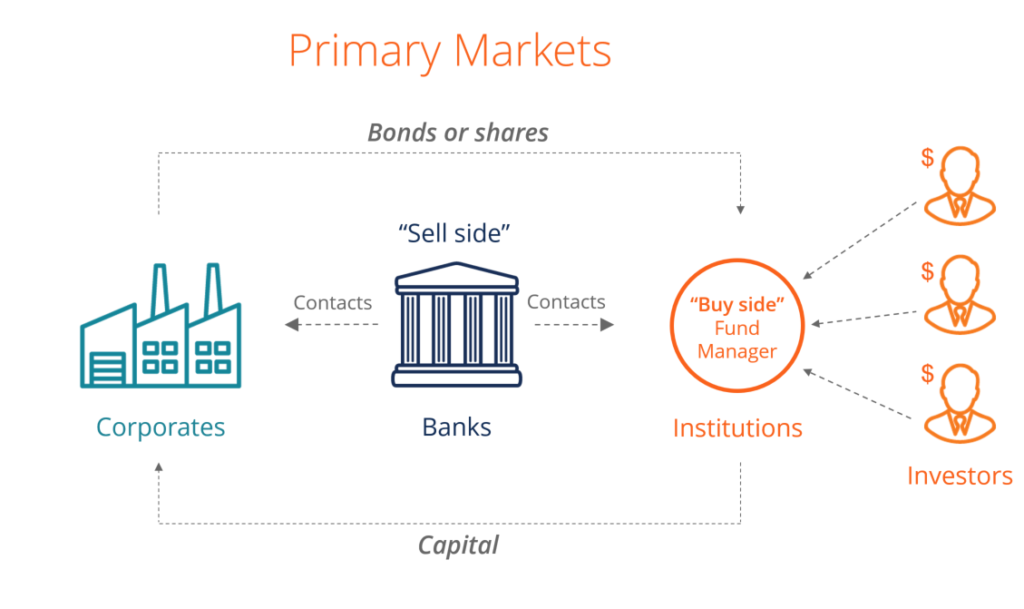
Image from CFI’s Free Corporate Finance 101 Course.
The primary market is where companies issue a new security, not previously traded on any exchange. A company offers securities to the general public to raise funds to finance its long-term goals. The primary market may also be called the New Issue Market (NIM). In the primary market, securities are directly issued by companies to investors. Securities are issued either by an Initial Public Offer (IPO)Initial Public Offering (IPO)An Initial Public Offering (IPO) is the first sale of stocks issued by a company to the public. Prior to an IPO, a company is considered a private company, usually with a small number of investors (founders, friends, family, and business investors such as venture capitalists or angel investors). Learn what an IPO is or a Further Public Offer (FPO).
An IPO is the process through which a company offers equity to investors and becomes a publicly-traded company. Through an IPO, the company is able to raise funds and investors are able to invest in a company for the first time. Similarly, an FPO is a process by which already listed companies offer fresh equity in the company. Companies use FPOs to raise additional funds from the general public.
Raising Funds from the Primary Market
Below are some of the ways in which companies raise funds from the primary market:
1. Public Issue
This is the most common way to issue securities to the general public. Through an IPO, the company is able to raise funds. The securities are listed on a stock exchange for trading purposes.
2. Rights Issue
When a company wants to raise more capital from existing shareholders, it may offer the shareholders more shares at a price discounted from the prevailing market price. The number of shares offered is on a pro-rata basis. This process is known as a Rights IssueRights IssueA rights issue is an offering of rights to the existing shareholders of a company that gives them an opportunity to buy additional shares directly from the company at a discounted price.
3. Preferential Allotment
When a listed company issues shares to a few individuals at a price that may or may not be related to the market price, it is termed a preferential allotment. The company decides the basis of allotment and it is not dependent on any mechanism such as pro-rata or anything else.
Secondary Market
The secondary market is where existing shares, debentures, bonds, etc. are traded among investors. Securities that are offered first in the primary market are thereafter traded on the secondary market. The trade is carried out between a buyer and a seller, with the stock exchange facilitating the transaction. In this process, the issuing company is not involved in the sale of their securities.
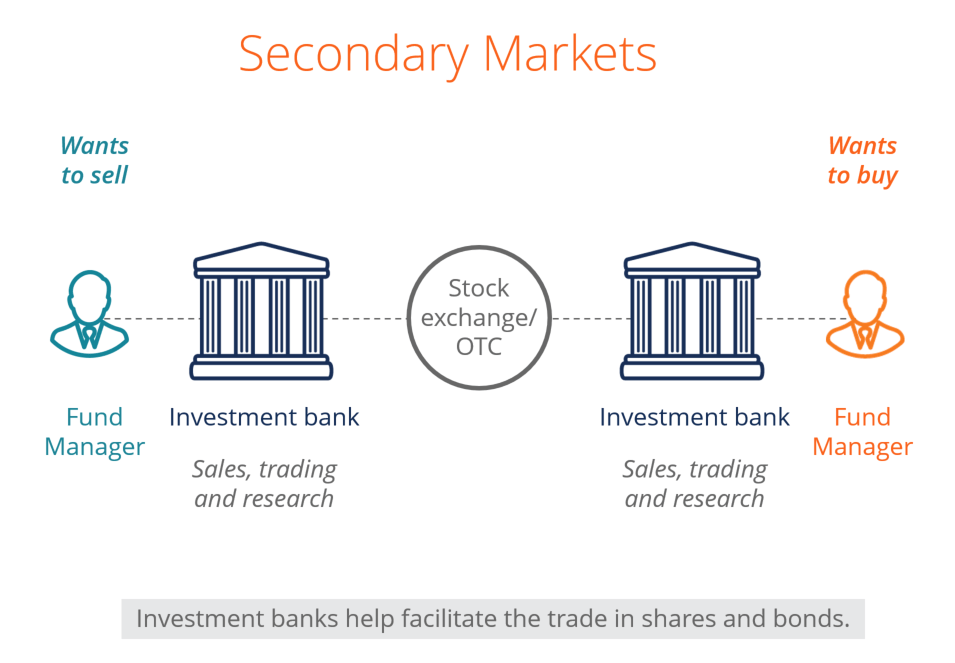
Image from CFI’s Free Corporate Finance 101 Course.
Primary Market vs. Secondary Market
Primary Market Secondary Market It is a way of issuing fresh shares in the market. It is also called New Issue Market. A major component of the primary market is the IPO.It is a place where already issued or existing shares are traded. It is called After Issue Market.The amount received from the issue of shares goes to the company for their business expansion purposes.The amount invested by the buyer of shares goes to the seller, and hence the company doesn’t receive anything.Securities are issued by the companies to the investors.Securities are exchanged between buyers and sellers, and stock exchanges facilitates the trade.The securities are all issued at one price for all investors participating in the offering.Securities are exchanged at the market price.The primary market doesn’t provide liquidity for the stock.The secondary market provides liquidity to the stock.Underwriters act as intermediaries.Brokers act as intermediaries.On the primary market, security can be sold just once.On the secondary market, securities can be sold innumerable times.
Related Reading
Thank you for reading CFI’s explanation of the primary market. CFI Is the official provider of the Financial Modeling and Valuation Analyst (FMVA)Become a Certified Financial Modeling & Valuation Analyst (FMVA)®CFI's Financial Modeling and Valuation Analyst (FMVA)® certification will help you gain the confidence you need in your finance career. Enroll today! certification, designed to help anyone become a world-class financial analyst. To continue learning and advancing your career, these free resources will be helpful:
- Types of Markets – Dealers, Brokers, ExchangesTypes of Markets - Dealers, Brokers, ExchangesMarkets include brokers, dealers, and exchange markets. Each market operates under different trading mechanisms, which affect liquidity and control. The different types of markets allow for different trading characteristics, outlined in this guide
- Equity Capital MarketEquity Capital Market (ECM)The equity capital market is a subset of the capital market, where financial institutions and companies interact to trade financial instruments
- Stock MarketStock MarketThe stock market refers to public markets that exist for issuing, buying and selling stocks that trade on a stock exchange or over-the-counter. Stocks, also known as equities, represent fractional ownership in a company
- Stock Investment StrategiesStock Investment StrategiesStock investment strategies pertain to the different types of stock investing. These strategies are namely value, growth and index investing. The strategy an investor chooses is affected by a number of factors, such as the investor’s financial situation, investing goals, and risk tolerance.
-

Understanding Stock Market Proxies: A Comprehensive Guide
If you've ever tried to explain how the stock market did on a particular day, you'll know that it's a deceptively tricky question to answer. There are hundreds of thousands of publicly tra
-

Navigating Market Crashes: Expert Strategies for Investors
If you happen to have investments in stocks — say, with Wealthsimple — and the market crashes, we advise the strategy advocated by all the wisest financial gurus alive: do nothing. Trying to time entr
invest
- SEBI Primary Market Guidelines: IPOs & Investor Protection
- Equity Capital Market: Definition & How It Works
- Modigliani-Miller Theorem: Understanding Capital Structure & Firm Value
- Understanding the Call Market: Trading Hours & Price Determination
- Understanding the Money Market: Short-Term Debt & Lending
- NASDAQ Explained: A Comprehensive Guide to the Stock Market Exchange
- Understanding the Stock Market: A Beginner's Guide
- Serviceable Obtainable Market (SOM): Definition & Calculation
- Understanding Total Addressable Market (TAM): A Comprehensive Guide
-
 Understanding the S&P 500: A Comprehensive Guide
The Standard and Poor’s 500 Index, abbreviated as S&P 500 index, is an index comprising the stocks of 500 publicly traded companies in the U.S. with the highest values of market capitalizati...
-
 Value Traps: Identifying & Avoiding Investment Pitfalls
A value trap occurs when an investor looks at the fundamentals and market priceDow Jones Industrial Average (DJIA)The Dow Jones Industrial Average (DJIA), also referred to as Dow Jones” or the D...