
NASDAQ Explained: A Comprehensive Guide to the Stock Market Exchange
The NASDAQ is a U.S.-based stock market exchange and the second-largest stock exchange by market cap globally. NASDAQ stands for National Association of Security Dealers Automated Quotations and is owned and operated by NASDAQ Inc.
NASDAQ Inc. is the parent organization to the NASDAQ stock exchange. NASDAQ Inc. also operates exchanges throughout Europe and owns several business lines, including SMART (market surveillance technology services) and GlobeNewswire (press release distribution).
Summary
- The NASDAQ is the second-largest stock market exchange globally by market cap.
- Many technology stocks such as Apple and Microsoft trade on the NASDAQ.
- The NASDAQ makes money through fees charged on its business lines: corporate services, info services, market services, and technology services.
History of the NASDAQ
The National Association of Securities Dealers founded the NASDAQ in 1971 in New York City. The principal idea behind its founding was to be the world’s first electronically-run stock market. While it initially didn’t allow trading to be executed electronically, it did provide automated stock quotes. The feature helped to lower the bid-ask spread, making it unpopular among securities brokers.
Soon after, the NASDAQ became the exchange for the majority of major OTC trades. In 1998 the NASDAQ became the first exchange to offer online trading. NASDAQ Inc. continues to expand its business lines beyond a stock exchange, focusing on applying technology to finance.
Trading Hours
Like the New York Stock Exchange, NASDAQ trading is open between 9:30 a.m. and 4:30 p.m. EST. The NASDAQ also offers trading during pre-market hours (4:00-9:30 am) and after-market hours (4:00-8:00 pm).
Market Tiers
Companies listed on the NASDAQ are grouped into three different tiers based on market cap: Capital Market, Global Market, and Global Select Market. Capital Market is a market for stocks with smaller levels of market capitalization and with the least stringent listing requirements.
Global Market and Global Select Market features mid-cap and large-cap stocks, respectively, and face strict regulations regarding corporate governanceCorporate GovernanceCorporate governance is something altogether different from the daily operational management activities enacted by a company’s executives. It is a system of and liquidity standards.
Stocks Listed on the NASDAQ
The NASDAQ is known to list stocks from technology companies. Some of the major stocks trading on the NASDAQ include Amazon, Alphabet (Google), Facebook, Microsoft, and Apple. For a stock to be listed on the NASDAQ, it must meet certain finance, governance, and liquidity requirements.
The NASDAQ Composite
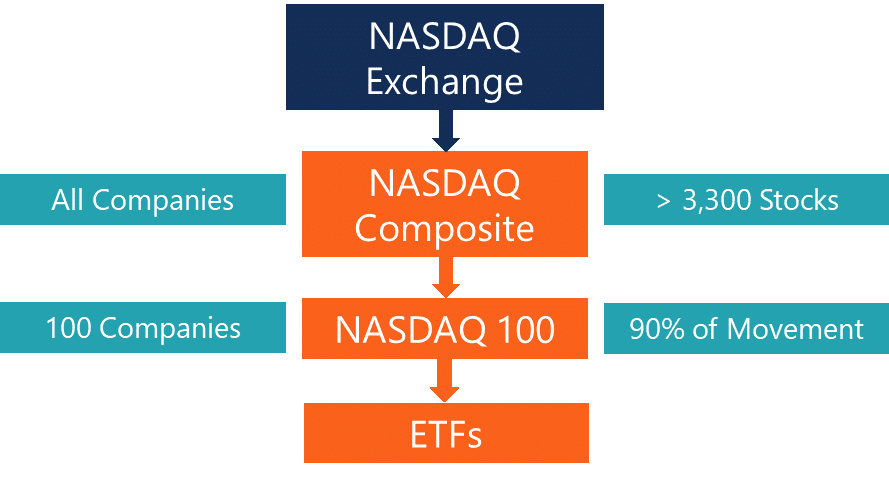
The NASDAQ Composite is the main index used on the NASDAQ. Along with the S&P 500 Index and the Dow Jones Industrial Average (DJIA)Dow Jones Industrial Average (DJIA)The Dow Jones Industrial Average (DJIA), also referred to as "Dow Jones” or "the Dow", is one of the most widely-recognized stock market indices., the NASDAQ Composite is one of the most widely followed indices globally.
Within the NASDAQ Composite is the NASDAQ 100, which is a market-value-weighted index of the top 100 non-financial stocks on the NASDAQ. The NASDAQ 100 accounts for 90% of the movement of the NASDAQ Composite. The model below shows the relationship between the NASDAQ Composite and NASDAQ 100.
How Does the NASDAQ Make Money?
The NASDAQ provides several connected services that charge fees to users. The users range from large tech companies that pay various fees to be listed on the exchange to retail investors who pay transaction fees to buy and sell securities. NASDAQ Inc.’s four main business lines include corporate services, info services, market services, and technology services.
- Corporate Services: Fees are generated from companies that want to list on the NASDAQ.
- Info Services: Provides users various data and research on the market to help inform market participants.
- Market Services: BrokerageBrokerageA brokerage provides intermediary services in various areas, e.g., investing, obtaining a loan, or purchasing real estate. A broker is an intermediary who and clearing services charged on all transactions.
- Technology Services: Includes services related to investor relations, public relations, and governance.
DotCom Bubble
Being the default marketplace for U.S. tech stocks in the 1990s, the NASDAQ was affected greatly by the boom and bust of the tech stocks. By 1991, the NASDAQ’s share of securities market transactions was 46% and continued to rise to unprecedented amounts as the internet, and adjacent technologies rose in prominence.
Due to excessive speculation at that time, tech stocks became massively inflated in price. The NASDAQ Composite peaked in March 2000 and then fell nearly 40% between March and April.
Additional Resources
CFI is the official provider of the global Capital Markets & Securities Analyst (CMSA)®Program Page - CMSAEnroll in CFI's CMSA® program and become a certified Capital Markets &Securities Analyst. Advance your career with our certification programs and courses. certification program, designed to help anyone become a world-class financial analyst. To keep advancing your career, the additional resources below will be useful:
- Bid and AskBid and AskThe term bid and ask refers to the best potential price that buyers and sellers in the marketplace are willing to transact at.
- New York Stock Exchange (NYSE)New York Stock Exchange (NYSE)The New York Stock Exchange (NYSE) is the largest securities exchange in the world, hosting 82% of the S&P 500, as well as 70 of the biggest
- Small CapsSmall CapsSmall caps refer to companies with a market capitalization generally ranging from $300 million to $2 billion. The market capitalization
- S&P 500 IndexS&P 500 IndexThe Standard and Poor’s 500 Index, abbreviated as S&P 500 index, is an index comprising the stocks of 500 publicly traded companies in the
-

Understanding Derivatives: A Comprehensive Overview
The derivatives market refers to the financial market for financial instruments such as futures contracts or options that are based on the values of their underlying assets. SummaryThe deri
-

National Market System (NMS): Understanding US Securities Trading
The National Market System (NMS) is a regulatory mechanism that governs the operations of securities trading in the United States. It covers all entities and facilities, both public and private, that
invest
- Understanding the Call Market: Trading Hours & Price Determination
- Hindenburg Omen: Predicting Stock Market Crashes - A Comprehensive Guide
- Understanding Market Support: What is 'Holding the Market'?
- Understanding the Money Market: Short-Term Debt & Lending
- Nasdaq Capital Market: A Guide to Small-Cap Investing
- NASDAQ Composite: Understanding the US Stock Market Index
- Nasdaq Global Select Market: Definition & Key Information
- Understanding the Primary Market: A Comprehensive Guide
- Understanding the S&P 500: A Comprehensive Guide
-
 Advance/Decline Ratio (ADR): A Comprehensive Guide
The advance decline ratio (ADR) is a technical indicatorTechnical Analysis - A Beginners GuideTechnical analysis is a form of investment valuation that analyses past prices to predict future price act...
-
 Capitalization-Weighted Index (CWI): Explained
The Capitalization-Weighted Index (cap-weighted index, CWI) is a type of stock market index in which each component of the index is weighted relative to its total market capitalizationMarket Capitaliz...