
Price-Weighted Index Explained: How It Works & Examples
A price-weighted index is a type of stock market index in which each component of the index is weighted according to its current share price. In price-weighted indices, companies with a high share price have a greater weight than those with a low share price. Therefore, the price movements of companies with the highest share price have the largest impact on the value of the index.
Nowadays, price-weighted indices are less common than other indices. Instead, the capitalization-weighted index is the most prevalent form of market indices. The biggest price-weighted indices are the US Dow Jones Industrial Average (DJIA)Dow Jones Industrial Average (DJIA)The Dow Jones Industrial Average (DJIA), also referred to as "Dow Jones” or "the Dow", is one of the most widely-recognized stock market indices. and Japan’s Nikkei 225Nikkei IndexThe Nikkei Index, or Nikkei 225, is the most recognized Japanese stock market index. It comprises Japan's top 225 companies listed on the Tokyo Exchange..

A price-weighted index is often criticized because it considers only the price of each component as the driver of the index value. Therefore, even a small price fluctuation in a higher priced company may significantly affect the value of the index.
How to Calculate the Weights in a Price-Weighted Index
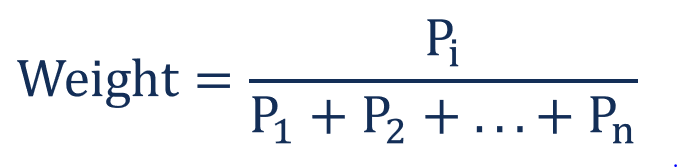
The weight of a individual component is calculated by dividing its price by the sum of all the components’ prices. Mathematically, it is expressed in the following way:
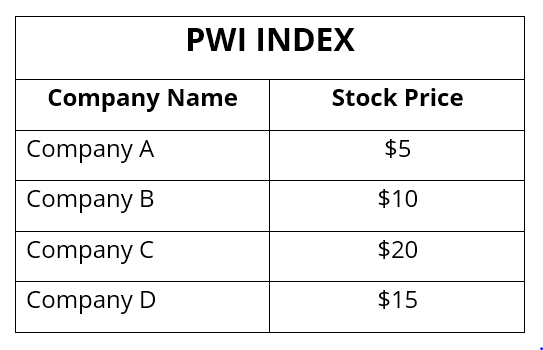
Let’s consider the following example. The PWI Index is a price-weighted index that includes the stocks of four companies. The information about the companies included in the index can be found in the table below:
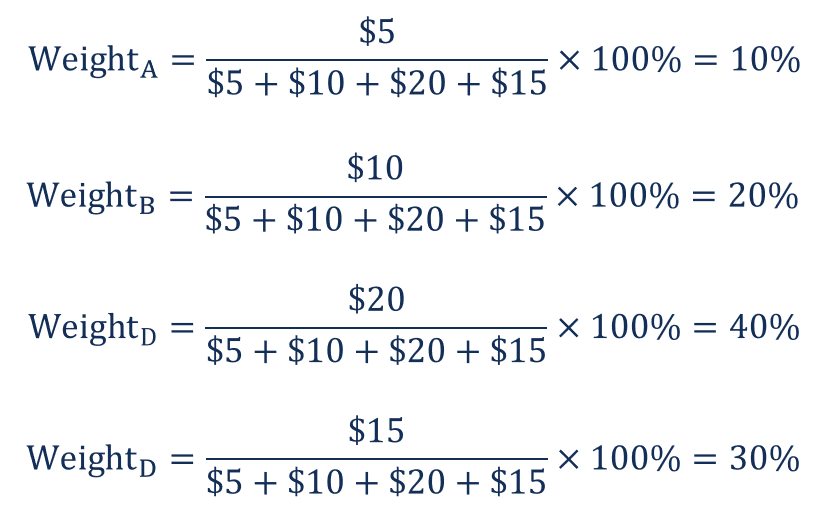
Using the formula above, we can calculate the weight of each index component:
How to Calculate the Value of a Price-Weighted Index
In theory, the value of the index can be determined as an arithmetic average by dividing the total sum of the prices of the components in the index by the number of the index components. However, such an approach is not usually encouraged because events such as spinoffs, stock splits, and mergersTypes of MergersA merger refers to an agreement in which two companies join together to form one company. In other words, a merger is the combination of two companies into a single legal entity. In this article, we look at different types of mergers that companies can undergo. Types of Mergers There are five different types of affect the composition of the index.
In reality, the value of a price-weighted index is calculated by dividing the total sum of the prices of the index components by the divisor. The divisor is an arbitrary value computed by the index and adjusted for various structural changes in the index components.
For example, the Dow Jones Industrial Average, which is the most prominent price-weighted index, calculates its own divisor (Dow divisor). The Dow divisor changes over time to better match the existing composition of the index.
More Resources
CFI is the official provider of the global Financial Modeling & Valuation Analyst (FMVA)™Become a Certified Financial Modeling & Valuation Analyst (FMVA)®CFI's Financial Modeling and Valuation Analyst (FMVA)® certification will help you gain the confidence you need in your finance career. Enroll today! certification program, designed to help anyone become a world-class financial analyst. To keep advancing your career, the additional resources below will be useful:
- New York Stock Exchange (NYSE)New York Stock Exchange (NYSE)The New York Stock Exchange (NYSE) is the largest securities exchange in the world, hosting 82% of the S&P 500, as well as 70 of the biggest
- Technical Analysis: A Beginner’s GuideTechnical Analysis - A Beginner's GuideTechnical analysis is a form of investment valuation that analyses past prices to predict future price action. Technical analysts believe that the collective actions of all the participants in the market accurately reflect all relevant information, and therefore, continually assign a fair market value to securities.
- Trading FloorTrading FloorA trading floor refers to a literal floor in a building where equity, fixed income, futures, options, commodities, or foreign exchange traders buy and sell securities.
- Types of Markets – Dealers, Brokers, ExchangesTypes of Markets - Dealers, Brokers, ExchangesMarkets include brokers, dealers, and exchange markets. Each market operates under different trading mechanisms, which affect liquidity and control. The different types of markets allow for different trading characteristics, outlined in this guide
-
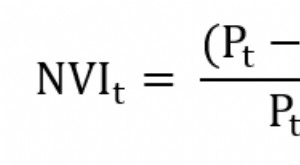
Negative Volume Index (NVI): A Comprehensive Guide
The Negative Volume Index (NVI) is a technical indicator used to identify trends in a market. It is a cumulative indicator, which means that all changes to the indicator accumulate. Put another way, t
-

NIFTY 50 Index: Understanding India's Top 50 Stocks | NSE
NIFTY 50 is the most important index of the National Stock Exchange of India Limited (NSE)National Stock Exchange of India Limited (NSE)The National Stock Exchange of India Limited (NSE) is the larges
invest
- Advance-Decline Line: Understanding Market Sentiment & Trends
- Arms Index (TRIN): Understanding Short-Term Market Sentiment
- DAX Index: Your Guide to Germany's Top 30 Companies
- EAFE Index: Understanding Developed Market Performance
- KBW Bank Index: Tracking US Banking Sector Performance
- NASDAQ-100 Index: Definition, Components & Historical Data
- Nikkei Index: Understanding Japan's Top Stock Market Indicator
- NYSE Composite Index: Definition & What It Measures
- Understanding the S&P 500: Top Holdings & Long-Term Performance
-
 Herrick Payoff Index: Understanding Derivative Market Trends
The Herrick Payoff Index is a forward-looking technical analysis tool used to identify trends in derivative markets. Using price, volume, and open interest, the index provides an overview of money flo...
-
 MSCI Emerging Markets Index: Definition & Key Facts
The MSCI Emerging Markets Index is used to measure the stock market performance within emerging countries. Established in the 1960s, It is one of many indexes created by Morgan Stanley Capital Interna...