
Pump and Dump Schemes: Understanding Securities Fraud
A pump and dump scheme is a type of securities fraud that involves the artificial inflation (“pump”) of the price of a security through false, misleading, or exaggerated statements regarding the security’s price. The fraudster can profit from the price inflation by quickly selling the securitiesPublic SecuritiesPublic securities, or marketable securities, are investments that are openly or easily traded in a market. The securities are either equity or debt-based. at a high price (“dump”).
At the same time, the new owner of the shares will likely lose a substantial part of their capital because the security’s price will quickly fall. The pump and dump scheme is considered an illegal activity.
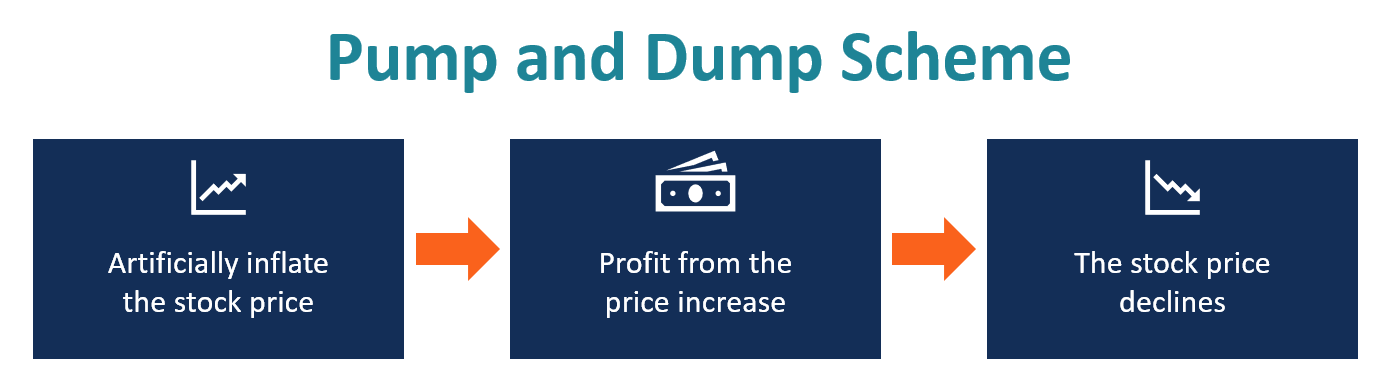
How Does the Pump and Dump Scheme Work?
The scheme often involves the manipulation of microcap stocks (penny stocks). They are the stocks of companies with a small market capitalization. The microcap stocks are usually traded over-the-counter (OTC)Over-the-Counter (OTC)Over-the-counter (OTC) is the trading of securities between two counter-parties executed outside of formal exchanges and without the supervision of an exchange regulator. OTC trading is done in over-the-counter markets (a decentralized place with no physical location), through dealer networks. at an extremely low price (less than $1 or equivalent). They do not adhere to strict requirements for public listingInitial Public Offering (IPO)An Initial Public Offering (IPO) is the first sale of stocks issued by a company to the public. Prior to an IPO, a company is considered a private company, usually with a small number of investors (founders, friends, family, and business investors such as venture capitalists or angel investors). Learn what an IPO is.
Therefore, the information about the securities can be easily manipulated by the fraudsters. The lack of public information creates additional favorable conditions for fraudsters as potential investors lack enough sources to check all available information about a company.
In addition, microcap stocks are highly illiquid securities with extremely low trading volume. Thus, even relatively small transactions can significantly inflate the price of the security.
In a pump and dump scheme, fraudsters may use various tools, including cold calling, email spam, and fake news releases.
Types of Pump and Dump Schemes
There are several types of pump and dump schemes that may be utilized by fraudsters. They include the following:
1. Classic pump and dump scheme
The classic scheme may involve any type of manipulation of information regarding a company and its stock. It may include stock pitches via telephone, fake news releases, and distribution of some sort of “inside” information that can boost the stock price. In addition, the services of dishonest stock promoters can be used to attract the attention of investors to the stocks.
2. Boiler room
A boiler room is a small brokerage firm that employs a number of brokers that use dishonest sales practices to sell questionable investments to investors. The brokers sell penny stocksSmall Cap StockA small cap stock is a stock of a publicly traded company whose market capitalization ranges from $300 million to approximately $2 billion. that the firm buys or sells as a market maker by employing cold calling. The brokers working at boiler rooms try to sell as many stocks as possible, thus boosting the price of the stocks. Once the stock price rises, the firm sells its shares of the stock for a profit.
3. “Wrong number” scheme
The “wrong number” method is a new pump and dump scheme. Some people may receive voicemails from strangers with a “hot” investment tip to a friend. The fraudsters want you to believe that the voicemail was accidentally left on your phone. However, it is a targeted action to attract the attention of potential investors to a particular stock and boost the demand for this stock.
Additional Resources
CFI is the official provider of the Financial Modeling and Valuation Analyst (FMVA)™Become a Certified Financial Modeling & Valuation Analyst (FMVA)®CFI's Financial Modeling and Valuation Analyst (FMVA)® certification will help you gain the confidence you need in your finance career. Enroll today! certification program, designed to transform anyone into a world-class financial analyst.
To keep learning and developing your knowledge of financial analysis, we highly recommend the additional resources below:
- Insider TradingInsider TradingInsider trading refers to the practice of purchasing or selling a publicly-traded company’s securities while in possession of material information that is
- Market CapitalizationMarket CapitalizationMarket Capitalization (Market Cap) is the most recent market value of a company’s outstanding shares. Market Cap is equal to the current share price multiplied by the number of shares outstanding. The investing community often uses the market capitalization value to rank companies
- Momentum InvestingMomentum InvestingMomentum investing is an investment strategy aimed at purchasing securities that have been showing an upward price trend or short-selling securities that
- Trading MechanismsTrading MechanismsTrading mechanisms refer to the different methods by which assets are traded. The two main types of trading mechanisms are quote driven and order driven trading mechanisms
-

Understanding Bid and Ask Prices in Stock Quotes: A Comprehensive Guide
Bid and ask prices are market terms representing supply and demand for a stock. The bid represents the highest price someone is willing to pay for a share. The ask is the lowest price some
-
Pump and Dump Schemes: Understanding Securities Fraud
A pump and dump scheme is a type of securities fraud that involves the artificial inflation (“pump”) of the price of a security through false, misleading, or exaggerated statements regardi
invest
- Understanding Stock Price Appreciation: A Guide for Investors
- Understanding Put and Call Options: A Beginner's Guide
- Understanding Adjusted Closing Price: A Comprehensive Guide
- Understanding Bid and Ask Prices in Financial Markets
- Quote Stuffing: Understanding Market Manipulation Tactics
- Understanding Quoted Prices: A Comprehensive Guide
- Understanding Stock Prices: A Comprehensive Guide
- Understanding Stock Quotes: A Comprehensive Guide
- Understanding Stock Warrants: A Comprehensive Guide
-
Stocks: Understanding the Risks & Unlimited Growth Potential
When you buy a lottery ticket, youre confident that the maximum amount that you can lose is limited to the price of the ticket. The same logic actually applies to buying stock; the most that can...
-
 Understanding Stock Tickers: A Beginner's Guide to Ticker Symbols
Most people know the stock ticker as the scrolling text at the bottom of a business news show or the top of a financial website. It’s an overwhelming amount of information for the uninitiated, so most...