
Protective Puts: A Comprehensive Guide to Risk Management
A protective put is a risk management and options strategy that involves holding a long position in the underlying asset (e.g., stock) and purchasing a put option with a strike priceStrike PriceThe strike price is the price at which the holder of the option can exercise the option to buy or sell an underlying security, depending on equal or close to the current price of the underlying asset. A protective put strategy is also known as a synthetic call.
Breaking Down a Protective Put
A protective put strategy is analogous to the nature of insuranceCommercial Insurance BrokerA commercial insurance broker is an individual tasked with acting as an intermediary between insurance providers and customers.. The main goal of a protective put is to limit potential losses that may result from an unexpected price drop of the underlying asset.
Adopting such a strategy does not put an absolute limit on potential profits of the investor. Profits from the strategy are determined by the growth potential of the underlying asset. However, a portion of the profits is reduced by the premium paid for the put.
On the other hand, the protective put strategy does create a limit for potential maximum loss, as any losses in the long stock position below the strike price of the put option will be compensated by profits in the option. A protective put strategy is typically employed by bullishBullish and BearishProfessionals in corporate finance regularly refer to markets as being bullish and bearish based on positive or negative price movements. A bear market is typically considered to exist when there has been a price decline of 20% or more from the peak, and a bull market is considered to be a 20% recovery from a market bottom. investors who want to hedge their long positions in the asset.
Example of Protective Put
You own 100 shares in ABC Corp, with each share valued at $100. You believe that the price of your shares will increase in the future. However, you want to hedge against the risk of an unexpected price decline. Therefore, you decide to purchase one protective put contract (one put contract contains 100 shares) with a strike price of $100. The premium of the protective put is $5.
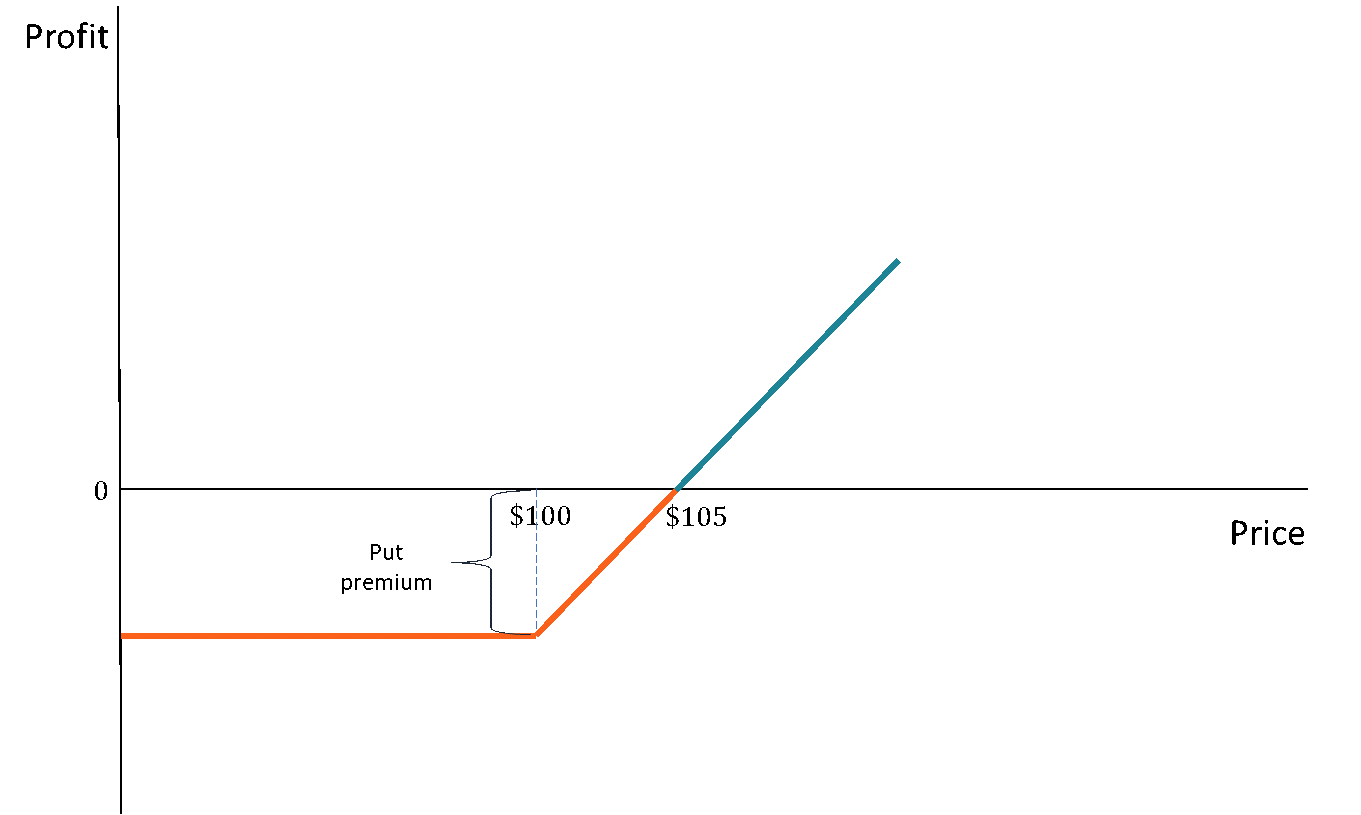
The payoff from the protective put depends on the future price of the company’s shares. The following scenarios are possible:
Scenario 1: Share price above $105.
If the share price goes beyond $105, you will experience an unrealized gain. The profit can be calculated as Current Share Price – $105 (it includes initial share price plus put premium). The put will not be exercised.
Scenario 2: Share price between $100 and $105.
In this scenario, the share price will remain the same or slightly rise. However, you will still lose money or hit the breakeven point in the best case. The small loss is caused by the premium you paid for the put contract. Similar to the previous scenario, the put will not be exercised.
Scenario 3: Share price below $100.
In this case, you will exercise the protective put option to limit the losses. After the put is exercised, you will sell your 100 shares at $100. Thus, your loss will be limited to the premium paid for the protective put.
Related Readings
We hope you’ve enjoyed reading CFI’s explanation of a protective put. CFI is the official provider of the global Financial Modeling & Valuation Analyst (FMVA)™Become a Certified Financial Modeling & Valuation Analyst (FMVA)®CFI's Financial Modeling and Valuation Analyst (FMVA)® certification will help you gain the confidence you need in your finance career. Enroll today! certification program, designed to help anyone become a world-class financial analyst. To keep learning and advancing your career, the additional resources below will be useful:
- Long and Short PositionsLong and Short PositionsIn investing, long and short positions represent directional bets by investors that a security will either go up (when long) or down (when short). In the trading of assets, an investor can take two types of positions: long and short. An investor can either buy an asset (going long), or sell it (going short).
- Options: Calls and PutsOptions: Calls and PutsAn option is a derivative contract that gives the holder the right, but not the obligation, to buy or sell an asset by a certain date at a specified price.
- Service ChargeService ChargeA service charge, also called a service fee, refers to a fee collected to pay for services that relate to a product or service that is being purchased.
- Technical Analysis: A Beginner’s GuideTechnical Analysis - A Beginner's GuideTechnical analysis is a form of investment valuation that analyses past prices to predict future price action. Technical analysts believe that the collective actions of all the participants in the market accurately reflect all relevant information, and therefore, continually assign a fair market value to securities.
-
Call Options: A Comprehensive Guide for Investors
A call option, commonly referred to as a “call,” is a form of a derivatives contract that gives the call option buyer the right, but not the obligation, to buy a stockStockWhat is a stock?
-

Understanding Call Prices: Callable Bonds & Preferred Stocks
A call price refers to the price that a preferred stock or bond issuer would pay to buyers if they chose to redeem the callable security before the maturity date. The price is set during the issuance
invest
- Protective Puts: A Guide to Risk Management Strategies
- Bear Put Spread: Definition, Strategy & Risk Management
- Understanding Divergence in Technical Analysis: A Guide
- Understanding Forward Prices: Definition & How They Work
- Understanding Hedging Strategies: A Comprehensive Guide
- Put Options Explained: A Comprehensive Guide for Investors
- Short Put Options: A Comprehensive Guide for Investors
- Understanding Slippage in Trading: Causes & Impact
- Understanding Strangle Options: A Comprehensive Guide
-
 Understanding Ascending Channels: A Technical Analysis Guide
An ascending channel occurs when visually analyzing an overall uptrend in the asset price of a stockStockWhat is a stock? An individual who owns stock in a company is called a shareholder and is eligi...
-
 Understanding Candlestick Charts: A Cryptocurrency Trading Guide
In our “Cryptocurrency Trading 101” series, we are exploring the basic principles of cryptocurrency trading. Some of the recent topics we covered include the following.Crypto Trading 101: Exchange Ord...