
Understanding Settlement Dates: A Comprehensive Guide
Settlement date is an industry term that refers to the date when a trade or derivative contract is deemed final, and the seller must transfer the ownership of the security to the buyer against the appropriate payment for the asset. It is the actual date when the seller completes the transfer of assets, and the payment is made to the seller.
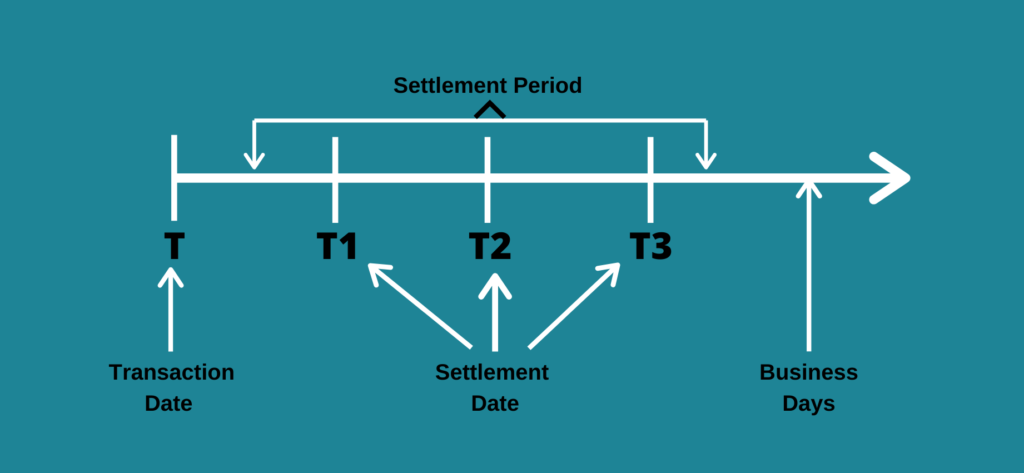
The duration between the transaction date, also known as trade date, and the settlement date varies depending on the type of security. For example, the settlement date for Treasury billsTreasury Bills (T-Bills)Treasury Bills (or T-Bills for short) are a short-term financial instrument issued by the US Treasury with maturity periods from a few days up to 52 weeks. is the next business day, denoted as T+1, whereas the settlement date for stocks is two business days, denoted as T+2. The settlement date excludes weekends, i.e., Saturday and Sunday, as well as exchange holidays.
Summary
- The settlement date is the date on which a trade is deemed settled when the seller transfers ownership of a financial asset to the buyer against payment by the buyer to the seller.
- The settlement date for securities ranges from one day to three days, depending on the type of security.
- The settlement date considers the number of days that have elapsed since the transaction date, excluding weekends and exchange holidays.
Understanding Settlement Dates
When an investor buys a stock, bondCorporate BondsCorporate bonds are issued by corporations and usually mature within 1 to 30 years. They usually offer a higher yield than government bonds but carry more risk., derivative contract, or other financial instruments, there are two important dates to remember, i.e., transaction date and settlement date. Transaction date is the actual date when the trade was initiated.
On the other hand, settlement date is the final date when the transaction is completed. That is, the date when the ownership of the security is transferred from the seller to the buyer, and the buyer makes the payment for the security to the seller. Settlement date does not occur on the same day as the transaction date since it takes some time to transfer ownership and make payment.
In the past, the transfer of ownership of securitiesPublic SecuritiesPublic securities, or marketable securities, are investments that are openly or easily traded in a market. The securities are either equity or debt-based. was done manually, where the security was dispatched via post mail, and the buyer would only pay for the security when the certificate was received. Due to the varying delivery period, it was common for prices to fluctuate between the transaction date and the settlement date.
The introduction of electronic transactions reduced the lag between the transaction date and the settlement date. Bonds and stocks are settled within two business days, whereas Treasury bills and bonds are settled within the next business day. Where the period between the transaction date and the settlement date falls on a holiday or weekend, the waiting period can increase substantially.
When Does Settlement Occur?
The settlement date is the number of days that have elapsed after the date when the buyer and seller initiated the trade. The abbreviations T+1, T+2, and T+3 are used to denote the settlement date. T+1 means the trade was settled on “transaction date plus one business day,” T+2 means the trade was settled on “transaction date plus two business days,” and T+3 means the trade was settled on “transaction date plus three business days.”
The delay between the transaction and settlement dates is known as the settlement process when the buyer and seller are required to meet their part of the bargain for the transaction to be completed.
For example, if an investor buys Microsoft’s stocks on Monday with a T+2 settlement date, it means that the transaction will be completed in two business days. If there is no public holiday within the week, the trade will be completed on Wednesday. It is the date when the buyer becomes a shareholder of the company.
Similarly, if the buyer initiates a trade with the seller on Friday with a T+2 settlement date, the transaction will be settled on Tuesday. The settlement date excludes weekends, and only Monday and Tuesday will be considered as business days. The settlement dates for financial assets are governed by the Securities Exchange Commission (SEC)Securities and Exchange Commission (SEC)The US Securities and Exchange Commission, or SEC, is an independent agency of the US federal government that is responsible for implementing federal securities laws and proposing securities rules. It is also in charge of maintaining the securities industry and stock and options exchanges.
Settlement Date Risks
The lag between the transaction date and the settlement date exposes the buyer and the seller to the following two risks:
1. Credit risk
Credit risk refers to the risk of loss resulting from the buyer’s failure to meet the contractual obligations of the trade. It occurs due to the elapsed time between the two dates and the volatility of the market. The buyer may fail to make the agreed payment by the settlement date, which causes an interruption of cash flows.
2. Settlement risk
Settlement risk occurs when one of the transacting parties fails to honor their part of a contract with the other party. It occurs when the seller fails to deliver the underlying asset, such as bond or stock, to the other party in exchange for payment for the exchange of securities.
Settlement risk may also occur when the buyer fails to make payment to the seller after the transfer of the ownership of the security. The risk is common in the foreign exchange market where currencies are not paid or transferred at the same time. Transactions across different time zones or geographical locations are also affected by the settlement risk.
Additional Resources
CFI is the official provider of the Commercial Banking & Credit Analyst (CBCA)®Program Page - CBCAGet CFI's CBCA™ certification and become a Commercial Banking & Credit Analyst. Enroll and advance your career with our certification programs and courses. certification program, designed to transform anyone into a world-class financial analyst.
In order to help you become a world-class financial analyst and advance your career to your fullest potential, these additional resources will be very helpful:
- Commodities: Cash Settlement vs Physical DeliveryCommodities: Cash Settlement vs Physical DeliveryThe modes of settlement for most options and futures contracts can be either of the following two methods: Cash Settlement vs Physical Delivery
- Calendar SpreadCalendar SpreadA calendar spread involves the buying of a derivative of an asset in one month and selling a derivative of the same asset in another month.
- Options: Calls and PutsOptions: Calls and PutsAn option is a derivative contract that gives the holder the right, but not the obligation, to buy or sell an asset by a certain date at a specified price.
- Term to MaturityTerm to MaturityTerm to maturity is the remaining life of a bond or other type of debt instrument. The duration ranges between the time when the bond is issued until its
-

Managing Your Lawsuit Settlement: Lump Sum vs. Structured Payments
Lawsuit settlement money may be paid as a lump sum or in installments. There are two types of lawsuit settlement: lump sum and structured settlement. In a lump sum settlement, you receive all
-

Understanding the Escrow Close Date: A Real Estate Guide
A real estate agent shakes hands with a couple next to a for sale sign outside a new house The escrow close date is the date when the ownership transfer deed, such as a grant deed or warranty
invest
- Understanding Trade and Settlement Dates in Stock Trading
- Understanding Trade Settlement: A Comprehensive Guide
- Settlement Date vs. Closing Date: Understanding the Difference
- Debt Settlement: Definition, How It Works & Is It Right For You?
- Net Settlement Explained: How Banks Settle Transactions
- What is Value Date?
- Understanding Call Dates: What You Need to Know
- Understanding Settlement Periods in Securities Transactions
- Understanding Structured Settlements: A Comprehensive Guide
-
 What Is the Importance of the Date on a Personal Check?
A bank may cash any check if they believe it to be valid and there are funds to cover it. The date on a personal or business check can dictate the last opportunity the payee has to deposit or...
-
Understanding Cryptocurrency: A Beginner's Guide to Digital Currency
Cryptocurrency is a kind of digital currency that is intended to act as a medium of exchange. Cryptocurrency has become popular in the last decade, in particular, with Bitcoin becoming the most widel...