
Debt Settlement: Definition, How It Works & Is It Right For You?
A debt settlement refers to an agreement reached between a creditor and a borrower in which a reduced payment from the borrower is regarded as full payment. In other words, a debt settlement is a debt reduction agreement reached between a creditor and borrower.
Understanding a Debt Settlement
A debt settlement is entered into by a borrower when they lack the capacity to pay the outstanding amount of debt to their creditors. Instead of declaring bankruptcyBankruptcyBankruptcy is the legal status of a human or a non-human entity (a firm or a government agency) that is unable to repay its outstanding debts, the borrower may attempt to reach a debt settlement with their creditors.
In a debt settlement, the borrower may engage with a debt settlement company, who would act on the borrower’s behalf. The typical process for a debt settlement is as follows:
- The borrower explains their financial situation to a debt settlement company.
- During the process, the debt settlement company would advise the borrower to stop making payments to their creditors and instead make payments to the debt settlement company (albeit at a lower payment rate).
- The debt settlement company would put the payments made by the borrower into a savings accountSavings AccountA savings account is a typical account at a bank or a credit union that allows an individual to deposit, secure, or withdraw money when the need arises. A savings account usually pays some interest on deposits, although the rate is quite low..
- Once the savings account’s reached a certain threshold, the debt settlement company would engage with the borrower’s creditors to negotiate a debt settlement.
- If negotiations are successful, the debt settlement company would retain a portion of the money in the savings account (it is collected as fees by the debt settlement company) and distribute the remainder to the borrower’s creditors.
Practical Example
A borrower is required to make monthly debt payments of $10,000 to her creditor for a period of three months. The debt payment schedule is as follows:
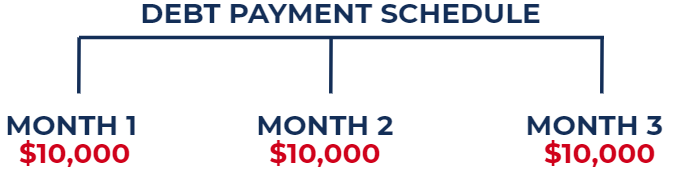
Due to unforeseen events, the borrower is unable to satisfy the debt payment schedule shown above – the borrower is left with $0 in her savings account but earns a monthly disposable income of $8,000.
The borrower engages with a debt settlement company, who advises the borrower to withhold debt payments to her creditor and to instead make debt payments to the debt settlement company. The debt payment schedule proposed by the company is as follows:

After three months of making payments to the debt settlement company, the debt settlement company has collected a total of $24,000 from the borrower. The debt settlement company calls the borrower’s creditor and negotiates a lump-sum debt payment of $20,000 to satisfy the previously required monthly debt payments of $10,000.
The creditor, having written off the borrower due to non-payments for three months, accepts the lump-sum payment of $20,000. As such, the debt settlement company forwards $20,000 on behalf of the borrower to the creditor to satisfy the debt. For helping the borrower settle the debt, the debt settlement company retains the remaining $4,000 as a fee.
Advantages of a Debt Settlement
1. Lowering the amount of debt outstanding
A debt settlement would lower the amount of debt outstanding. In the example above, although the borrower owed $30,000 in debt, the borrower only ended up paying $24,000.
2. Avoiding bankruptcy
A debt settlement allows the borrower to avoid bankruptcy. Depending on the country, consumer bankruptcy can last up to ten years – significantly impacting the credit score of a borrower. In addition, declaring bankruptcy can potentially impact employability.
Implications of a Debt Settlement
Although a debt settlement lowers the amount of debt outstanding and allows the borrower to avoid bankruptcy, there are significant repercussions to be considered, such as:
1. No debt settlement
There is no guarantee that the debt settlement company would be able to reach a successful settlement with the borrower’s creditors. In fact, according to the Credit Counselling Society, the success rate of for-profit debt settlement companies is less than 10%.
2. Legal action by creditors
While the borrower is making debt payments to a debt settlement company and not its creditors, creditors could pursue legal action or enlist the help of collection agencies.
3. Adverse impact on credit score
A debt settlement is noted on the borrower’s credit report and adversely impacts the credit scoreFICO ScoreA FICO score, more commonly known as a credit score, is a three-digit number that is used to assess how likely a person is to repay the credit if the individual is given a credit card or if a lender loans them money. FICO scores are also used to help determine the interest rate on any credit extended of the borrower.
4. Additional debt accumulation
When the borrower is not making the required debt payments to creditors, interest may accumulate on that debt. If a debt settlement falls through, the borrower will end up with more than the initial debt owed.
More Resources
CFI offers the Financial Modeling & Valuation Analyst (FMVA)™Become a Certified Financial Modeling & Valuation Analyst (FMVA)®CFI's Financial Modeling and Valuation Analyst (FMVA)® certification will help you gain the confidence you need in your finance career. Enroll today! certification program for those looking to take their careers to the next level. To keep learning and advancing your career, the following CFI resources will be helpful:
- Credit AdministrationCredit AdministrationCredit administration involves a department in a bank or lending institution that is tasked with managing the entire credit process. Lending money is one of the core functions of a bank, and banks generate revenue by charging a higher interest rate on loans than the interest they pay on customer deposits.
- Debt CovenantDebt CovenantsDebt covenants are restrictions that lenders (creditors, debt holders, investors) put on lending agreements to limit the actions of the borrower (debtor).
- Intercreditor AgreementIntercreditor AgreementAn Intercreditor Agreement, commonly referred to as an intercreditor deed, is a document signed between one or more creditors, stipulating in advance how their competing interests are resolved and how to work in tandem in service to their mutual borrower.
- Loan ServicingLoan ServicingLoan servicing is the way a finance company (a lender) goes about collecting principal, interest, and escrow payments that are due or overdue.
-

Understanding Debt & Debt Settlement Options
Because we live in a credit culture, it stands to reason that we must also reside in a debt culture. This is necessarily so, for if youve used credit to buy, then by definition you are in debt.
-
Understanding Structured Settlements: A Comprehensive Guide
A structured settlement is an agreement for periodic payments from an insurance company. For example, you file a lawsuit against a grocery store where you have a slip and fall. The grocery store
finance
- Understanding Capital: Types, Categories & Value Creation
- Understanding Debt: Types, Obligations & Financial Implications
- Understanding Debt Capacity: A Guide for Businesses
- Debt Consolidation: Simplify Payments & Lower Interest Rates
- Understanding Debt Default: Causes, Consequences, and Prevention
- Debt Financing: A Comprehensive Guide for Businesses
- Debt Refinancing: A Comprehensive Guide to Lowering Your Payments
- Debt Restructuring: A Comprehensive Guide for Financial Distress
- Net Settlement Explained: How Banks Settle Transactions
-
 Understanding Bad Debt: Definition and Financial Statement Impact
First, let’s determine what the term bad debt means. Sometimes, at the end of the fiscal periodFiscal Year (FY)A fiscal year (FY) is a 12-month or 52-week period of time used by governments and ...
-
Debt Settlement vs. Debt Management: Which is Right for You?
Both debt settlement and debt management can be used to get out of debt. However, there are a few differences between the two. These differences must be appreciated before you can decide whether...