
Understanding Call Dates: What You Need to Know
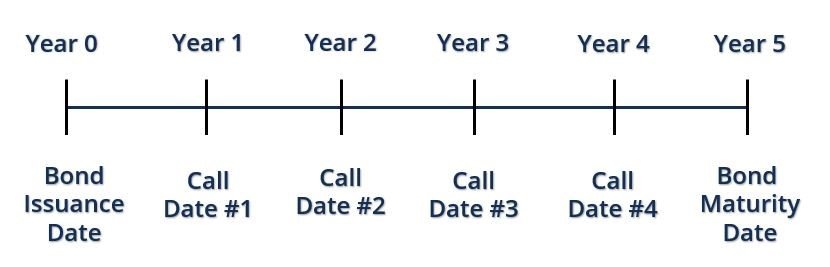
A call date refers to the date when a callable bondCallable BondA callable bond (redeemable bond) is a type of bond that provides the issuer of the bond with the right, but not the obligation, to redeem the bond before its maturity date. The callable bond is a bond with an embedded call option. These bonds generally come with certain restrictions on the call option. can be redeemed for a specific call price before its maturity date. There can be more than one call date where the issuer owns the right to redeem the bond prematurely before the bond’s maturity date.
The callable bond can be redeemed at par or at a premium. The call price that can be redeemed on the call date is predetermined, and the specific details of the date(s) can be found in the bond’s prospectus.
How Does a Call Date Work?
If a callable bond comes with multiple call dates, there will be a call schedule. A call schedule lists all the dates that the bond can be redeemed at specific prices before its maturity date. In the bond’s prospectus, it will specify the value that the bond can be redeemed for each of the call dates.
For example, suppose that Company X issued a callable bond on January 1, 2020, with a face value of $1,000, and the bond would mature on January 1, 2025. The callable bond is offered with an interest rate of 10%. Company X is also offering the choice for the bond to be redeemed before the maturity date with the following call schedule:
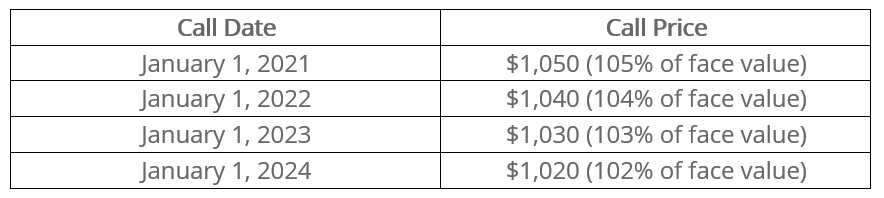
In the above example, the bond can be redeemed at a small premium because the call price is slightly higher than the bond’s face valueFace ValueThe value mentioned on an instrument like a coin, stamp, or bill is called the face value of the instrument. It always remains constant of $1,000.
Why is the Call Date Important?
An issuer may want to redeem a bond on the call date if there is a benefit from redeeming the bond before its maturity date. For example, if interest rates are declining, the bond issuer may want to redeem the bond if they want to avoid paying the investor with interest rates that are higher than the average interest rates in the market. When redeeming the bond, the issuer must pay the investor the call price. After redeeming the bond, the issuer may want to issue the bond again at a lower interest rate.
On the other hand, an issuer may not want to redeem a bond prematurely if interest rates are increasing above the bond’s interest rate. Redeeming the bond early means that the issuer will need to stop paying lower-than-average interest rates to the investor. If the issuer redeems the bond and issues the bond again, the issuer must pay higher interest rates, which is not favorable.
Callable bonds are riskier than non-callable bondsNon-Callable BondA non-callable bond is a bond that is only paid out at maturity. The issuer of a non-callable bond can’t call the bond prior to its date of maturity. It is different from a callable bond, which is a bond where the company or entity that issues the bond owns the right to repay the face value of the bond for investors since there is a chance that the issuer may redeem the bond earlier than its maturity date. As a result, the investor may have to reinvest in another bond with a lower interest rate.
In order to compensate for the risk, callable bonds usually offer higher coupon rates and a higher call price when it is redeemed. For example, a callable bond may be issued at a face value of $5,000. When it is redeemed on a call date, it can be redeemed at a slight premium, such as $5,100.
Additional Resources
CFI is the official provider of the Capital Markets & Securities Analyst (CMSA)®Program Page - CMSAEnroll in CFI's CMSA® program and become a certified Capital Markets &Securities Analyst. Advance your career with our certification programs and courses. certification program. It also offers a variety of lessons and courses for you to continue learning about topics related to investing:
- Debt Capital Markets (DCM)Debt Capital Markets (DCM)Debt Capital Markets (DCM) groups are responsible for providing advice directly to corporate issuers on the raising of debt for acquisitions, refinancing of existing debt, or restructuring of existing debt. These teams operate in a rapidly moving environment and work closely with an advisory partner
- Hard Call ProtectionHard Call ProtectionHard call protection, also known as absolute call protection, is a requirement in a callable bond where the issuer does not have the ability
- High-Yield Bond SpreadHigh-Yield Bond SpreadA high-yield bond spread, also known as a credit spread, is the difference in yields between multiple high-yield bonds, expressed in basis
- Par ValuePar ValuePar Value is the nominal or face value of a bond, or stock, or coupon as indicated on a bond or stock certificate. It is a static value
-

Understanding Bond Accretion: A Comprehensive Guide
Accretion is a finance term that refers to the increment in the value of a bond after purchasing it at a discount and holding it until the maturity date. A bond is said to be purchased at a discount p
-

Understanding Amortizable Bond Premiums: A Comprehensive Guide
An amortizable bond premium refers to the excess amount paid for a bond over its face value or par valuePar ValuePar Value is the nominal or face value of a bond, or stock, or coupon as indicated on a
invest
- Call Premium Explained: Understanding Issuer Redemptions & Option Pricing
- Understanding Call Prices: Callable Bonds & Preferred Stocks
- Understanding Call Protection in Bonds: Investor Protection Explained
- Understanding Call Provisions in Bonds: A Comprehensive Guide
- Understanding Call Risk in Bonds: A Comprehensive Guide
- Coupon Bonds: Understanding Fixed Income & Interest Payments
- Discount Bonds: Understanding Pricing & Secondary Markets
- Understanding Hard Call Protection in Callable Bonds
- Make-Whole Call Provisions: Understanding Early Bond Redemption
-
 Understanding Bond Duration: A Key Fixed Income Metric
Duration is one of the fundamental characteristics of a fixed-income security (e.g., a bondBondsBonds are fixed-income securities that are issued by corporations and governments to raise capital....
-
 What is Value Date?
Value date refers to the date when a transaction takes place or when the value of assets or money becomes effective. it is also used to determine the present value of a product with a fluctuating pric...