
Hard Stop Orders: Protecting Your Investments in Volatile Markets
A hard stop is an instruction from a client to their broker which informs them to sell units of a security when the market price declines to a specific level. Hard stops are used to minimize risk and reduce potential losses in the financial market when price fluctuations and unexpected events occur.

A hard stop can also lead to missed gains if the security experiences a price recovery or rebound after the hard stop is executed.
A hard stop will continue until the order is filled or cancellation occurs. It is also referred to as a “stop-loss orderStop-Loss OrderA stop-loss order is a tool used by traders and investors to limit losses and reduce risk exposure. Learn more about stop-loss orders in this article.” or a “stop order.”
Hard Stop vs. Soft Stop
When a client is trying to reduce the potential risk associated with investing in securities, they may ask their broker for a hard stop. This allows the broker to automatically sell the client’s securities when they reach a minimum price.
Also referred to as a “mental stop,” a soft stop is an unofficial price at which financial traders believe it is time to exit a losing position. In this case, the trader can have a numeric exit value in mind without setting up a hard stop.
Avoiding the biggest downfall of a hard stop, a soft stop allows the trader to evaluate the financial market and decide if the share will recover after a price level stop (rather than the share being automatically sold when the stock reaches the specific hard stop price level).
Advantages of Implementing a Hard Stop
When purchasing a stock, it is beneficial to evaluate some of the other important considerations and factors that play into how it is treated. Listed below are the advantages of implementing a hard stop for your security.
- A hard stop reduces an investor’s loss on a security position.
- It reduces the time spent monitoring the holdings.
- No costs are associated with its implementation.
- It decreases emotional stock connection by automatically selling the stock once it reaches a value below the limit.
- Hard stops can be canceled at any time.
Disadvantages of Implementing a Hard Stop
Apart from the advantages, it is also extremely crucial to evaluate some of the disadvantages to ensure that the most educated trading strategy is made. Listed below are the disadvantages of implementing a hard stop for a security.
- Potential future gains are lost if the price level recovers after a hard stop sale.
- Short-term volatility could activate the hard stop price quickly.
- Once the hard stop price is met, it is sold as a market orderMarket OrderMarket order is a request made by an investor to purchase or sell a security at the best possible price. It is executed by a broker or brokerage service., potentially resulting in a sales price lower than the original hard stop price.
- Certain securities, such as penny stocks, restrict the use of a hard stop.
Practical Example
In order to illustrate the process of a hard stop, we will be looking to deal with a broker, a client, and a number of price levels.
For example, in January, assume that a client purchased 500 shares of stock in XYZ Company for $20/share.
Since the client would like to minimize potential losses, he decides to ask his broker to put a hard stop if the shares reach any value below the purchase price.
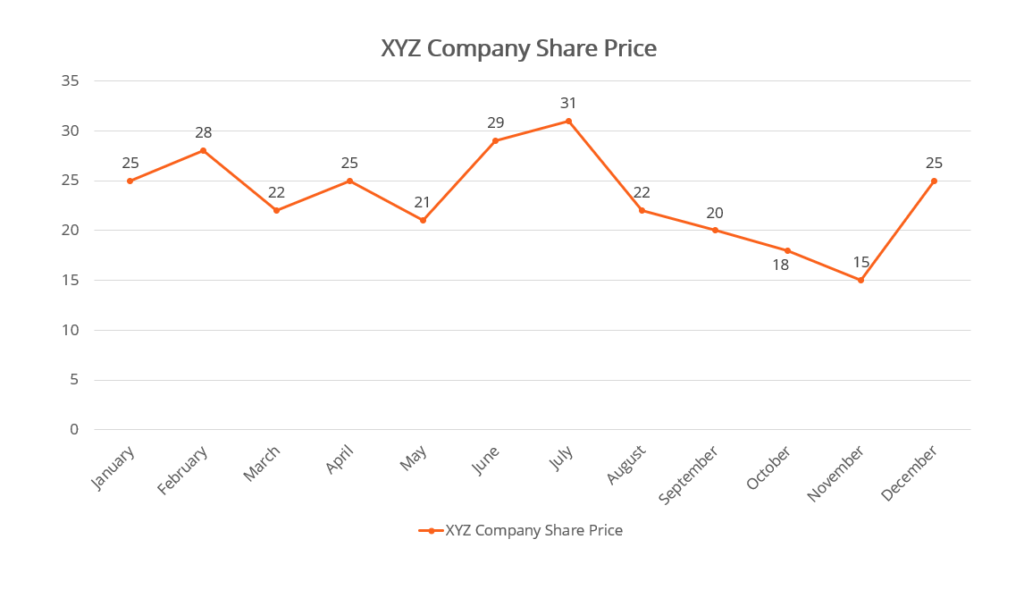
As seen in the graph, the share price of XYZ Company began to reach a level below $20 between September and October. Once the price level reaches any value below the hard stop line, the shares are automatically sold at the best price available.
Setting a financial hard stop for securities can be beneficial because it can potentially reduce the client’s financial loss. But in this case, it is seen that the hard stop prevented future gains when the stock price shot back up to $25 in December.
More Resources
CFI is the official provider of the global Capital Markets & Securities Analyst (CMSA)®Program Page - CMSAEnroll in CFI's CMSA® program and become a certified Capital Markets &Securities Analyst. Advance your career with our certification programs and courses. certification program, designed to help anyone become a world-class financial analyst. To keep advancing your career, the additional CFI resources below will be useful:
- Long and Short PositionsLong and Short PositionsIn investing, long and short positions represent directional bets by investors that a security will either go up (when long) or down (when short). In the trading of assets, an investor can take two types of positions: long and short. An investor can either buy an asset (going long), or sell it (going short).
- Penny StockPenny StockA penny stock is a common share of a small public company that is traded at a low price. The specific definitions of penny stocks may vary among countries. For example, in the United States, the stocks that are traded at a price less than $5 are considered
- Stop Limit OrderStop-Limit OrderA stop-limit order is a tool that traders use to mitigate trade risks by specifying the highest or lowest price of stocks they are willing to
- Trade OrderTrade OrderPlacing a trade order seems intuitive – a “buy” button to initiate a trade and a “sell” button to close a trade.
-

DeFi Explained: A Beginner's Guide to Decentralized Finance
The Beginner’s Guide to Decentralized FinanceIf you’re diving deep into the world of cryptocurrency, you have probably heard the term “DeFi” used to describe a variety of new protocols and assets. Fi
-
0x: A Comprehensive Guide to Decentralized Ethereum Trading
What Is 0x? 0x is a decentralized exchange for trading ERC 20 tokens. (See also: What Is ERC 20 And What Does It Mean For Ethereum?). It is among the most high-profile examples of decentra
invest
- Hard Forks in Cryptocurrency: Understanding the Impact
- Understanding Hard Currencies: Stability and Global Trade
- Stop Payment Orders: Definition, Process & How to Request
- Understanding Hard Assets: Definition, Examples & Investment
- Understanding Hard Call Protection in Callable Bonds
- Understanding Commodities: Hard vs. Soft - Definitions & Examples
- Stop Orders: A Comprehensive Guide for Investors
- Understanding Cryptocurrency: A Beginner's Guide to Digital Currency
- Trailing Stop Orders: A Comprehensive Guide for Traders
-
 Hard Money Loans: Definition, How They Work & Benefits
Hard money loans are a way for borrowers to take out a real estate loan without having to work with traditional lenders, like banks, credit unions, or mortgage agencies. Traditional lende...
-
 Understanding Regulation Z: Your Rights as a Borrower
Regulation Z is a consumer-protection regulation that compels lenders to disclose the cost of credit in a clear way for consumers. Whether you’re applying for a mortgage or dealing...