
Economic Order Quantity (EOQ): Definition & Importance
EOQ stands for Economic Order Quantity. It is a measurement used in the field of Operations, Logistics, and Supply Management. In essence, EOQ is a tool used to determine the volume and frequency of orders required to satisfy a given level of demand while minimizing the cost per order.
The Importance of EOQ
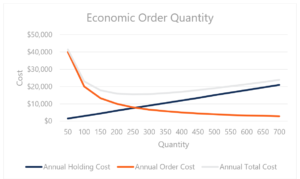
The Economic Order Quantity is a set point designed to help companies minimize the cost of ordering and holding inventoryInventoryInventory is a current asset account found on the balance sheet, consisting of all raw materials, work-in-progress, and finished goods that a. The cost of ordering inventory falls with the increase in ordering volume due to purchasing on economies of scaleEconomies of ScaleEconomies of scale refer to the cost advantage experienced by a firm when it increases its level of output.The advantage arises due to the. However, as the size of inventory grows, the cost of holding the inventory rises. EOQ is the exact point that minimizes both of these inversely related costs.
EOQ Formula
The Economic Order Quantity formula is calculated by minimizing the total cost per order by setting the first-order derivative to zero. The components of the formula that make up the total cost per order are the cost of holding inventory and the cost of ordering that inventory. The key notations in understanding the EOQ formula are as follows:
Components of the EOQ Formula:
D: Annual Quantity Demanded
Q: Volume per Order
S: Ordering Cost (Fixed Cost)
C: Unit Cost (Variable Cost)
H: Holding Cost (Variable Cost)
i: Carrying Cost (Interest Rate)
Ordering Cost
The number of orders that occur annually can be found by dividing the annual demand by the volume per order. The formula can be expressed as:

For each order with a fixed cost that is independent of the number of units, S, the annual ordering cost is found by multiplying the number of orders by this fixed cost. It is expressed as:

Holding Cost
Holding inventory often comes with its own costs. This cost can be in the form of direct costs incurred by financing the storage of said inventory or the opportunity costOpportunity CostOpportunity cost is one of the key concepts in the study of economics and is prevalent throughout various decision-making processes. The of holding inventory instead of investing the money elsewhere. As such, the holding cost per unit is often expressed as the cost per unit multiplied by the interest rate, expressed as follows:
H = iC
With the assumption that demand is constant, the quantity of stock can be seen to be depleting at a constant rate over time. When inventory reaches zero, an order is placed and replenishes inventory as shown:
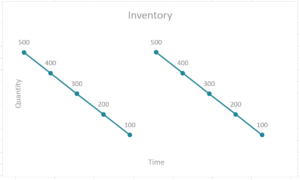
As such, the holding cost of the inventory is calculated by finding the sum product of the inventory at any instant and the holding cost per unit. It is expressed as follows:

Total Cost and the Economic Order Quantity
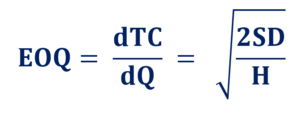
Summing the two costs together gives the annual total cost of orders. To find the optimal quantity that minimizes this cost, the annual total cost is differentiated with respect to Q. It is shown as follows:

Example
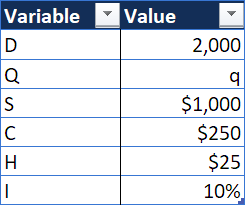
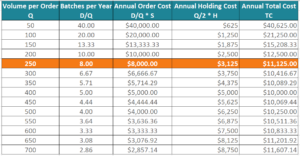
For example, a company faces an annual demand of 2,000 units. It costs the company $1,000 for every order placed and $250 per unit of the product. It faces a carrying cost of 10% of a unit cost. What is the economic order quantity?
The variables can be arranged as follows:
The cost for each value of Q is shown as:
Download the Free Template
Enter your name and email in the form below and download the free template now!
Other Resources
CFI is dedicated to helping you expand your knowledge, increase your skills as a financial analyst, and advance your career. To learn more, see the following CFI resources:
- Law of SupplyLaw of SupplyThe law of supply is a basic principle in economics that asserts that, assuming all else being constant, an increase in the price of goods
- Economies of ScopeEconomies of ScopeEconomies of scope is an economic concept that refers to the decrease in the total cost of production when a range of products are produced together rather than separately.
- Consumer Surplus FormulaConsumer Surplus FormulaConsumer surplus is an economic measurement to calculate the benefit (i.e., surplus) of what consumers are willing to pay for a good or
- Financial Analyst ProgramBecome a Certified Financial Modeling & Valuation Analyst (FMVA)®CFI's Financial Modeling and Valuation Analyst (FMVA)® certification will help you gain the confidence you need in your finance career. Enroll today!
-
Understanding Average Cost Basis: A Comprehensive Guide
Average cost basis is defined as the means to attribute the purchase price to shares underlying a mutual fundMutual FundsA mutual fund is a pool of money collected from many investors for the purpose
-

Day Orders: A Comprehensive Guide for Investors
A day order is a type of trading order that an investor gives to his or her broker – a directive that the broker will buy and/or sell certain assets (such as stocksPublic SecuritiesPublic securi
finance
- Limit Orders: A Comprehensive Guide for Investors
- Cost of Capital: Definition, Calculation & Importance
- Understanding Held Orders: A Quick Guide for Traders
- Stop Orders: A Comprehensive Guide for Investors
- Stop-Loss Orders: Protecting Your Investments & Managing Risk
- Marginal Cost: Definition, Calculation & Examples
- Economic Order Quantity (EOQ): Calculation & Cost Optimization
- Understanding Money Orders: A Comprehensive Guide
- Money Orders: A Comprehensive Guide to Usage, Benefits & Alternatives
-
 Understanding the Cost of Preferred Stock: A Key Capital Metric
The cost of preferred stock to a company is effectively the price it pays in return for the income it gets from issuing and selling the stock. In other words, it’s the amount of money the compan...
-
 Understanding Flotation Costs: A Comprehensive Guide
Flotation costs are the costs that are incurred by a company when issuing new securities. The costs can be various expenses including, but not limited to, underwriting, legal, registration, and audit ...