
Trading Software: A Comprehensive Guide for Traders
Trading software are computer programs that traders use to trade and analyze financial products such as currencies, stocks, bonds, and derivatives over a network with a financial intermediaryFinancial IntermediaryA financial intermediary refers to an institution that acts as a middleman between two parties in order to facilitate a financial transaction. The institutions that are commonly referred to as financial intermediaries include commercial banks, investment banks, mutual funds, and pension funds., which can be a broker, market maker, or stock exchange. Investors can use trading software to place trades from any location. Trading software directly contrasts with the traditional floor trading method that employs an open outcry system to place orders.
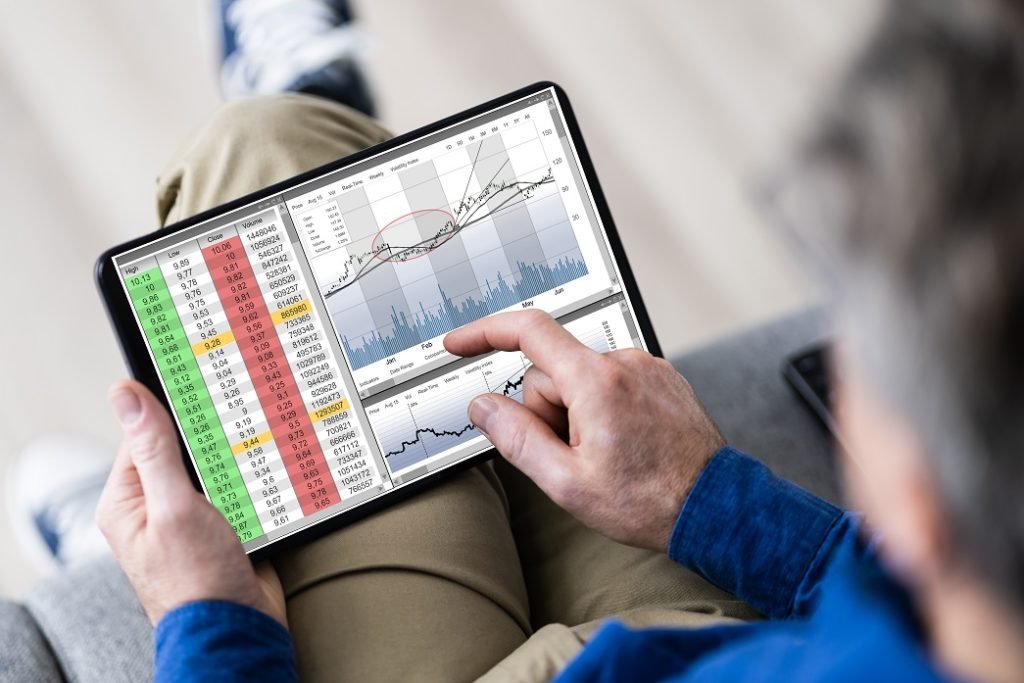
Usually, brokerage firms provide online trading platforms to their clients either for free or at a discount if they maintain a funded account. The software allows clients to manage their accounts conveniently from any location, and the software may be launched from a desktop, mobile device, or a web-based platform.
Some trading platforms allow traders to purchase third-party software that enhances the performance of the platform provided by the brokerage firm. Key features of online trading software include live market prices, charting packages, news feeds, order placement, fundamental analysisFundamental AnalysisIn accounting and finance, fundamental analysis is a method of assessing the intrinsic value of a security by analyzing various macroeconomic and microeconomic factors. The ultimate goal of fundamental analysis is to quantify the intrinsic value of a security., and technical analysis.
Summary
- Trading software is a program that facilitates the analysis and trading of financial products, such as stocks, currencies, and cryptos, with a financial intermediary.
- Traders use trading software to place trades, execute market positions, and monitor their accounts.
- Trading software provides various features such as charting tools, real-time quotes, informational research, and programmatic trading for ease of trading.
Understanding Trading Software
A trading software allows investors to place orders, open and close trades, and monitor trades through their financial intermediaries. As the traditional floor trading is being phased out, most traders now prefer trading using self-directed trading accounts.
The self-directed accounts include all the essential features that traders need to execute trades and monitor their accounts. Some of the features include technical analysis indicators, chat rooms, charts, fundamental analysis data, and other proprietary functions that brokers use to attract new investors to their platforms. Also, the availability of APIs is helping improve the functionality of trading software by allowing two pieces of software to be linked up and function as one.
Trading software can fall into two categories – commercial and prop (proprietary) platforms. Commercial platforms are designed for day tradersDay TraderA day trader is an individual who opens and closes all of his or her trades before the end of the trading day; no open positions are and retail investors, and they include a variety of features for research and learning purposes, such as maps and news feeds. On the other hand, prop platforms are built for large brokerages to meet their trading style and specific demands.
Common Features of Trading Software
Some of the key features included in trading software include:
1. Order placement
Most trading software allows users to place new orders, including market orders, limit orders, and other order types. Users can also look up real-time prices, track trading statistics for the day, the win rate for the day, and the profit or loss on closed trades.
2. Technical analysis
Trading platforms provide various tools such as interactive charting, chart patterns, and technical indicatorsTechnical IndicatorA technical indicator is a mathematical pattern derived from historical data used by technical traders or investors to predict future price to allow users to analyze stocks and check any trends in security movements. Users can also customize certain items in their charts, such as resistance lines, indicators, and sector comparisons, and save the customizations for future reference.
3. Programmatic trading
Some trading platforms include programmatic trading functionality to allow users to execute trades automatically, without the need to click a button manually to perform a certain function. Users are also able to test how the automated trading system performs when given certain commands.
4. Paper trading
Paper trading is a riskless virtual money trading functionality that is incorporated in most trading platforms. Such functionality allows users to test their skills using no-real-money trades before committing actual capital. Users can test various strategies to see what works without risking their real money.
How to Choose a Trading Software
When choosing a trading software, traders should consider the features available to users and the fees involved. Day traders are more interested in trading platforms that offer real-time Level 2 quotes to decide which stocks to trade. On the other hand, options traders are more interested in trading platforms that help them visualize their strategies.
Most brokers allow clients to test out their platforms before opening an account. It allows users time to decide if a platform comes with the required features and compare several trading platforms before making the final decision.
Another consideration that traders make when choosing a trading platform is the fee structure. Depending on the trading strategy, traders prefer trading platforms with low fees if they get access to the required features such as responsive charts, news feeds, technical analysis tools, etc. For example, traders who employ scalping prefer lower fee platforms that do not eat into their small profits.
However, some platforms offer different pricing tiers, where low fees translate to fewer features compared to the features provided in the top-tier levels. Nevertheless, traders can still go with low-fee trading platforms and find third-party applications that they can integrate into the platform through an API or use independently.
Also, traders can sign up for third-party charting services and use them alongside the functionalities provided within their preferred trading platform.
Related Readings
CFI offers the Capital Markets & Securities Analyst (CMSA)®Program Page - CMSAEnroll in CFI's CMSA® program and become a certified Capital Markets &Securities Analyst. Advance your career with our certification programs and courses. certification program for those looking to take their careers to the next level. To keep learning and advance your career, the following resources will be helpful:
- Financial IntermediaryFinancial IntermediaryA financial intermediary refers to an institution that acts as a middleman between two parties in order to facilitate a financial transaction. The institutions that are commonly referred to as financial intermediaries include commercial banks, investment banks, mutual funds, and pension funds.
- Trade OrdersTrade Orders - TradingTrade orders refer to the different types of orders that can be placed on trading exchanges for financial assets, such as stocks or futures contracts.
- Open OutcryOpen OutcryOpen outcry is a trading method used in futures pits and stock exchanges where traders use verbal and nonverbal signals to communicate. Before the advent of electronic trading, nearly all financial trading was conducted via open outcry.
- Trading PlatformTrading PlatformA trading platform is an online trading system that uses computer software to execute trades in a networked environment. Trading platforms
-
Basis Trading: Definition, Strategy & How It Works
Basis trading is a financial arbitrage trading strategy that involves the trading of a financial instrument, such as a financial derivative or a commodityCommoditiesCommodities are another class of as
-
Circuit Breakers: Understanding Trading Halts & Market Stability
A circuit breaker is a regulatory instrument that halts the trading of a securityStockWhat is a stock? An individual who owns stock in a company is called a shareholder and is eligible to claim part o
invest
- CFD Trading Explained: A Comprehensive Guide for Investors
- Day Trading Explained: Strategies, Risks & How It Works
- Proprietary Trading: A Comprehensive Guide for Investors
- Quantitative Trading: A Deep Dive into Models & Analysis
- Spread Trading: A Comprehensive Guide to Relative Value Trading
- Trading Authorization: Empowering Your Broker & Account Security
- Trading Channels: Understanding Uptrends & Downtrends
- Trading Plan: A Comprehensive Guide to Successful Trading
- Understanding Trading Sessions: Hours & Global Markets
-
 After Hours Trading Explained: A Comprehensive Guide
After hours trading refers to the time outside regular trading hours when an investor can buy and sell securities. The main exchanges in the United States, NASDAQ and NYSENew York Stock Exchange (NYSE...
-
![Top Stock Trading Software: Reviews & Comparison - [Year]](https://www.etffin.com/article/uploadfiles/202206/2022061110420223_S.jpg) Top Stock Trading Software: Reviews & Comparison - [Year]
Top Stock Trading Software: Reviews & Comparison - [Year]Online services have transformed every sector of commerce and services, and stock trading is no exception. With a vast number of online brokerages, stock screeners, software packages, and other fin...