
Understanding Option Strike Prices: A Key to Options Trading
The strike price of an option is the price at which shares of the underlying security are bought and sold for if the option is exercised. This price is important because it forms the basis for determining the option’s value. When the underlying security is trading above this price, the call holder is said to be in-the-money. In this case, if you are the call holder your option has intrinsic value because if the option is exercised, you can buy the security for less than its current market price. Likewise, if you own a put on a security that is trading below its strike price, the option allows you to sell the security for more than its market price. In either case, you are in-the-money.
The strike price is fixed for the life of an option; it cannot change from the time the option is written until expiration. The distance between strike prices can be important as well. This is usually based on the absolute value of the underlying, cheaper stocks. This distribution is important because it limits the choices you have when trading options because it affects the absolute expense of a given trade.
-
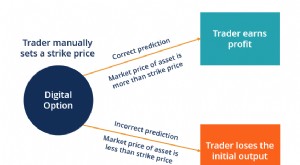
Understanding Digital Options: A Comprehensive Guide for Traders
A digital option is a form of option that allows traders to manually set a strike price. The digital option provides the traders with a fixed payout in the case when the market price of the underlying
-
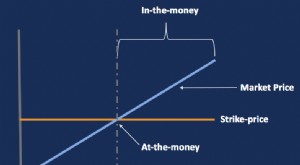
Understanding Exercise Price in Options Trading
The exercise price within an option is the price at which the holder is capable of purchasing the underlying asset. If the market price of the asset is above the exercise price, the holder is capable
Option
- Understanding Swing Options in Energy Markets
- Balloon Options: Understanding and Leveraging Increased Leverage
- Understanding At-The-Money (ATM) Options: A Comprehensive Guide
- In-the-Money vs. Out-of-the-Money Options: A Clear Explanation
- Buy-Write Strategy: Generate Income with Options Trading
- Understanding At-The-Money (ATM) Options: A Comprehensive Guide
- Understanding Strike Price: Options Trading Explained
- Options Hedging: A Beginner's Guide to Risk Management
- Understanding Option Classes: A Guide for Investors
-
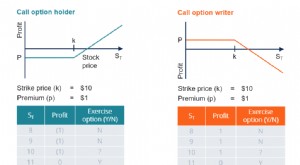 Call Options: A Comprehensive Guide for Investors
A call option, commonly referred to as a “call,” is a form of a derivatives contract that gives the call option buyer the right, but not the obligation, to buy a stockStockWhat is a stock?...
-
 Understanding Delta: A Key Risk Measure in Derivatives
Delta is a risk sensitivity measure used in assessing derivativesDerivativesDerivatives are financial contracts whose value is linked to the value of an underlying asset. They are complex financial in...