
Understanding Strike Price: Options Trading Explained
The strike price is the price at which the holder of the option can exercise the option to buy or sell an underlying security, depending on whether they hold a call optionCall OptionA call option, commonly referred to as a "call," is a form of a derivatives contract that gives the call option buyer the right, but not the obligation, to buy a stock or other financial instrument at a specific price - the strike price of the option - within a specified time frame. or put option. An option is a contract where the option buyer purchases the right to exercise the contract at a specific price, which is known as the strike price.
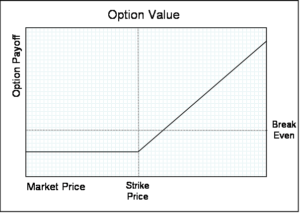
Buying or selling options is a popular trading strategy. Options trading is not complex, but as with any other investment, having good information is important. In the image below, we can see the strike price for a call option, which confers the right to buy at the strike price and the break-even point where the option seller starts losing money.
Call Options – Strike Price
The buyer and the seller of a call option enter into an agreement, according to which the buyer gets the right to buy a specified number of shares of stock at a specified price, and the seller receives the purchase price for the option in return for agreeing to sell the shares to the option holder at the strike price if the option holder elects to exercise their option. Options are only good for a set period of time, after which the option expires.
The buyer of the option can exercise the option at any time before the specified expiration date. If the call option expires “out-of-the-money,” that is, with the underlying stock price still below the option strike price, then the option seller will profit by the amount of money received for the sale of the option.
If the option is “in-the-money” prior to expiration – meaning the underlying stock price has risen to a point above the strike price of the option – then the buyer will profit by the difference between the option strike price and the actual stock price, multiplied by the number of shares in the option. (Stock options are commonly for a lot of 100 shares.)
Put Options – Strike Price
Here, the buyer and the seller of an option also enter into an agreement, according to which the option buyer can exercise the right to sell short shares of the stock at the option strike price. Again, the option seller receives the purchase price of the option, known as the “premium.”
The buyer of a put option possesses the right, but not an obligation, to exercise the option and sell short the specified number of shares of stock to the option seller any time before the option expiry at the predetermined exercise price. In this trade, the buyer of the option will profit if the stock price falls below the option strike price prior to expiration.
The seller will profit from selling the option if the option expires out of the money, which in the case of a put option means the stock price remains higher than the strike price up to the date of the option’s expiration.
Related Readings
CFI is a global provider of financial modeling and valuation courses and on a mission to help you advance your career. To continue learning and developing your skills as a world-class financial analyst, these additional resources will be helpful:
- Technical Analysis – A Beginner’s GuideTechnical Analysis - A Beginner's GuideTechnical analysis is a form of investment valuation that analyses past prices to predict future price action. Technical analysts believe that the collective actions of all the participants in the market accurately reflect all relevant information, and therefore, continually assign a fair market value to securities.
- Trading MechanismsTrading MechanismsTrading mechanisms refer to the different methods by which assets are traded. The two main types of trading mechanisms are quote driven and order driven trading mechanisms
- Long and Short PositionsLong and Short PositionsIn investing, long and short positions represent directional bets by investors that a security will either go up (when long) or down (when short). In the trading of assets, an investor can take two types of positions: long and short. An investor can either buy an asset (going long), or sell it (going short).
- Buying on MarginBuying on MarginMargin trading or buying on margin means offering collateral, usually with your broker, to borrow funds to purchase securities. In stocks, this can also mean purchasing on margin by using a portion of profits on open positions in your portfolio to purchase additional stocks.
-
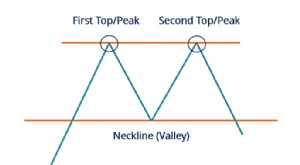
Double Top Pattern: Definition, Trading Signals & Analysis
Common in financial trading, the double top is a type of chart pattern that can be found when performing technical analysisTechnical Analysis - A Beginners GuideTechnical analysis is a form of investm
-

Understanding Options & Futures Expiration Dates
The expiration date, in derivatives trading, refers to the date in which options or futures contractsFutures ContractA futures contract is an agreement to buy or sell an underlying asset at a later da
invest
- Understanding At-The-Money (ATM) Options: A Comprehensive Guide
- Call Options: A Comprehensive Guide for Investors
- Understanding Delta: A Key Risk Measure in Derivatives
- Understanding Digital Options: A Comprehensive Guide for Traders
- Understanding Exercise Price in Options Trading
- Knock-In Options Explained: A Comprehensive Guide
- Knock-Out Options: A Comprehensive Guide
- Naked Options: Risks, Rewards, and How They Work
- Understanding Option Strike Prices: A Key to Options Trading
-
 Collar Option Strategy: A Comprehensive Guide for Risk Management
A collar option strategy, also referred to as a hedge wrapper or simply collar, is an optionsOptions: Calls and PutsAn option is a derivative contract that gives the holder the right, but not the obli...
-
 Delta Hedging Explained: A Comprehensive Guide for Traders
Delta hedging is a trading strategy that reduces the directional risk associated with the price movements of an underlying asset. The hedge is achieved through the use of optionsOptions: Calls and Put...