
Understanding Exercise Price in Options Trading
The exercise price within an option is the price at which the holder is capable of purchasing the underlying asset. If the market price of the asset is above the exercise price, the holder is capable of purchasing the asset at a discount relative to what the market is offering; thereby, the investor profits on the difference.
The exercise price is often used within options trading. An option is also known as a derivativeExchange-Traded DerivativesExchange-traded derivatives consist mostly of options and futures traded on public exchanges, with a standardized contract, which increases liquidity and market depth., where the most common types are puts and calls. A derivative is a financial instrument that fluctuates in value based on an underlying asset, such as a stock. Exercise prices can either be in-the-money or out-of-the-money.
Calls and Puts
A call option gives the holder the right, but not the obligation, to purchase a stock at a specific price in the future. Individuals tend to purchase calls if they believe the stock price will rise in the future. If the underlying equity goes up in the future, a call option hedges that scenario.
A put option gives the holder the right, but not the obligation, to sell a stock at a specific price in the future. Individuals who purchase the financial instruments tend to believe the stock price will be going down in the future. If the underlying stock goes down in the future, a put option hedges such an occurrence.
In-the-Money
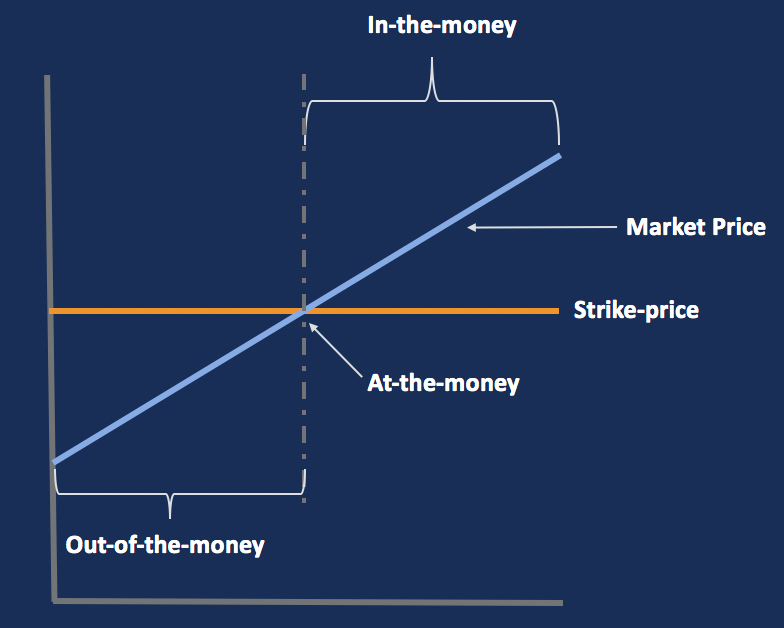
An in-the-money exercise price is when the option is capable of being exercised to provide some level of financial benefit. For example:
- An in-the-money call option is when the market price is above the exercise price. Thus, the holder can purchase the security at the lower exercise price and book the profit between it and the market price.
For example, a call option with a strike price of $50 would be in-the-money if the market price is $55. The investor who is exercising the call option would have the opportunity to purchase the stock at $50 and therefore earn $5.
- An in-the-money put option is when the exercise price is above the market price. Thus, the holder is eligible to sell the security at a price higher than what is being offered. For example, a put option with a strike price of $60 would be in the money if the market price is $45. The holder of the option can then sell the stock for $60 and thus make $15.
Out-of-the-Money
An out-of-the-money option is when the derivative yields zero intrinsic valueIntrinsic ValueThe intrinsic value of a business (or any investment security) is the present value of all expected future cash flows, discounted at the appropriate discount rate. Unlike relative forms of valuation that look at comparable companies, intrinsic valuation looks only at the inherent value of a business on its own.. For example:
- An out-of-the-money call option is when the market price is below the exercise price. Therefore, the holder’s option contract is worthless, as they would not purchase the stock at a price higher than what is offered within the marketplace.
For example, if the exercise price on a call option is $65, but the market price of the stock is $50, the contract holder would, of course, rather purchase the stock at a cheaper price ($50), which means the call option would be viewed as zero value.
- An out-of-the-money put option is when the market price is higher than the exercise price. Here, the contract holder would not exercise the option because they would not sell the stock for a price less than what is offered to the marketplace.
For example, if the market price of the underlying asset is $70, but the put option exercise price is $40, the wisest decision would be for the put holder to sell the asset for $70, which thereby foregoes the put option contract in the first place.
Essentially, the further out-of-the-money an option is, the less valuable it becomes. The option would lose intrinsic value and instead only yield extrinsic valueExtrinsic ValueExtrinsic value of an option is calculated by taking the difference between the market price of an option and its intrinsic price. based on the possibility that the underlying asset’s price may potentially enter the in-the-money zone. Vice-versa, the further in-the-money the option is, the more intrinsic value the contract yields, as it has a higher likelihood of being exercised.
More Resources
CFI offers the Capital Markets & Securities Analyst (CMSA)™Program Page - CMSAEnroll in CFI's CMSA® program and become a certified Capital Markets &Securities Analyst. Advance your career with our certification programs and courses. certification program for those looking to take their careers to the next level. To keep learning and advancing your career, the following resources will be helpful:
- Options: Calls and PutsOptions: Calls and PutsAn option is a derivative contract that gives the holder the right, but not the obligation, to buy or sell an asset by a certain date at a specified price.
- Horizontal SpreadHorizontal SpreadA horizontal spread is a type of options spread that involves buying the same underlying stocks at the same price, but with different
- Near-The-MoneyNear-The-MoneyNear-the-money means that an option contract’s stock price is close to its strike price. It is used to describe an option’s intrinsic value.
- Intrinsic Value TemplateIntrinsic Value TemplateThis intrinsic value template will demonstrate the calculation of intrinsic value using the discount rate method and certainty factor method. Risk Adjusting the Intrinsic Value The task of risk adjusting the cash flows is very subjective and a combination of both art and science. There are two main methods: Discount ra
-

Understanding Put-Call Parity: A Comprehensive Guide
Put-call parity is an important concept in options Options: Calls and PutsAn option is a derivative contract that gives the holder the right, but not the obligation, to buy or sell an asset by a certa
-
Understanding Option Intrinsic Value: A Clear Explanation
Intrinsic value for call options is literally the difference between the price of the market and the strike price (or exercise price), as long as the market is above the strike price. The intrin
invest
- Call Options: A Comprehensive Guide for Investors
- Understanding Delta: A Key Risk Measure in Derivatives
- Understanding Digital Options: A Comprehensive Guide for Traders
- Knock-In Options Explained: A Comprehensive Guide
- Knock-Out Options: A Comprehensive Guide
- Naked Options: Risks, Rewards, and How They Work
- Understanding Near-The-Money Options: A Comprehensive Guide
- Put Options Explained: A Comprehensive Guide for Investors
- Straddle Strategy: Definition, How It Works & Risk
-
 Understanding Exercise Price: Options Trading Explained
What Is an Exercise Price? The exercise price is the price at which an underlying security can be purchased or sold when trading a call or put option, respectively. It is also referred to ...
-
Understanding Options Exercise: A Comprehensive Guide
What Is Exercise? Exercise means to put into effect the right to buy or sell the underlying financial instrument specified in an options contract. In options trading, the holder of an option ha...