
Bank Reconciliation: Definition, Process & Importance
A bank reconciliation statement is a document that compares the cash balance on a company’s balance sheetBalance SheetThe balance sheet is one of the three fundamental financial statements. The financial statements are key to both financial modeling and accounting. to the corresponding amount on its bank statement. Reconciling the two accounts helps identify whether accounting changes are needed. Bank reconciliations are completed at regular intervals to ensure that the company’s cash records are correct. They also help detect fraudTop Accounting ScandalsThe last two decades saw some of the worst accounting scandals in history. Billions of dollars were lost as a result of these financial disasters. In this and any cash manipulations.
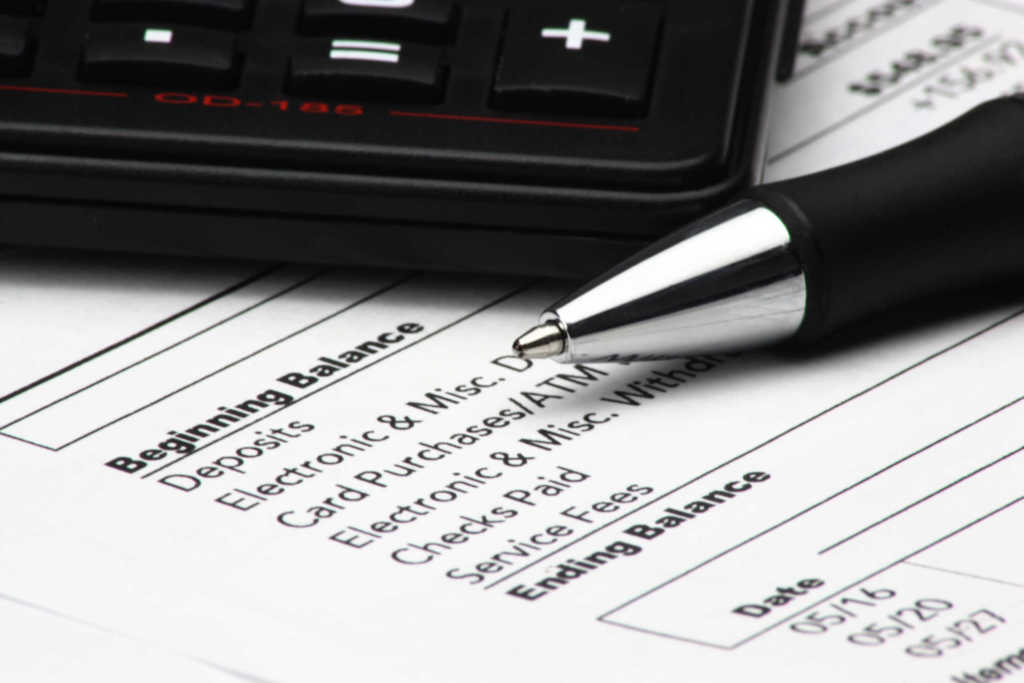
Reasons for Difference Between Bank Statement and Company’s Accounting Record
When banks send companies a bank statement that contains the company’s beginning cash balanceCash Flow StatementA cash flow Statement contains information on how much cash a company generated and used during a given period., transactions during the period, and ending cash balance, the bank’s ending cash balance and the company’s ending cash balance are almost always different. Some reasons for the difference are:
- Deposits in transit: Cash and checks that have been received and recorded by the company but have not yet been recorded on the bank statement.
- Outstanding checks: Checks that have been issued by the company to creditors but the payments have not yet been processed.
- Bank service fees: Banks deduct charges for services they provide to customers but these amounts are usually relatively small.
- Interest income: Banks pay interest on some bank accounts.
- Not sufficient funds (NSF) checks: When a customer deposits a check into an account but the account of the issuer of the check has an insufficient amount to pay the check, the bank deducts from the customer’s account the check that was previously credited. The check is then returned to the depositor as an NSF check.
Nowadays, many companies use specialized accounting software in bank reconciliation to reduce the amount of work and adjustments required and to enable real-time updates.
Bank Reconciliation Procedure
- On the bank statement, compare the company’s list of issued checks and deposits to the checks shown on the statement to identify uncleared checks and deposits in transit.
- Using the cash balance shown on the bank statement, add back any deposits in transit.
- Deduct any outstanding checks.
- This will provide the adjusted bank cash balance.
- Next, use the company’s ending cash balance, add any interest earned and notes receivable amount.
- Deduct any bank service fees, penalties, and NSF checks. This will arrive at the adjusted company cash balance.
- After reconciliation, the adjusted bank balance should match with the company’s ending adjusted cash balance.
Example
XYZ Company is closing its books and must prepare a bank reconciliation for the following items:
- Bank statement contains an ending balance of $300,000 on February 28, 2018, whereas the company’s ledger shows an ending balance of $260,900
- Bank statement contains a $100 service charge for operating the account
- Bank statement contains interest income of $20
- XYZ issued checks of $50,000 that have not yet been cleared by the bank
- XYZ deposited $20,000 but this did not appear on the bank statement
- A check for the amount of $470 issued to the office supplier was misreported in the cash payments journal as $370.
- A note receivable of $9,800 was collected by the bank.
- A check of $520 deposited by the company has been charged back as NSF.
Amount Adjustment to Books Ending Bank Balance$300,000Deduct: Uncleared cheques– $50,000NoneAdd: Deposit in transit+ $20,000NoneAdjusted Bank Balance$270,000Ending Book Balance$260,900Deduct: Service charge– $100Debit expense, credit cashAdd: Interest income+ $20Debit cash, credit interest incomeDeduct: Error on check– $100Debit expense, credit cashAdd: Note receivable+ $9,800Debit cash, credit notes receivableDeduct: NSF check– $520Debt accounts receivable, credit cashAdjusted Book Balance$270,000
Bank Reconciliation Statement
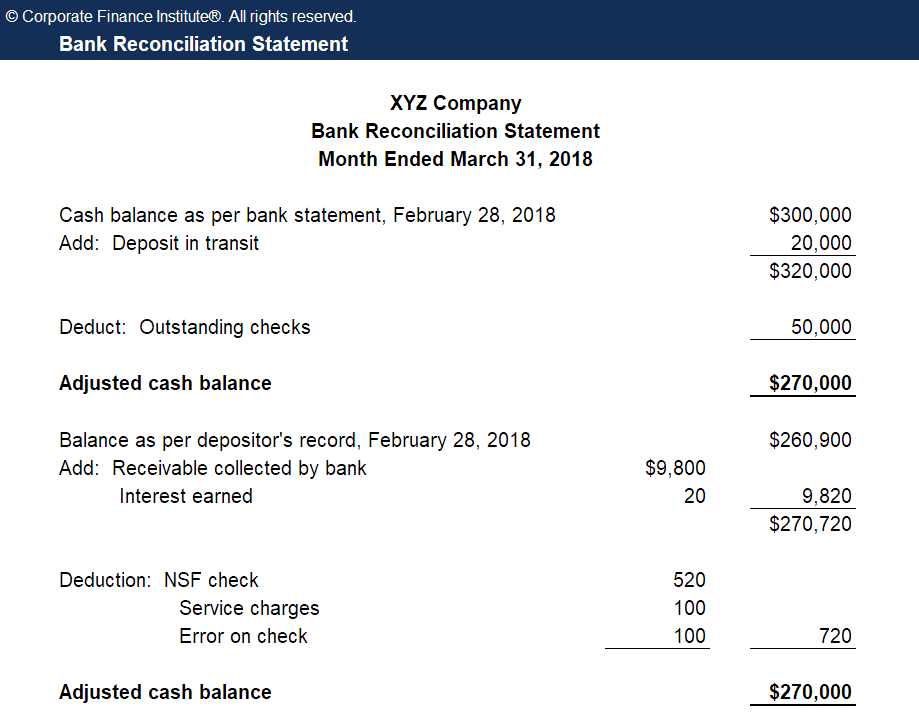
After recording the journal entries for the company’s book adjustments, a bank reconciliation statement should be produced to reflect all the changes to cash balances for each month. This statement is used by auditors to perform the company’s year-end auditing.
Download the Free Template
Enter your name and email in the form below and download the free template now!
Video Explanation of Bank Reconciliation
Below is a video explanation of the bank reconciliation concept and procedure, as well as an example to help you have a better grasp of the calculation of cash balance.
Related Readings
CFI is the official provider of the global Financial Modeling & Valuation Analyst (FMVA)®Become a Certified Financial Modeling & Valuation Analyst (FMVA)®CFI's Financial Modeling and Valuation Analyst (FMVA)® certification will help you gain the confidence you need in your finance career. Enroll today! certification program, designed to help anyone become a world-class financial analyst. Through financial modeling courses, training, and exercises, anyone in the world can become a great analyst.
To keep advancing your career, the additional CFI resources below will be useful:
- 3 Statement Model3 Statement ModelA 3 statement model links the income statement, balance sheet, and cash flow statement into one dynamically connected financial model. Examples, guide
- Financial Statement NormalizationNormalizationFinancial statements normalization involves adjusting non-recurring expenses or revenues in financial statements or metrics so that they only reflect the usual transactions of a company. Financial statements often contain expenses that do not constitute a company's normal business operations
- Financial Statements for BanksFinancial Statements for BanksFinancial Statements for Banks differ from those of non-banks in that banks use much more leverage than other businesses and earn a spread
- The Ultimate Cash Flow GuideValuationFree valuation guides to learn the most important concepts at your own pace. These articles will teach you business valuation best practices and how to value a company using comparable company analysis, discounted cash flow (DCF) modeling, and precedent transactions, as used in investment banking, equity research,
-

Understanding Accruals in Accounting: A Comprehensive Guide
An accrual is the basis of the accrual principle of accounting that adjusts the revenues earned and expenses incurred by a company at the end of a period, when no cash has been exchanged. The transact
-

Understanding Incremental Cash Flow: A Business Guide
Incremental cash flow refers to cash flow that is acquired by a company when it takes on a new projectProject ManagementProject management is designed to produce an end product that will make an impac
Accounting
- Understanding Bank Loans: Types, Terms & How They Work
- Bitcoin Cash (BCH): A Comprehensive Overview - Features, History & Future
- Bank Drafts: Definition, How They Work & Usage
- Understanding Bank Ratings: A Guide to Financial Stability
- Understanding Cash Consideration in Mergers & Acquisitions
- Understanding Cash Flow: A Comprehensive Guide
- Cash Management: A Comprehensive Guide to Financial Stability
- Understanding Finance: A Comprehensive Overview
- Understanding Financial Reconciliation: A Comprehensive Guide
-
 Bitcoin Cash (BCH): A Comprehensive Overview - What You Need to Know
‘Bitcoin cash’ (BCH) is a spin-off cryptocurrency created in August 2017, from a fork of Bitcoin. Bitcoin Cash specifically increases the size of blocks, which allow for more transactions to be proces...
-
 Understanding Bank Statements: A Comprehensive Guide
A bank statement is a document that summarizes all the transactions that have taken place in your bank account over a period of a month. The purpose of a bank statement is to record and track all your...