
Understanding Pretax Income: Definition & Calculation
Pretax income, also known as earnings before tax or pretax earnings, is the net incomeNet IncomeNet Income is a key line item, not only in the income statement, but in all three core financial statements. While it is arrived at through earned by a business before taxes are subtracted/accounted for. Pretax income, however, accounts for deductions related to operating expenses, depreciation, and interest expenses.
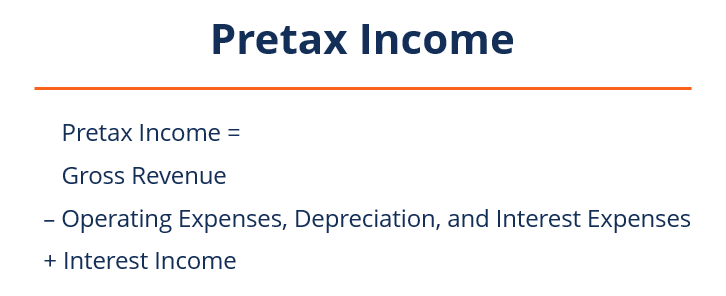
Formula for Pretax Income
The formula for calculating pretax income is as follows:
Pretax Income = Gross Revenue – Operating, Depreciation, and Interest Expenses + Interest Income
Where:
- Gross revenue: All revenues generated by the business
- Operating expenses: Includes deductions due to depreciation, amortization, and interest expenses
- Interest income: Revenues generated by the business from outstanding loans issued by the business
Illustrative Example
Consider Company ABC’s performance in 2018:
- Gross revenue: $8,000,000
- Cost of Goods Sold (COGS)Cost of Goods Sold (COGS)Cost of Goods Sold (COGS) measures the “direct cost” incurred in the production of any goods or services. It includes material cost, direct: $560,000
- Employee wages and salaries: $86,000
- Repair and maintenance costs: $12,000
- General administrative expenses: $240,000
- Interest expenses: $57,000
- Depreciation and amortization: $130,000
Using the formula above, the pretax income of Company ABC is calculated as:
Pretax Income = $8,000,000 – ($560,000 + $86,000 + $12,000 + $240,000 + $130,000 + $57,000) + 0
Pretax Income = $6,915,000
Significance of Pretax Income
1. Provides insight into a company’s financial standing
Taxes affect the overall earnings of a company. Pretax earnings, hence, provide an insight into the company’s financial performance and standing before its tax expense affects the net earnings and brings about any fluctuations.
2. Facilitates smooth, bias-free inter-company and intra-company comparisons
When performing an inter-company or an intra-company financial analysis or comparison, the year-by-year tax expense of an organization can vary widely. This is due to tax rules, tax rates, incentives vary widely from industry to industry, year to year and country to country. Also, companies can apply tax credits, and carry over losses in any given year.
An assessment of pretax income, as opposed to net earnings after tax, facilitates a much cleaner comparison of the organization over time, as well as to other companies. Looking at pretax income eliminates any discrepancies or effects that a tax expense could leave on an organization’s earnings.
3. Helps measures the fiscal health of a company over time
Another significance of pretax earnings is that it helps provide a more consistent and firm measure of the overall financial performance and fiscal health of a company over time. Pretax earnings eliminate the volatile differences that arise when tax considerations are accounted for.
4. Serves as a profitability ratio
Pretax earnings also help to accurately assess the profitability of a company. The pretax earnings margin is the ratio of a company’s pretax earnings to its total sales. The higher the ratio, the more profitable the position of the company. Using the information provided above, the pretax earnings margin for Company ABC is $6,915,000 / $8,000,000 (Pretax Earnings/Total Sales) = 87%.
Position on the Income Statement
On the income statement of an organization, pretax earnings are shown right before the calculation of the final net profit or net earnings of a company. The figure is shown as Earnings Before Taxes or Profit Before Taxes.
Pretax Income vs. Earnings Before Interest and Taxes (EBIT)
Earnings Before Interest and Tax (EBIT)EBIT GuideEBIT stands for Earnings Before Interest and Taxes and is one of the last subtotals in the income statement before net income. EBIT is also sometimes referred to as operating income and is called this because it's found by deducting all operating expenses (production and non-production costs) from sales revenue. refers to the net earnings of a company before accounting for any interest and tax expenses, whereas Earnings before Tax (EBT) refers to the net earnings of a company after accounting for all operating, depreciation, and interest expenses and interest incomes, but before accounting for any tax expenses.
Confusion often arises between the two terms. The main difference between them relates to interest expenses. EBIT is before the deduction of interest expenses and taxes, whereas EBT is after the deduction of all interest expenses and adding of all interest incomes to the operating income of a company.
More Resources
CFI is the official provider of the Financial Modeling and Valuation Analyst (FMVA)Become a Certified Financial Modeling & Valuation Analyst (FMVA)®CFI's Financial Modeling and Valuation Analyst (FMVA)® certification will help you gain the confidence you need in your finance career. Enroll today!®Become a Certified Financial Modeling & Valuation Analyst (FMVA)®CFI's Financial Modeling and Valuation Analyst (FMVA)® certification will help you gain the confidence you need in your finance career. Enroll today! certification program, designed to transform anyone into a world-class financial analyst.
To keep learning and developing your knowledge of financial analysis, we highly recommend the additional CFI resources listed below:
- Comparable Company AnalysisComparable Company AnalysisThis guide shows you step-by-step how to build comparable company analysis ("Comps") and includes a free template and many examples.
- Depreciation MethodsDepreciation MethodsThe most common types of depreciation methods include straight-line, double declining balance, units of production, and sum of years digits.
- Fixed and Variable CostsFixed and Variable CostsCost is something that can be classified in several ways depending on its nature. One of the most popular methods is classification according
- SG&ASG&ASG&A includes all non-production expenses incurred by a company in any given period. It includes expenses such as rent, advertising, marketing
-

Understanding Taxable Income: Definition & Calculation
Taxable income refers to any individual’s or business’ compensation that is used to determine tax liability. The total income amount or gross income is used as the basis to calculate how m
-

Net Income Explained: A Comprehensive Guide for Businesses & Individuals
Net income is revenue minus expenses, interest, and taxes. Here’s what you need to know about net income and why businesses and individuals pay close attention to it.What is net income?Net income is a
Accounting
- Understanding Accounting Income: A Key Financial Metric
- Accrued Income Explained: Definition & Accounting
- EBT vs. Pretax Income: Understanding the Difference
- Income Smoothing: Definition, Methods & Implications
- Understanding Net Income: A Comprehensive Guide
- Non-Operating Income: Definition, Examples & Significance
- Understanding Profit: A Key Financial Metric
- Understanding Revenue: A Comprehensive Guide for Businesses
- Revenue vs. Income: Understanding the Key Differences
-
 Understanding Income Tax: A Comprehensive Guide for Individuals & Businesses
Income tax is a tax that is imposed by governments on individuals and businesses with respect to income or profits earned by them. To determine the amount of income tax that should be paid by individu...
-
 Understanding Interest Income: A Comprehensive Guide
Interest income is the amount paid to an entity for lending its money or letting another entity use its funds. On a larger scale, interest income is the amount earned by an investor’s money that...