
Negative Income Tax: A Comprehensive Explanation
Negative income tax is a system where cash is given by the government to eligible tax residents who are earning below a certain threshold. We can consider negative income tax as a mirror image of regular income tax, where those individuals earning above the threshold pay tax to the government, and those below receive refundable credits from the government.

Rationale
Negative income tax was initially proposed by Nobel laureate Milton Freidman as a utopian way of addressing inequality in society. The purpose of the scheme is to provide a kind of self-correcting safety net. It helps neutralize to a great extent the income gap that exists between the masses in the society, thereby providing positive externalities.
Advantages of Negative Income Tax
1. Precise targeting
In an ideal world, suppose an individual pays income tax only if the household incomeTaxable IncomeTaxable income refers to any individual's or business’ compensation that is used to determine tax liability. The total income amount or gross income is used as the basis to calculate how much the individual or organization owes the government for the specific tax period. crosses $10,000. In our case, our protagonist, Mr. X, makes $8,000 per annum.
- Get the difference between the threshold ($10,000) and the actual money earned ($8,000). The amount, in our case, $2,000, will be taxed negatively, i.e., paid by the government at the rate of say 20%. It works out to a negative income tax of $400.
- So, instead of $8,000, Mr. X now earns $8,400. As can be seen in this example, only people earning income below a certain level are targeted, the rest will not be paid the negative income tax amount.
2. Plug leakages in welfare schemes
Once an individual files a tax returnForm 1040EZForm 1040-EZ is a U.S. federal income tax form that was offered by the Internal Revenue Service (IRS) up through tax year 2017. Many American, there is a paper trail available with all the personal information. Hence, people cannot falsify claims.
An automatic self-check mechanism is built into the system. It will automatically eliminate people with bad intent, as it can prove to be too costly to deceive the government with an established paper trail coupled with a concrete trail of one’s economic activity.
Many welfare schemes suffer from leakages, wherein the benefit does not reach the targeted citizens. However, negative income tax is applied to all tax filers.
3. Absence of disincentivization
Suppose an individual earns $10,000. Based on a negative income tax rate of 20%. The maximum that a person can earn is $10,000 * 20%, which is $2,000. The amount is substantially less than the $8,400 earned by Mr. X in our previous example.
This illustrates that below the threshold, all applicants are not treated similarly. There is an incentive to look for a source of income, thereby maximizing the impact of the negative income tax. The purpose of the tax scheme is to help keep the vulnerable sections of the society in good stead, especially during bad times.
4. Simpler tax regime
Currently, there is a long list of deductions, subsidies, social welfareSocial SecuritySocial Security is a US federal government program that provides social insurance and benefits to people with inadequate or no income. The first Social, and many other difficult to administer schemes. With a negative income tax, many schemes can be eliminated. It will save a substantial amount of financial resources on admin-related work, thereby leading to greater compliance and streamlined service delivery.
Challenges
The biggest challenge confronting negative income tax is the fiscal burden on the government of the day. Currently, nearly 24% of the federal US budget is spent on social security, which amounts to around $950 billion.
Across the world, all countries employ some kind of social benefits scheme that target the weaker segments of society. Therefore, the government is already spending funds on the same goals as that of negative income tax.
The biggest challenge is to channel existing governmental resources into the negative income tax regime as there are many overlapping social welfare programs that strain the system. Unless some of the existing welfare is not curtailed, it is very difficult to create fiscal space for the execution of negative income tax.
Negative Income Tax vs. Other Alternatives
With automation and artificial intelligence expected to make several jobs redundant, a new form of robust, sustainable, and scalable welfare/social security net is needed.
There are a few alternatives, such as universal basic income, which are also talked about quite favorably. Nevertheless, universal basic income suffers from the issue of imprecise targeting. As the name suggests, universal basic income would provide a fixed amount of income to all the citizens regardless of their existing income levels.
The imprecise targeting will lead to minuscule benefits, thereby rendering the whole exercise meaningless. It is where negative income tax may be more effective in providing tangible benefits to society.
Conclusion
Negative income tax provides a interesting solution to a complex problem of delivering benefits to the needy segments of the society. The policy is simple to administer and would help plug leakages in the current service delivery by providing precise targeting. The tax is a self-correcting safety net.
Additional Resources
CFI is the official provider of the global Commercial Banking & Credit Analyst (CBCA)™Program Page - CBCAGet CFI's CBCA™ certification and become a Commercial Banking & Credit Analyst. Enroll and advance your career with our certification programs and courses. certification program, designed to help anyone become a world-class financial analyst. To keep advancing your career, the additional resources below will be useful:
- Corporate vs Personal Income TaxCorporate vs Personal Income TaxIn this article, we will discuss corporate vs personal income tax. Corporate tax is an expense of a business (cash outflow) levied by the government
- Flat TaxFlat TaxA flat tax refers to a tax system where a single tax rate is applied to all levels of income. This means that individuals with a low income
- Tax ShieldTax ShieldA Tax Shield is an allowable deduction from taxable income that results in a reduction of taxes owed. The value of these shields depends on the effective tax rate for the corporation or individual. Common expenses that are deductible include depreciation, amortization, mortgage payments and interest expense
- Voluntary ComplianceVoluntary ComplianceVoluntary compliance is an assumption under which the U.S. tax system operates. It is the principle for which all the taxpayers will cooperate
-
Understanding Revenue: A Comprehensive Guide for Businesses
Revenue is the value of all sales of goods and services recognized by a company in a period. Revenue (also referred to as Sales or Income) forms the beginning of a company’s income statementInco
-
Revenue vs. Income: Understanding the Key Differences
This guide provides an overview of the main differences between revenue vs income. RevenueSales RevenueSales revenue is the income received by a company from its sales of goods or the provision of ser
Accounting
- Corporate vs. Personal Income Tax: Key Differences Explained
- Understanding Federal Income Tax: A Comprehensive Guide
- Understanding Income Tax: A Comprehensive Guide for Individuals & Businesses
- Understanding Income Tax Payable: A Guide for Businesses
- Understanding Net of Tax: Definition & Calculation
- Annualized Income: Definition, Calculation & Tax Implications
- Understanding Deferred Income Tax: A Comprehensive Guide
- Net Income After Tax (NIAT): Definition & Importance
- Voluntary Tax Compliance: Understanding the U.S. Tax System
-
 Progressive Tax Explained: How It Works & Examples
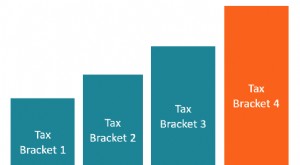
A progressive tax is a tax system that increases rates as the taxable income goes up. It is usually segmented into tax brackets that progress to successively higher rates. For example, a progressive t...
-
 Regressive Taxes: Definition, Examples & Impact on Income Inequality
A regressive tax is a tax applied in a way that the tax rate decreases with the increase of the taxpayer’s incomeRemunerationRemuneration is any type of compensation or payment that an individua...