
Understanding Intersegment Sales: Definition & Reporting
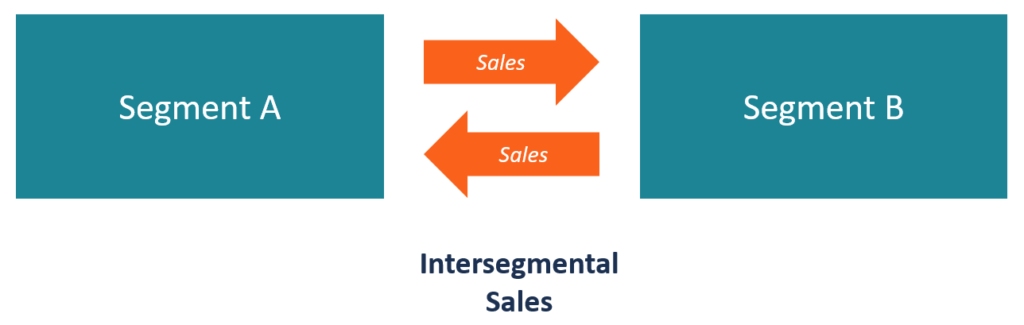
Intersegment sales refer to revenue generated by means of a transaction between segments within the same business. It is generally the case with large conglomerates that engage in several lines of business. Such companies manage segments that have interconnect operations either vertically or horizontally.
Companies are required to disclose all intersegment sales under a specific heading, usually referred to as “Intersegment Reporting,” or “Intersegment Sales,” in the notes to the financial statements in their annual reportsThree Financial StatementsThe three financial statements are the income statement, the balance sheet, and the statement of cash flows. These three core statements are. Several accounting standards boards around the world require companies to disclose such sales in order to provide full disclosure or an accurate picture of the business’ financial health.
Summary
- Revenue generated from transactions between two segments that belong to the same business is known as intersegment sales.
- Companies are required to disclose all intersegment sales under a specific heading in the notes to the financial statements.
- Intersegment sales and segment sales reporting are related, but are composed of different amounts and are reported differently in the audit report.
Intersegment Sales vs. Segment Reporting
When a company operates a business with multiple branches of operations, and each branch, or segment, generates revenue independently through its operations, the individual revenue results are recorded under the “segment reporting” section in the company’s annual report. If that same company generates revenue by means of sales between segments, those amounts are reported in the notes to the financial statements in a section normally called intersegmental sales revenue.
Companies generally divide their operations into different geographical segments, or different operative or functional segments, and so on. The key difference between the two terms basically relates to the nature of the transactions and how they are disclosed. For example, when a company is operating three segments, such that, segment A deals in raw materials for the production of product A, which the company exclusively sells under segment B, and provides services on the product under Segment C.
In such a case, when the company is transacting between segment A and segment B for the production of product A, it is engaging in intersegment sales, as segment A is booking revenue by selling to segment B.
On the other hand, when multinational companiesMultinational Corporation (MNC)A multinational corporation is a company that operates in its home country, as well as in other countries around the world. It maintains a are divergent in their operations and generate revenue through different operational segments, and not internally but externally by making sales in the market, it will fall under segment reporting.
Benefits of Disclosing Intersegment Sales
1. Provides an accurate financial picture
When a company discloses its intersegment sales, it provides an accurate financial picture of its sales and operations through its annual reports.
2. Helps navigate internal operations
Diligently reporting intersegment sales helps in the smooth navigation of the company’s internal operations. The practice gives an accurate financial, as well as operational picture, of the interdependency of the operating segments of the company – and eventually helps in efficient planning and management.
3. Helps in sales/revenue planning
Full and precise disclosure of intersegment sales accurately segregates the revenue that the company is generating externally and internally. It helps in knowing how much revenue comes from where – which essentially helps the management in making financial and operational decisions.
More Resources
CFI offers the Financial Modeling & Valuation Analyst (FMVA)Become a Certified Financial Modeling & Valuation Analyst (FMVA)®CFI's Financial Modeling and Valuation Analyst (FMVA)® certification will help you gain the confidence you need in your finance career. Enroll today!®Become a Certified Financial Modeling & Valuation Analyst (FMVA)®CFI's Financial Modeling and Valuation Analyst (FMVA)® certification will help you gain the confidence you need in your finance career. Enroll today! certification program for those looking to take their careers to the next level. To keep learning and advancing your career, the following resources will be helpful:
- Accounting Profit vs Economic ProfitAccounting Profit vs Economic ProfitThis guide will help you thoroughly understand accounting profit vs economic profit, and while they may sound similar, they are actually quite
- Analysis of Financial StatementsAnalysis of Financial StatementsHow to perform Analysis of Financial Statements. This guide will teach you to perform financial statement analysis of the income statement,
- IFRS vs US GAAPIFRS vs. US GAAPThe IFRS vs US GAAP refers to two accounting standards and principles adhered to by countries in the world in relation to financial reporting
- Projecting Income Statement Line ItemsProjecting Income Statement Line ItemsWe discuss the different methods of projecting income statement line items. Projecting income statement line items begins with sales revenue, then cost
-
Understanding Financial Statement Notes: A Comprehensive Guide
Financial statement notes are the supplemental notes that are included with the published financial statements of a company. The notes are used to explain the assumptions used to prepare the numbers i
-

Understanding IFRS Standards: A Comprehensive Guide
IFRS standards are International Financial Reporting Standards (IFRS) that consist of a set of accounting rules that determine how transactions and other accounting events are required to be reported
Accounting
- Understanding Financial Barriers: How Costs Impact Your Lifestyle
- Financial Covenants: Definition, Types & Importance
- Robo-Advisors: A Comprehensive Guide to Automated Investment Management
- Understanding Audit Assertions: A Comprehensive Guide
- Understanding Credit Sales: Definition & Benefits | CFI
- Understanding Financial Assets: Definitions & Types
- Understanding Financial Statements: A Comprehensive Guide
- Understanding Net Sales: Definition & Importance
- Understanding Financial Services: A Comprehensive Guide
-
![Marketable Securities: Definition & Types | [Your Brand/Company Name]](https://www.etffin.com/article/uploadfiles/202110/2021100815155870_S.jpg) Marketable Securities: Definition & Types | [Your Brand/Company Name]
Marketable Securities: Definition & Types | [Your Brand/Company Name]Marketable securities are unrestricted short-term financial instruments that are issued either for equity securitiesStockWhat is a stock? An individual who owns stock in a company is ca...
-
 Understanding Financial Markets: A Comprehensive Guide
Financial markets, from the name itself, are a type of marketplace that provides an avenue for the sale and purchase of assets such as bondsBondsBonds are fixed-income securities that are issued by co...