
Understanding Credit Sales: Definition & Benefits | CFI
Credit sales refer to a sale in which the amount owed will be paid at a later date. In other words, credit sales are purchases made by customers who do not render payment in full, in cash, at the time of purchase. To learn more, check out CFI’s Credit Analyst Certification programProgram Page - CBCAGet CFI's CBCA™ certification and become a Commercial Banking & Credit Analyst. Enroll and advance your career with our certification programs and courses..

Types of Sales Transactions
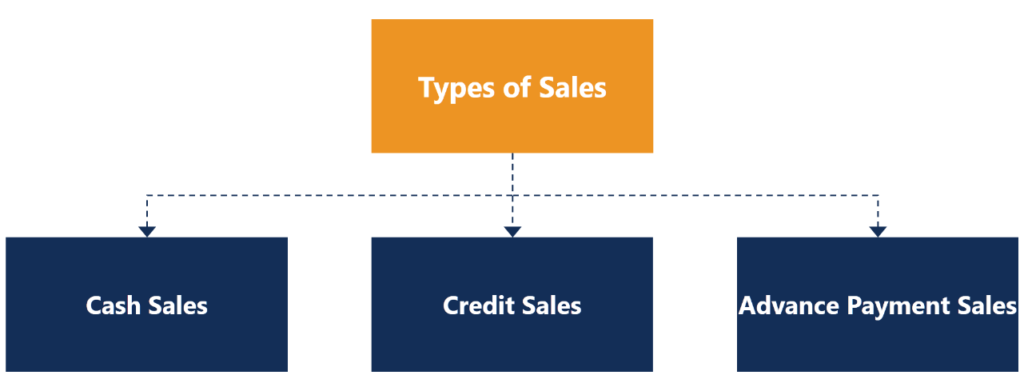
There are three main types of sales transactions: cash sales, credit sales, and advance payment sales. The difference between these sales transactions simply lies in the timing of when cash is received.
1. Cash sales: Cash is collected when the sale is made and the goodsInventoryInventory is a current asset account found on the balance sheet, consisting of all raw materials, work-in-progress, and finished goods that a or services are delivered to the customer.
2. Credit sales: Customers are given a period of time after the sale is made to pay the seller.
3. Advance payment sales: Customers pay the seller in advance before the sale is made.
Credit Terms and Credit Sales
It is common for credit sales to include credit terms. Credit terms are terms that indicate when payment is due for sales that are made on credit, possible discounts, and any applicable interest or late payment fees.
For example, the credit terms for credit sales may be 2/10, net 30. This means that the amount is due in 30 days (net 30). However, if the customer pays within 10 days, a 2% discount will be applied.
Assume Company A sold $10,000 worth of goods to Michael. Company A offers credit terms 5/10, net 30. If Michael pays the amount owed ($10,000) within 10 days, he would be able to enjoy a 5% discount. Therefore, the amount that Michael would need to pay for his purchases if he paid within 10 days would be $9,500.
How to Record a Credit Sale
On January 1, 2018, Company A sold computers and laptops to John on credit. The amount owed is $10,000, due on January 31, 2018. On January 30, 2018, John made the full payment of $10,000 for the computers and laptops.
The journal entries would be as follows:
DateAccount TitleDebitCreditJanuary 1, 2018Accounts Receivable$10,000 Sales$10,000To record the sale of goods to John on creditDateAccount TitleDebitCreditJanuary 30, 2018Cash$10,000 Accounts Receivable$10,000To record the full payment made by John for purchases on January 1, 2018
How to Record a Credit Sale with Credit Terms
Consider the same example above – Company A selling goods to John on credit for $10,000, due on January 31, 2018. However, let us consider the effect of the credit terms 2/10 net 30 on this purchase.
The journal entries would be as follows:
DateAccount TitleDebitCreditJanuary 1, 2018Accounts Receivable$10,000 Sales$10,000To record the sale of goods to John on credit
John decides to take advantage of the credit terms and thus pays on January 5, 2018:
DateAccount TitleDebitCreditJanuary 5, 2018Cash$9,800Cash Discount $200 Accounts Receivable$10,000To record the sale of goods to John on credit with the credit discount
John paid his invoice four days (January 5) after purchasing the goods on credit. Therefore, he would be able to enjoy a 2% discount on his credit purchase ($10,000 x 2% = $200).
Advantages and Disadvantages of Credit Sales
As previously mentioned, credit sales are sales where the customer is given an extended period to pay. There are several advantages and disadvantages for a company offering credit sales to customers.
Advantages
- Credit sales can be used to more easily acquire new customers. Offering credit can attract new customers to purchase from the company.
- Customers are sometimes without enough cash on hand. Offering credit gives customers the flexibility to go ahead and buy now and pay for purchases at a later date.
Disadvantages
- Customers can potentially go bankruptBankruptcyBankruptcy is the legal status of a human or a non-human entity (a firm or a government agency) that is unable to repay its outstanding debts. If customers go bankrupt, the amount owed may be unrecoverable and must be written off.
- Costs of collection may decrease profits. If a customer misses the payment or refuses to pay, the company may incur collection costs in trying to obtain the payment.
More Reading
CFI is the official provider of the online Commercial Banking & Credit Analyst (CBCA)™Program Page - CBCAGet CFI's CBCA™ certification and become a Commercial Banking & Credit Analyst. Enroll and advance your career with our certification programs and courses. program, designed to help anyone become a world-class credit analyst. To develop your career in corporate finance, these additional CFI resources will be helpful:
- Trade CreditTrade CreditA trade credit is an agreement or understanding between agents engaged in business with each other that allows the exchange of goods and services
- Sale and Purchase AgreementSale and Purchase AgreementThe Sale and Purchase Agreement (SPA) represents the outcome of key commercial and pricing negotiations. In essence, it sets out the agreed elements of the deal, includes a number of important protections to all the parties involved and provides the legal framework to complete the sale of a property.
- Projecting Income Statement Line ItemsProjecting Income Statement Line ItemsWe discuss the different methods of projecting income statement line items. Projecting income statement line items begins with sales revenue, then cost
- Allowance for Doubtful AccountsAllowance for Doubtful AccountsThe allowance for doubtful accounts is a contra-asset account that is associated with accounts receivable and serves to reflect the true value of accounts receivable. The amount represents the value of accounts receivable that a company does not expect to receive payment for.
-
VantageScore 3.0: Understanding the Latest Credit Scoring Model
While the FICO score remains the most popular credit scoring model in the U.S., VantageScore is quickly growing as a favorite amongst lenders. Developed jointly by the three major credit bureaus (E
-

Understanding Revolving Credit: A Comprehensive Guide
There are many ways to get financing in the world today. Revolving credit is a great way to do this, and there are many ways in which you can access this type of credit. Ready to learn more about h
Accounting
- Understanding Credit Card Pending Charges: What You Need to Know
- Credit Card Dimensions & Security: Everything You Need to Know
- Indent Sales Explained: How to Expand Your Market Reach
- Understanding Business Metrics: Key Performance Indicators & KPIs
- Credit Analysis Ratios: A Comprehensive Guide for Investors & Analysts
- Understanding Intersegment Sales: Definition & Reporting
- Understanding Net Sales: Definition & Importance
- Understanding Same-Store Sales: A Key Retail Performance Indicator
- Understanding Tax Credits: Reduce Your Tax Bill - [Year]
-
 Understanding Credit Scores: What They Are & Why They Matter
A credit score is a number representative of an individual’s financial and credit standing and ability to obtain financial assistance from lenders. LendersFinancial IntermediaryA financial inter...
-
 HELOCs Explained: Flexible Home Equity Financing
One of the most popular personal financing options in recent decades has been the HELOC. What is a HELOC? It’s a type of credit facility that enables you to access the equity in your home, but to do s...