
Understanding Net Sales: Definition & Importance
Net sales are the total revenue generated by a company, excluding any sales returns, allowances, and discounts. It is a very important figure and is used by analysts when making decisions about the business or analyzing a company’s top line growth. The formula for net sales is demonstrated in the image below:

Typically, a company’s income statementIncome StatementThe Income Statement is one of a company's core financial statements that shows their profit and loss over a period of time. The profit or highlights the net sales figure. In some cases, companies will choose to report both gross and net sales, but they will always be displayed as separate line items. The deductions from gross sales show the quality of sales transactions. If there is a large difference between both figures, the company may be giving large discounts on its sales.
Summary
- Net sales are the total revenue generated by the company, excluding any sales returns, allowances, and discounts.
- The figure is used by analysts when making decisions about the business or analyzing a company’s top line growth.
- Net sales are derived from gross sales and are more important when analyzing the quality of a company’s sales.
Net Sales Components
The formula given above for net sales comprises several components. It is important to understand what each term in the formula indicates and its importance while deriving the net sales number:
- Gross sales: The total sales that are not adjusted for any discounts, allowances, or returns. They include all types of sales, such as cash, debit or credit cardCredit CardA credit card is a simple yet no-ordinary card that allows the owner to make purchases without bringing out any amount of cash. Instead, by using a credit, and trade credit sales.
- Sales returns: If any goods that are purchased are eventually returned, they fall under returns. Companies typically refund the complete or partial amount of the goods, and the amount of gross sales is reduced by the amount of the refunds.
- Allowances: For any goods that are damaged, companies reduce the marked price and sell it at a lower price. The sales of such goods are recorded at a lower price; therefore, the difference between the marked price and the selling price (known as the allowance) is reduced from the gross sales number.
- Discounts: Several stores offer seasonal discounts to customers on goods purchased. Discounts can also be offered if the customer makes a bulk purchase or makes a payment before the stipulated time. Such discounts are reduced from gross sales.
Net Sales vs. Gross Sales
Gross sales and net sales are, at times, confused and assumed to be similar. Net sales are derived from gross sales and are more important when analyzing the quality of a company’s sales. Gross sales on their own are not as informative, as it overstates a company’s actual sales because it includes several other variables that cannot essentially be classified as sales.
Net sales, on the other hand, is a more accurate reflection of a company’s revenues and can be used to assess the true turnover of the company, along with deriving strategies for the sales and marketing teams to enhance future revenues.
Gross sales are calculated simply as the units sold multiplied by the sales price per unit. The gross sales amount is typically much higher, as it does not include returns, allowances, or discounts. The net sales amount, which is calculated after adjusting for the variables, is lower.
Because the non-sales revenue items are removed, net sales are a better reflection of the company’s turnover and health, and it is employed for decision-making purposes. The table below highlights the key differences between net and gross sales:
Net Sales Gross Sales DefinitionTotal sales after deductionsTotal sales with no deductionsInterdependencyDependent on gross salesNot dependent on net salesAmountComparatively lessHighFormulaGross Sales – DeductionsUnits Sold x Sales Price
Net Sales and the Income Statement
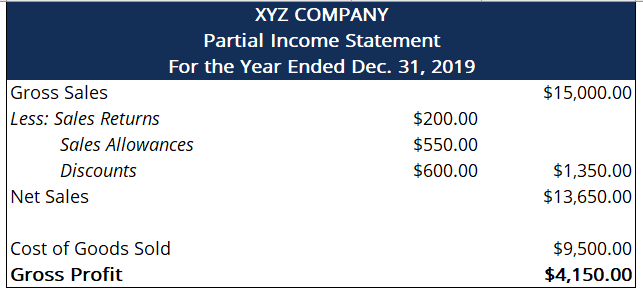
Net sales are depicted on a company’s income statement. Most companies directly report the net sales numbers, and the derivation is given in the notes to the financial statementsFinancial Statement NotesFinancial statement notes are the supplemental notes that are included with the published financial statements of a company. The notes are. However, some companies report gross and net sales both on the income statement itself. The table below shows an excerpt from a sample income statement.
The top number is gross sales, and the different components are deducted to derive net sales. Gross profit is calculated using the net sales, and not the gross sales numbers. If the discrepancy between the gross and net sales numbers is very high, it can be a red flag that the company’s quality of revenue for the company is not good, because they are discounting products from list price to generate the revenues.
Additional Resources
CFI offers the Commercial Banking & Credit Analyst (CBCA)™Program Page - CBCAGet CFI's CBCA™ certification and become a Commercial Banking & Credit Analyst. Enroll and advance your career with our certification programs and courses. certification program for those looking to take their careers to the next level. To keep learning and developing your knowledge base, please explore the additional relevant resources below:
- Projecting Income Statement Line ItemsProjecting Income Statement Line ItemsWe discuss the different methods of projecting income statement line items. Projecting income statement line items begins with sales revenue, then cost
- Gross Merchandise Value (GMV)Gross Merchandise Value (GMV)Gross Merchandise Value (GMV), also referred to as gross merchandise volume, is the total amount of sales a company makes over a specified period of time, typically measured quarterly or yearly. GMV is calculated before accrued expenses are deducted.
- Net PremiumNet PremiumNet premium is the amount received or written on insurance policies when premiums are incurred or paid and return premiums are deducted from gross premiums.
- Sales and Collection CycleSales and Collection CycleThe Sales and Collection Cycle, also known as the revenue, receivables, and receipts (RRR) cycle, is comprised of various classes of
-

Biological Assets: Definition, Examples & Accounting
Biological Assets are assets that are living – for example, trees, animals, or cannabis. The balance sheetBalance SheetThe balance sheet is one of the three fundamental financial statements. The
-

Discontinued Operations: Definition & Accounting Treatment
Discontinued operations is a term used in accounting to refer to parts of a company’s business that have been terminated and are no longer operational. In accounting, discontinued operations are
Accounting
- Indent Sales Explained: How to Expand Your Market Reach
- Understanding Business Metrics: Key Performance Indicators & KPIs
- Net Liquid Assets: Definition, Calculation & Importance
- Understanding Unrestricted Net Assets for Nonprofits
- Understanding Credit Sales: Definition & Benefits | CFI
- Gross vs. Net: Understanding the Difference - Definitions & Examples
- Understanding Intersegment Sales: Definition & Reporting
- Understanding Net Income: A Comprehensive Guide
- Net Tangible Assets (NTA): Definition, Calculation & Importance
-
 Understanding Administrative Expenses: A Comprehensive Guide
Administrative expenses refer to the costs incurred by a company or organization that include, but are not limited to, the salaries and benefitsRemunerationRemuneration is any type of compensation or ...
-
 Understanding Assurance Services: Risk Reduction & Improved Decisions
Assurance services are an independent examination of a company’s processes and controls. Assurance aims to reduce information risk by improving the quality or context of the information. &n...