
Long-Term Assets: Definition, Examples & Importance
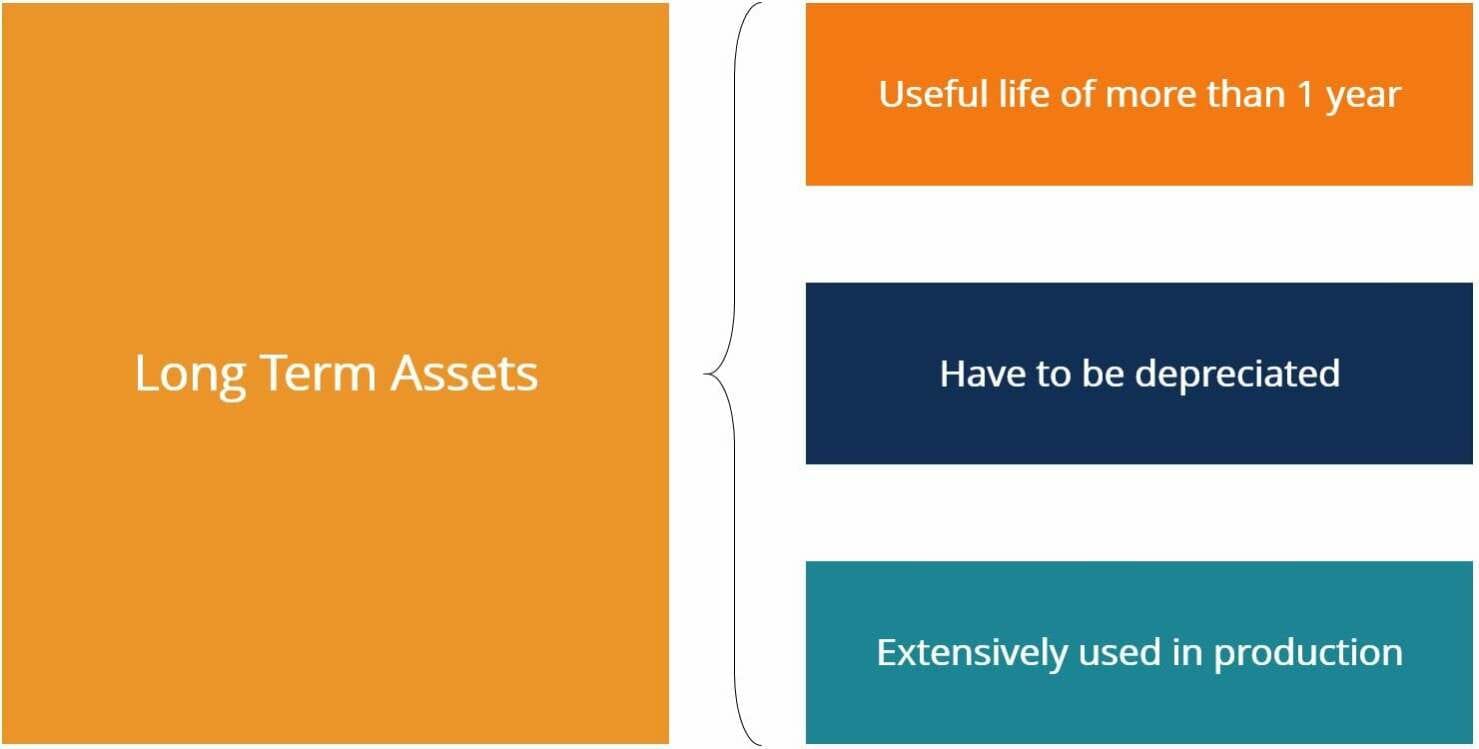
Long term assets are assets that a company uses in its production process and with a useful life of more than one year. Such assets are also called “fixed assets,” as they can contribute to a big portion of the company’s fixed costsFixed and Variable CostsCost is something that can be classified in several ways depending on its nature. One of the most popular methods is classification according associated with production. For example, an automobile manufacturer might consider factories to be long term assets since they are at the core of the business’ production process.
Regardless of the company’s monthly or yearly output, the costs associated with running the factories do not fluctuate greatly and represent a significant portion of the company’s cost of goods sold (COGSCost of Goods Sold (COGS)Cost of Goods Sold (COGS) measures the “direct cost” incurred in the production of any goods or services. It includes material cost, direct). The factories would be treated as long term assets. The assets also need to be depreciatedDepreciation MethodsThe most common types of depreciation methods include straight-line, double declining balance, units of production, and sum of years digits. over the course of their useful lives. In summary:
Depreciation of Long Term Assets
As with most types of assets, long term assets needs to be depreciated over the course of their useful life. It is because a long term asset is not expected to generate a benefit for an infinite amount of time. In the automobile factory example, machines will become old and may experience breakdowns or fall victim to obsolescence.
There are many accounting treatments a company can use to depreciate its assets, such as the double-declining balanceDouble Declining Balance DepreciationThe double declining balance depreciation method is a form of accelerated depreciation that doubles the regular depreciation approach. It is method, the units of production method, or the straight-line depreciationStraight Line DepreciationStraight line depreciation is the most commonly used and easiest method for allocating depreciation of an asset. With the straight line method. It is important to note that depreciation is not considered a cash expense for the company.
Depreciation amounts that are incurred for the purposes of depreciating fixed assets provide a tax shield for the company’s income. Depreciation is subtracted from EBITDA to calculate taxable income, and then tax expense.
Long Term Asset Terminology
In order to better understand how long term assets affect a company’s financial health, it is important to become familiar with some terminology.
Property, Plant, and Equipment
Property, plant, and equipment (PP&E)PP&E (Property, Plant and Equipment)PP&E (Property, Plant, and Equipment) is one of the core non-current assets found on the balance sheet. PP&E is impacted by Capex, refers to the long term assets that a company owns, and that are crucial to the production process. Property refers to any property or proprietary assets that the company employs in its production. Plant refers to buildings and factories that are required for production.
For example, if a company decides to purchase the land on which its factories reside, this land would be counted under the PP&E account. Equipment refers to machines and other production aids that a company utilizes in its manufacturing process. Generally speaking, the majority of a company’s long term (or fixed) assets fall under this category.

Book Value
When a company acquires PP&E or other long term assets, it initially records the value of the assets at the time of purchase, which becomes their “book value.” The number is usually recorded as the purchase price that was paid by the company in order to acquire the asset.
Carrying Value
The carrying value of a long term asset (also called the net book value) refers to the value of the asset on the company’s books. The carrying value is the original cost of the asset less any accumulated depreciation. It can be thought of as the historical accounting value of the asset.
Below is an example of what long term assets such as PP&E would look like on a company’s balance sheetBalance SheetThe balance sheet is one of the three fundamental financial statements. The financial statements are key to both financial modeling and accounting.:
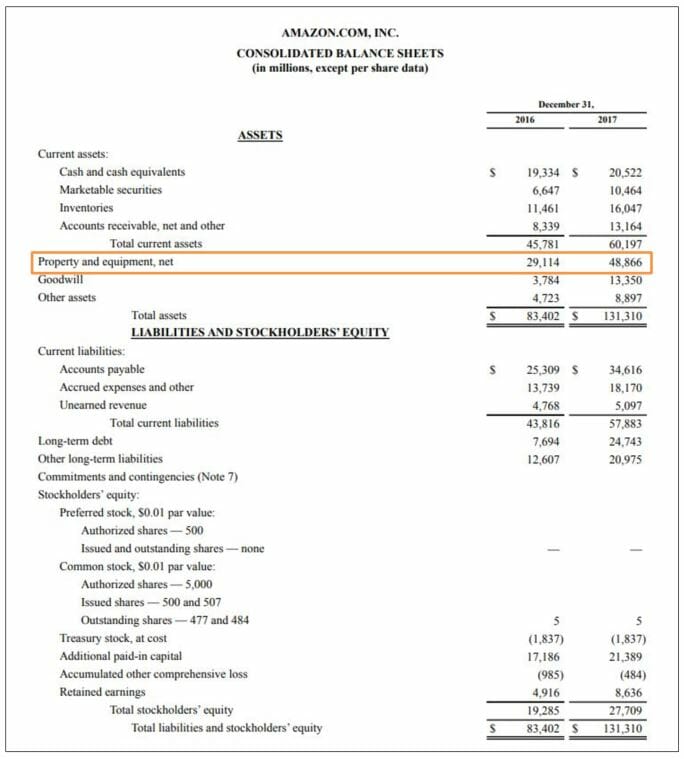
As we can see here, Amazon’s PP&E account grew substantially, from $29 billion in 2016 to $49 billion in 2017. This could be an indication that Amazon is pursuing capital-intensive projects and is investing in long term assets to sustain this expansion.
Applications in Financial Modeling
Long term assets are a crucial element of a company’s balance sheet and are required in order to accurately calculate the equivalent liabilities and shareholder’s equity. Below is a screenshot of CFI’s Balance Sheet TemplateBalance Sheet TemplateThis balance sheet template provides you with a foundation to build your own company's financial statement showing the total assets, liabilities and shareholders' equity. The balance sheet is based on the fundamental equation: Assets = Liabilities + Equity Using this template, you can add and remove line items under ea:
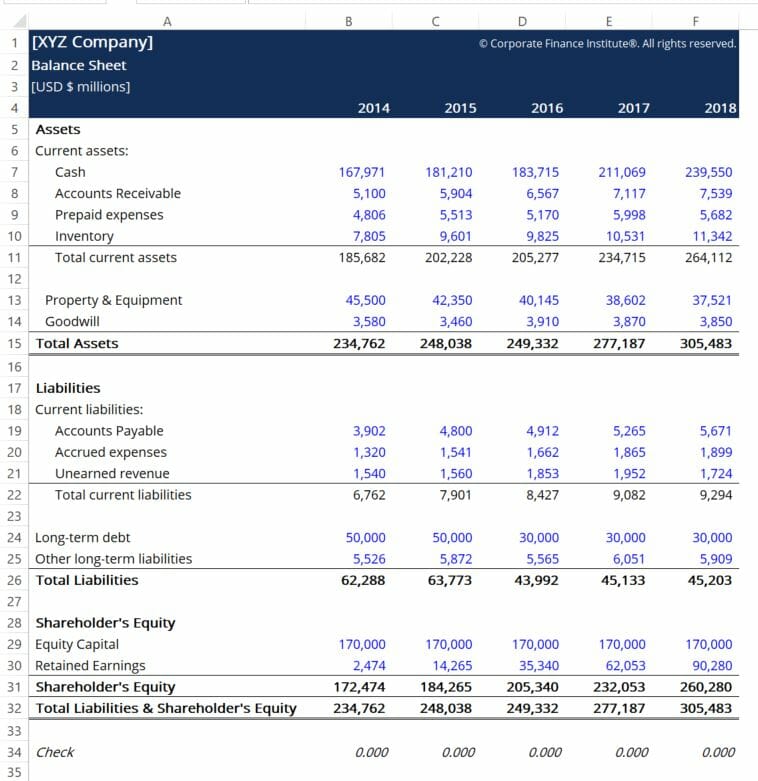
To further understand the relationship between the various line items on a company’s balance sheet and how they relate to the company’s income and cash flow statements, check out CFI’s Accounting Fundamentals Course.
Additional Resources
CFI offers the Financial Modeling & Valuation Analyst (FMVA)®Become a Certified Financial Modeling & Valuation Analyst (FMVA)®CFI's Financial Modeling and Valuation Analyst (FMVA)® certification will help you gain the confidence you need in your finance career. Enroll today! certification program for those looking to take their careers to the next level. To learn more about related topics, check out the following CFI resources:
- EBITDAEBITDAEBITDA or Earnings Before Interest, Tax, Depreciation, Amortization is a company's profits before any of these net deductions are made. EBITDA focuses on the operating decisions of a business because it looks at the business’ profitability from core operations before the impact of capital structure. Formula, examples
- NPV FunctionNPV FunctionThe NPV Function is categorized under Excel Financial functions. It will calculate the Net Present Value (NPV) for periodic cash flows. The NPV will be calculated for an investment by using a discount rate and series of future cash flows. In financial modeling, the NPV function is useful in determining the value of a business
- Payback PeriodPayback PeriodThe payback period shows how long it takes for a business to recoup an investment.
- Tax ShieldTax ShieldA Tax Shield is an allowable deduction from taxable income that results in a reduction of taxes owed. The value of these shields depends on the effective tax rate for the corporation or individual. Common expenses that are deductible include depreciation, amortization, mortgage payments and interest expense
-

Understanding Normalized Earnings: A Guide for Investors
Normalized earnings refer to adjustments made to financial statements to eliminate one-off effects that may impact the net income. A fundamental premise of normalizing earnings is to help financial an
-
Understanding Stranded Assets: Risks and Impacts
Stranded assets are assets that are unable to earn their original economic return due to changes in the landscape in which the assets operate. In simpler terms, stranded assets are assets that are wor
Accounting
- Investable Assets: A Comprehensive Guide for Investors
- Understanding Household Assets: A Comprehensive Guide
- Understanding Company Bylaws: A Comprehensive Guide
- Understanding Earnings: A Guide to Financial Profitability
- Fixed Assets: Definition, Examples & Importance for Businesses
- Understanding Redundant Assets: Definition & Impact on Business
- Biological Assets: Definition, Examples & Accounting
- Understanding Financial Assets: Definitions & Types
- Understanding Intangible Assets: Definition & Importance
-
 Understanding Explicit Costs: Definition & Examples
Explicit costs are business operating costs, or expenses, that are easily quantifiable and identifiable. Also referred to as accounting costs, the explicit costs of a company are recorded in its books...
-
 Non-Current Assets: Definition, Examples & Accounting
Non-current assets are assets whose benefits will be realized over more than one year and cannot easily be converted into cash. The assets are recorded on the balance sheet at acquisition cost, and th...