
Depreciated Cost Explained: Calculation & Importance
Depreciated cost is the remaining cost of an asset after reducing the asset’s original cost by the accumulated depreciation. Understanding the concept of a depreciation scheduleDepreciation ScheduleA depreciation schedule is required in financial modeling to link the three financial statements (income, balance sheet, cash flow) in Excel. and the depreciated cost is important for both accounting and valuation purposes.
Summary
- The depreciated cost of an asset is the purchase price less the total depreciation taken to date.
- The depreciated cost equals the net book value if the asset is not written off for impairment.
- The depreciated cost of an asset is determined by the depreciation method applied.
Depreciation and Depreciated Cost
In accounting, depreciation is an accounting process of reducing the cost of a physical asset over the asset’s useful life to mirror its wear and tear. It can be applied to tangible assets, of which the values decrease as they are used up. Buildings, vehicles, computers, equipment, and computers are some other examples of depreciable assets.
The fixed tangible assets typically come with a high purchase cost and a long life expectancy. Expensing the costs fully to a single accounting period doesn’t portrait the benefits of usage over time accurately. Thus, the IFRS and the GAAP allows companies to allocate the costs over several periods through depreciation.
The depreciated cost of an asset is the value that remained after the asset’s been depreciated over a period of time. It will be equal to the net book valueNet Book ValueNet book value (NBV) refers to a company’s assets or how the assets are recorded by the accountant. NBV is calculated using the asset’s or the carrying value of an asset if there is no impairment or other write-offs on that asset. At the end of its useful life, an asset’s depreciated cost will be equal to its salvage value.
The depreciated cost can be used as an asset valuation tool to determine the useful value of an asset at a specific point in time. It can be compared with the market value to examine whether there is an impairment to the asset. If an asset is sold, the depreciated cost can be compared with the sales price to report a gain or loss from the sale.
Calculation of Depreciated Cost
The depreciated cost of an asset can be calculated by deducting the acquisition cost of the asset by the accumulated depreciation. The formula is shown below:

The acquisition cost refers to the overall cost of purchasing an asset, which includes the purchase price, the shipping cost, sales taxes, installation fees, testing fees, and other acquisition costs.
Accumulated depreciation is the summation of the depreciation expense taken on the assets over time. It is a contra-asset account and is displayed together with the asset on the balance sheet.
Depreciated Cost and Depreciation Expense
Although the two terms look similar, depreciated cost and depreciation expense come with very different meanings and should not be confused with one another. The depreciation expense refers to the value depreciated during a certain period. It is reported in the income statement for that period.
The accumulated depreciation is equal to the sum of the incurred depreciation expenses. The depreciated cost can also be calculated by deducting the sum of depreciation expenses from the acquisition cost.

For example, a manufacturing company purchased a machine at the beginning of 2017. The purchase price of the machine was $100,000, and the company paid another $10,000 for shipment and installation. The overall acquisition cost was $110,000 ($100,000 + $10,000).
If the machine’s life expectancy is 20 years and its salvage value is $15,000, in the straight-line depreciation method, the depreciation expense is $4,750 [($110,000 – $15,000) / 20].
Thus, at the end of 2019, the accumulated depreciation is $14,250 ($4,750 * 3), and the depreciated cost is $95,750 ($110,000 – $14,250).
At the end of the useful life of the asset, the accumulated depreciation will be $95,000 ($4,750 * 20). The depreciated cost will be $15,000 ($110,000 – $95,000), equal to the salvage valueSalvage ValueSalvage value is the estimated amount that an asset is worth at the end of its useful life. Salvage value is also known as scrap value.
Depreciation Schedules
The depreciated cost of an asset can be determined by a depreciation schedule that a company applies to the asset. There are several allowable methods of depreciation, which will lead to different rates of depreciation, as well as different depreciation expenses for each period. Thus, the depreciated cost balance will also differ under different depreciation methods.
1. Straight-Line Method
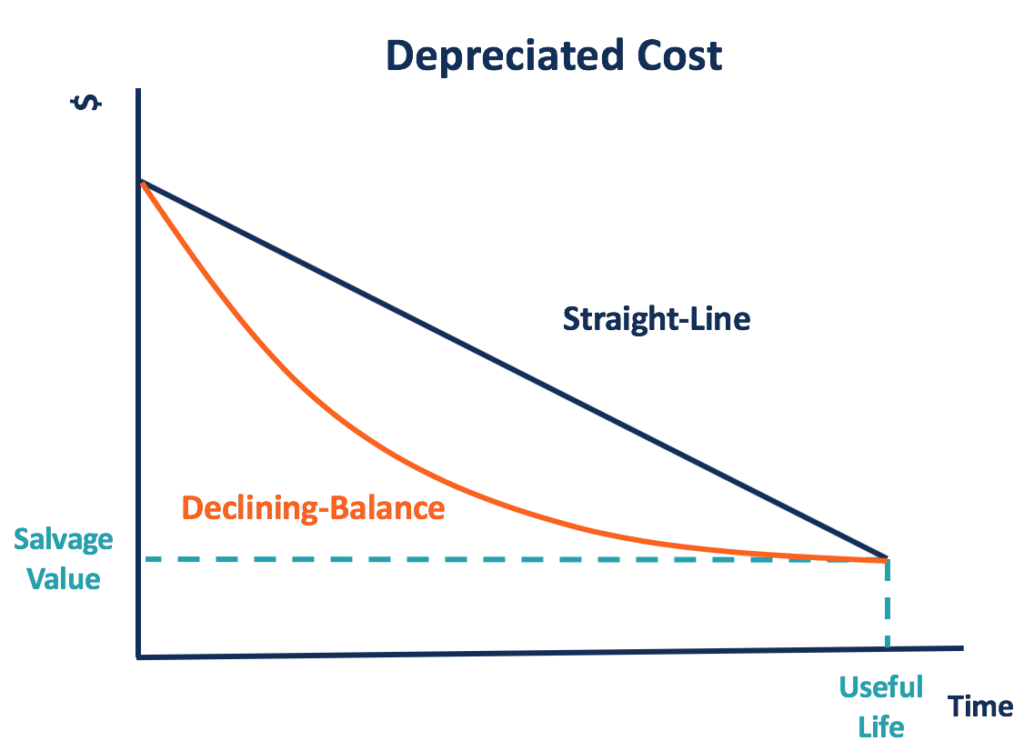
The most common depreciation method is the straight-line method, which is used in the example above. The cost available for depreciation is equally allocated over the asset’s life span. As the depreciation expense is constant for each period, the depreciated cost decreases at the constant rate under the straight-line depreciation methodStraight Line DepreciationStraight line depreciation is the most commonly used and easiest method for allocating depreciation of an asset. With the straight line.
2. Declining-Balance Method
The declining-balance method is an accelerated depreciation method. An asset is depreciated faster with higher depreciation expenses in the earlier years, compared with the straight-line method.
Thus, the depreciated cost decreases faster at first and slows down later. The double declining-balance depreciation is a commonly used type of declining-balance method.
3. Sum-of-the-Year’s-Digits (SYD) Method
Similar to the declining-balance method, the sum-of-the-year’s method also accelerates the depreciation of an asset. The asset will lose more of its book value during the early periods of its lifespan.
4. Units-of-Production Method
The units-of-production method depreciates equipment based on its usage versus the equipment’s expected capacity. The more units produced by the equipment, the greater amount the equipment is depreciated, and the lower the depreciated cost is.
Additional Resources
CFI is the official provider of the global Commercial Banking & Credit Analyst (CBCA)™Program Page - CBCAGet CFI's CBCA™ certification and become a Commercial Banking & Credit Analyst. Enroll and advance your career with our certification programs and courses. certification program, designed to help anyone become a world-class financial analyst. To keep advancing your career, the additional resources below will be useful:
- Direct CostDirect CostDirect cost is an accounting term that describes any type of expenditure that can be directly attributable to a cost object. Cost objects can
- IFRS vs. US GAAPIFRS vs. US GAAPThe IFRS vs US GAAP refers to two accounting standards and principles adhered to by countries in the world in relation to financial reporting
- Depreciation MethodsDepreciation MethodsThe most common types of depreciation methods include straight-line, double declining balance, units of production, and sum of years digits.
- Tangible AssetsTangible AssetsTangible assets are assets with a physical form and that hold value. Examples include property, plant, and equipment. Tangible assets are
-

Asset Dissipation: Financing Your Home with Liquid Assets
A family is in front of their house. Asset dissipation, sometimes called "asset utilization," "asset depletion" or an "asset-based loan," allows individuals to f
-

Understanding Acquisition Cost: Definitions & Applications
Acquisition cost is the cost of purchasing an asset. It is generally used in three different contexts in business, which include the following:Mergers and acquisitionsFixed assetsCustomer acquisition&
Accounting
- Cost of Capital: Definition, Calculation & Importance
- Understanding Allowed Depreciation: Tax Deductions for Businesses
- Asset Disposal: Definition, Types & Financial Statement Impact
- Capitalized Costs Explained: Definition & Examples
- Fully Depreciated Assets: Definition, Causes & Implications
- Historical Cost Accounting: Definition & Importance
- Understanding Leases: Types, Classifications, and Key Concepts
- Marginal Cost: Definition, Calculation & Examples
- Synthetix: A Decentralized Platform for Synthetic Asset Trading
-
 Non-Financial Assets: Definition, Examples & Value
A non-financial asset refers to an asset that is not traded on the financial markets, and its value is derived from its physical characteristics rather than from contractual claims. Examples of non-fi...
-
 Target Costing: A Comprehensive Guide to Value-Based Pricing
Target costing is not just a method of costing, but rather a management technique wherein prices are determined by market conditions, taking into account several factors, such as homogeneous products,...