
Marginal Profit: Definition, Calculation & Maximization
Marginal profit refers to the profit earned by a business when an additional unit is produced and sold. Under the mainstream economic theory, the marginal approach to profit maximization states that if a company chooses to maximize its profits, it should continue producing a good or service up to the point where the marginal revenueMarginal RevenueMarginal Revenue is the revenue that is gained from the sale of an additional unit. It is the revenue that a company can generate for each additional unit sold is equal to marginal cost (marginal profit is zero).

Where, marginal revenue is the additional revenue realized when an extra unit is produced and sold, and marginal cost is the change in production cost when the quantity produced increases by one unit. Businesses use marginal profit to determine whether to expand, reduce, or terminate the production of a good based on the projected revenue and costs.
Summary
- Marginal profit is the incremental profit realized by producing and selling an additional unit.
- Marginal profit is expressed as the marginal revenue less marginal cost.
- Companies use marginal profit to determine whether to expand, contract, or stop production based on the projected profit.
Understanding Marginal Profit
Businesses make a profit in various forms, i.e., operating profit, gross profitGross ProfitGross profit is the direct profit left over after deducting the cost of goods sold, or cost of sales, from sales revenue. It's used to calculate the gross profit margin., marginal profit, and net profit. Each of these profits is calculated differently, and they provide insight into business operations and prospects.
What differentiates marginal profit is that it is concerned with the profit to be made by producing an extra unit of production, instead of focusing on the company’s cost structure. It implies that it accounts for the scale of production because a company’s profitability changes with the changes in the quantity of production.
Significance of Marginal Profit
Marginal profit excludes fixed costs and other variable costs that are not directly related to production. For example, if a company decides to keep an attorney on a retainer basis for $30,000 per annum, adding another unit of production will not change the retainer. In such a case, marginal profit will not take into account the expense tied to the attorney.
Take another scenario where an employee only makes 900 ice pops a day, and each employee is capable of making 1,200 popsicles. When calculating the margin profit, we exclude the employee’s cost until we reach the expected production capacity of 1,200 popsicles and exceed said production quantity by one extra unit.
As a company reaches the upper end of its available production capacity, producing goods becomes more expensive because of the increase in maintenance and overtime costs, which minimizes the additional sales achievable. As such, companies will only increase production up to the point marginal profit equals zero. Producing an extra unit does not make economic sense because, when the marginal profit is zero, the company will not earn any additional profit.
Calculating Marginal Profit
Marginal profit is expressed as the difference between the marginal revenue and the marginal cost as it relates to a sale of a unit. The marginal profit formula is expressed as follows:
Marginal Profit (MP) = Marginal Revenue (MR) – Marginal Cost (MC)
Companies produce goods up to the point where marginal cost equals marginal revenue to foster competition. By doing so, the producer is effectively left with no marginal profit. In modern microeconomics, perfect competitionPerfect CompetitionIn a market with perfect competition, both producers and consumers are price-takers. Such a characteristic implies production and leaves no room for marginal profit because selling prices will be reduced down to marginal cost, with companies operating with zero marginal profit because of the competitive forces.
Companies that cannot sustain marginal loss will eventually stop production. Therefore, companies make the maximum profit in the production process until the marginal profit equals zero.
Marginal Profit Cap
The way marginal profit is calculated reflects a step-change view of a company’s performance. It may not hold for companies where, during production, the cost of goods soldCost of Goods Sold (COGS)Cost of Goods Sold (COGS) measures the “direct cost” incurred in the production of any goods or services. It includes material cost, direct is the largest cost incurred. Typically, marginal profit focuses on all income and costs. In the event of a significant increase in cost to increase production, a company’s marginal profit rate will plummet.
For example, consider a solar panel manufacturing company that produces 300 solar panel units at $100. Each unit contains $40 worth of materials, and the marginal profit on the 300th unit is $60. If the company intends to acquire a small competitor at $50,000, the marginal profit for the 301st item is -$49,940.
Key Takeaways
Marginal profit can help companies adopt plans that optimize profit by focusing on two important elements. One element is to maximize production with the current fixed costs to gain more marginal profit. A business can focus on creating an extra unit of production at the current fixed costs to maximize the marginal profits.
The second element involves knowing the point at which marginal profit turns negative and the number of units needed to offset the loss. For example, using the example of the solar manufacturer, if the company gets a tender to supply 500 solar units at $100 each, it would make sense to consider the takeover transaction.
Learn More
CFI is the official provider of the global Commercial Banking & Credit Analyst (CBCA)™Program Page - CBCAGet CFI's CBCA™ certification and become a Commercial Banking & Credit Analyst. Enroll and advance your career with our certification programs and courses. certification program, designed to help anyone become a world-class financial analyst. To keep advancing your career, the additional CFI resources below will be useful:
- Cost StructureCost StructureCost structure refers to the types of expenses that a business incurs, and is typically composed of fixed and variable costs. Fixed costs remain unchanged
- Marginal Cost FormulaMarginal Cost FormulaThe marginal cost formula represents the incremental costs incurred when producing additional units of a good or service. The marginal cost
- Fixed and Variable CostsFixed and Variable CostsCost is something that can be classified in several ways depending on its nature. One of the most popular methods is classification according
- Net Profit MarginNet Profit MarginNet Profit Margin (also known as "Profit Margin" or "Net Profit Margin Ratio") is a financial ratio used to calculate the percentage of profit a company produces from its total revenue. It measures the amount of net profit a company obtains per dollar of revenue gained.
-

Understanding Gross Profit Margin: Definition & Calculation
What Is Gross Profit Margin? Gross profit margin is the percentage of sales revenue tha
-
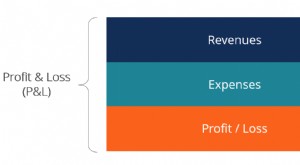
Profit & Loss Statement (P&L): Definition & Key Components
A profit and loss statement (P&L), or income statement or statement of operations, is a financial report that provides a summary of a company’s revenues, expenses, and profits/losses ov
Accounting
- Profit vs. Cash Flow: Understanding the Key Difference
- Accounting Profit Explained: Calculation & Importance
- Gross Profit Explained: Definition, Calculation & Importance
- Marginal Cost: Definition, Calculation & Examples
- Marginal Revenue: Definition, Calculation & Importance
- Understanding Normal Profit: A Key Concept in Economics
- Operating Margin: Definition, Calculation & Importance
- Understanding Profit: A Key Financial Metric
- Profit Margin Explained: Types & How to Calculate
-
 Profit Before Tax (PBT): Definition, Calculation & Importance
Profit before tax (PBT) is a measure of a company’s profitability that looks at the profits made before any tax is paid. It matches all the company’s expenses, which include operating and ...
-
 Marginal Cost of Production: Definition & Economic Significance
The Marginal Cost of Production is the cost to provide one additional unit of a product or service. It is a fundamental principle that is used to derive economically optimal decisionsFiscal PolicyFisc...