
Gross Profit Explained: Definition, Calculation & Importance
The Gross Profit (GP) of a business is the accounting result obtained after deducting the cost of goods sold and sales returns/allowances from total sales revenueSales RevenueSales revenue is the income received by a company from its sales of goods or the provision of services. In accounting, the terms "sales" and. GP is located on the income statement (sometimes referred to as the statement of profit and loss) produced by a company and used to determine a company’s gross margin. Below is an example:
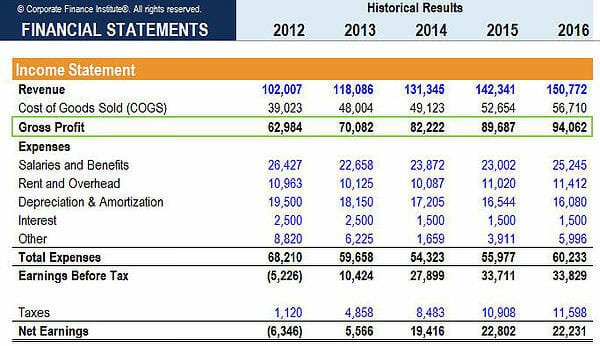
Formula for Calculating Gross Profit
The gross profit formula is:
Gross Profit = Sales Revenue – Cost of Goods Sold
To illustrate:
As of the first quarter of business operation for the current year, a bicycle manufacturing company has sold 200 units, for a total of $60,000 in sales revenue. However, it has incurred $25,000 in expenses, for spare parts and materials, along with direct labor costs. There were also returns and allowances for a total of $1,000. As a result, the gross profit declared in the financial statement for Q1 is $34,000 ($60,000 – $1,000 – $25,000).
What is Sales Revenue?
Sales revenue or net sales is the monetary amount obtained from selling goods and services to customers – excluding merchandise returned and any allowances/discounts offered to customers. This can be realized either as cash sales or credit salesAccounts ReceivableAccounts Receivable (AR) represents the credit sales of a business, which have not yet been collected from its customers. Companies allow.
What is Cost of Goods Sold?
Cost of goods sold, or “cost of sales,” is an expense incurred directly by creating a product. It includes any raw materials and labor costs incurred. However, in a merchandising business, cost incurred is usually the actual amount of the finished product (plus shipping cost, if any) purchased by a merchandiser from a manufacturer or supplier. In any event, cost of sales is properly determined through an inventory account or a list of raw materials or goods purchased.
Gross Margin
Gross profit serves as the financial metric used in determining the gross profitability of a business operation. It shows how well sales cover the direct costs related to the production of goods.
The formula for calculating gross margin is:
Gross Margin = Gross Profit / Total Revenue x 100
Gross margin is expressed as a percentage. For example, a company has revenue of $500 million and cost of goods sold of $400 million; therefore, their gross profit is $100 million. To get the gross margin, divide $100 million by $500 million, which results in 20%.
Download the Free Template
Enter your name and email in the form below and download the free template now!
Additional Resources
Thank you for reading this CFI guide to gross profit. CFI’s mission is to help you become a world-class financial analyst. With that in mind, these additional CFI resources will help you advance your career:
- Income Statement Template
- Earnings Before Interest Taxes Depreciation & AmortizationEBITDAEBITDA or Earnings Before Interest, Tax, Depreciation, Amortization is a company's profits before any of these net deductions are made. EBITDA focuses on the operating decisions of a business because it looks at the business’ profitability from core operations before the impact of capital structure. Formula, examples
- Net IncomeNet IncomeNet Income is a key line item, not only in the income statement, but in all three core financial statements. While it is arrived at through
- Cash Flow GuideValuationFree valuation guides to learn the most important concepts at your own pace. These articles will teach you business valuation best practices and how to value a company using comparable company analysis, discounted cash flow (DCF) modeling, and precedent transactions, as used in investment banking, equity research,
-
![Total Sales Revenue: Definition & Importance | [Your Company Name]](https://www.etffin.com/article/uploadfiles/202110/2021100811445605_S.jpg)
Total Sales Revenue: Definition & Importance | [Your Company Name]
Total sales revenue, also known as gross sales, is the combined value of goods and services a business delivers to its customers during a specific reporting period. What Is Tota
-

Gross Profit: Definition, Calculation & Examples - Financial Clarity
Gross profit, also known as gross income, appears on income statements that helps companies determine how much
Accounting
- Understanding Gross Profit Margin: Definition & Calculation
- Profit vs. Cash Flow: Understanding the Key Difference
- Gross Profit Explained: Definition, Calculation & Importance
- Gross vs. Net: Understanding the Difference - Definitions & Examples
- Marginal Profit: Definition, Calculation & Maximization
- Understanding Profit: A Key Financial Metric
- Profit Margin Explained: Types & How to Calculate
- Understanding Same-Store Sales: A Key Retail Performance Indicator
- Gross Profit Explained: Definition, Calculation & Significance
-
![EV/Gross Profit Ratio: Definition & Interpretation | [Your Company Name]](https://www.etffin.com/article/uploadfiles/202110/2021100815143263_S.jpeg) EV/Gross Profit Ratio: Definition & Interpretation | [Your Company Name]
EV/Gross Profit Ratio: Definition & Interpretation | [Your Company Name]The EV/Gross Profit Ratio is a profitability financial ratio that estimates the enterprise value of a company to its gross profit. It demonstrates how many dollars of enterprise value are generated fo...
-
 Understanding Underlying Profit: A Deeper Look
Underlying profit is an internal profit calculation that a company uses as it more accurately portrays the earnings of the business than a standard accounting metric such as net profit. A c...